Remote Partners AI

Missed-call decision guide

AI receptionist, answering service, or managed support?

The best choice depends on what is actually breaking. Some businesses only need a better first answer. Others need callback ownership, dispatch notes, tool updates, QA, and a human escalation path after the call.

Operations command center showing calls, ticket queues, QA review, and escalation cards.

Short answer

Do not choose based on the demo. Choose based on ownership.

An AI receptionist can answer simple calls. An answering service can add a human voice. A managed support team is better when the work after the call matters: notes, callbacks, dispatch context, ticket cleanup, QA, and escalation. If nobody owns the handoff, the first answer is not enough.

Video comparison

Watch AI receptionist vs real human answering team.

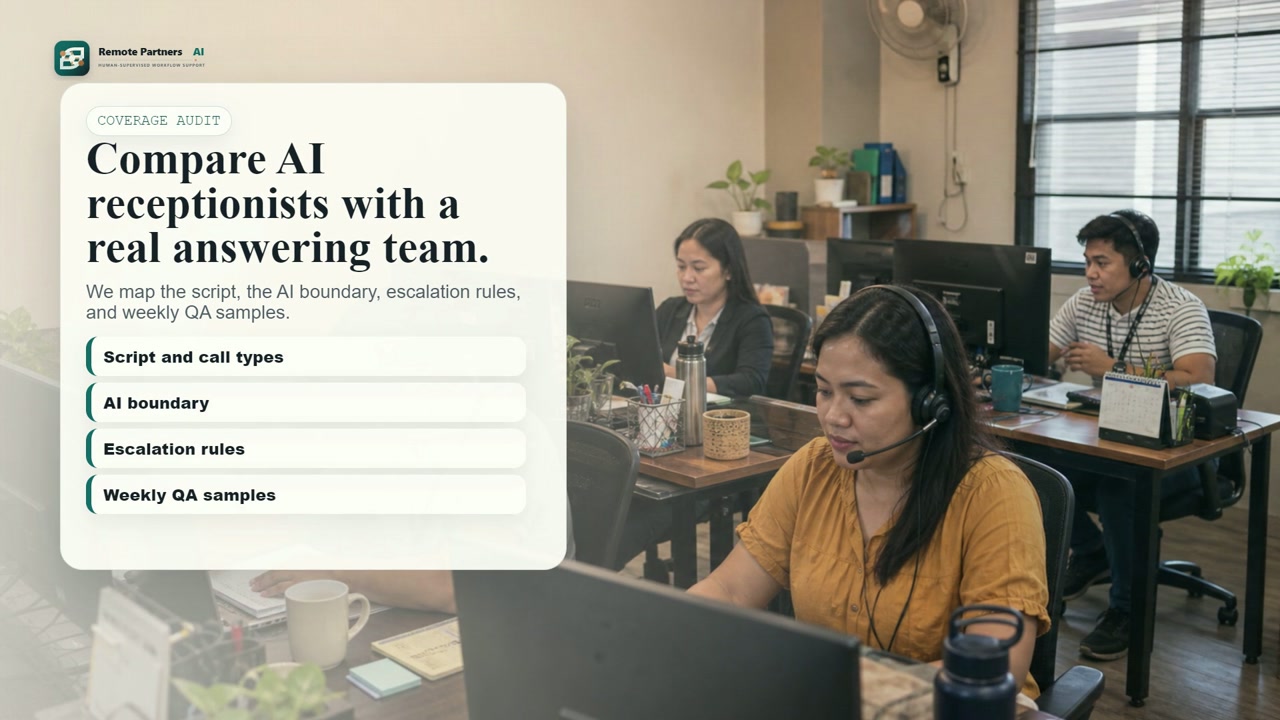
The 52-second explainer shows where AI call capture fits, where trained people protect the customer moment, and how Remote Partners AI maps the handoff before expanding coverage.

Watch the explainer
Remote Partners AI video thumbnail comparing an AI receptionist with a real human answering team.

Comparison

What each option is good at and where it can fail.

Missed-call and after-hours support options
Option Best for Weak spot Use when
AI receptionist Simple intake, FAQ answers, routing prompts, summaries, and low-risk calendar checks. Urgent judgment, upset callers, unclear requests, bad tool responses, and calls that need a human owner. The workflow is narrow and a human reviews exceptions quickly.
Traditional answering service Live human answer, message capture, after-hours coverage, and basic call forwarding. Messy notes, weak callback ownership, generic scripts, and limited visibility into quality. The main problem is phone coverage and the script is easy to follow.
Managed support team Missed calls, intake, dispatch notes, callbacks, tickets, follow-up, QA, and human escalation. Requires more workflow mapping before launch because agents need rules, access, and review. The business needs coverage plus accountability for what happens after the first answer.

Decision path

How to choose without overbuying.

Step 1

Separate answer from ownership

Decide whether the problem is answering the phone, owning the callback queue, or cleaning up the full support handoff.

Step 2

Write the escalation rules

List the calls that can be handled, the calls that must transfer, and the calls that need internal review.

Step 3

Check the notes and QA path

Ask how calls, transcripts, notes, tool updates, and missed follow-ups will be reviewed after launch.

Step 4

Start with one lane

Move one trainable lane first, such as after-hours intake, missed-call callbacks, or dispatch-ready notes.

FAQ

Common questions before choosing a support model.

Is an AI receptionist enough for missed calls?

An AI receptionist can help with simple intake and routing, but missed-call recovery usually also needs callback ownership, escalation rules, QA review, and a human path for unclear or urgent calls.

When is an answering service better than AI?

A live answering service can be better when callers need a human voice, but it still needs clear scripts, required fields, escalation rules, and quality review to avoid messy handoffs.

When does managed support make more sense?

Managed support makes sense when the business needs trained agents to handle repeatable calls, tickets, callbacks, or follow-up inside approved workflows instead of only taking messages.

Next step

Map the support leak before picking the tool.

Bring the missed calls, after-hours intake, dispatch notes, tickets, or callbacks that are slipping. Remote Partners AI will help identify the first workflow to train, QA, and escalate safely.