Remote Partners AI

How It Works

How AI-assisted outsourcing turns your process into a trained Cebu support team.

Remote Partners AI turns one support workflow into a managed outsourcing launch: map the work, document the tools and rules, train a Cebu, Philippines support team, use AI to draft missing instructions where useful, launch with QA, and expand only after handoffs and escalation are stable.

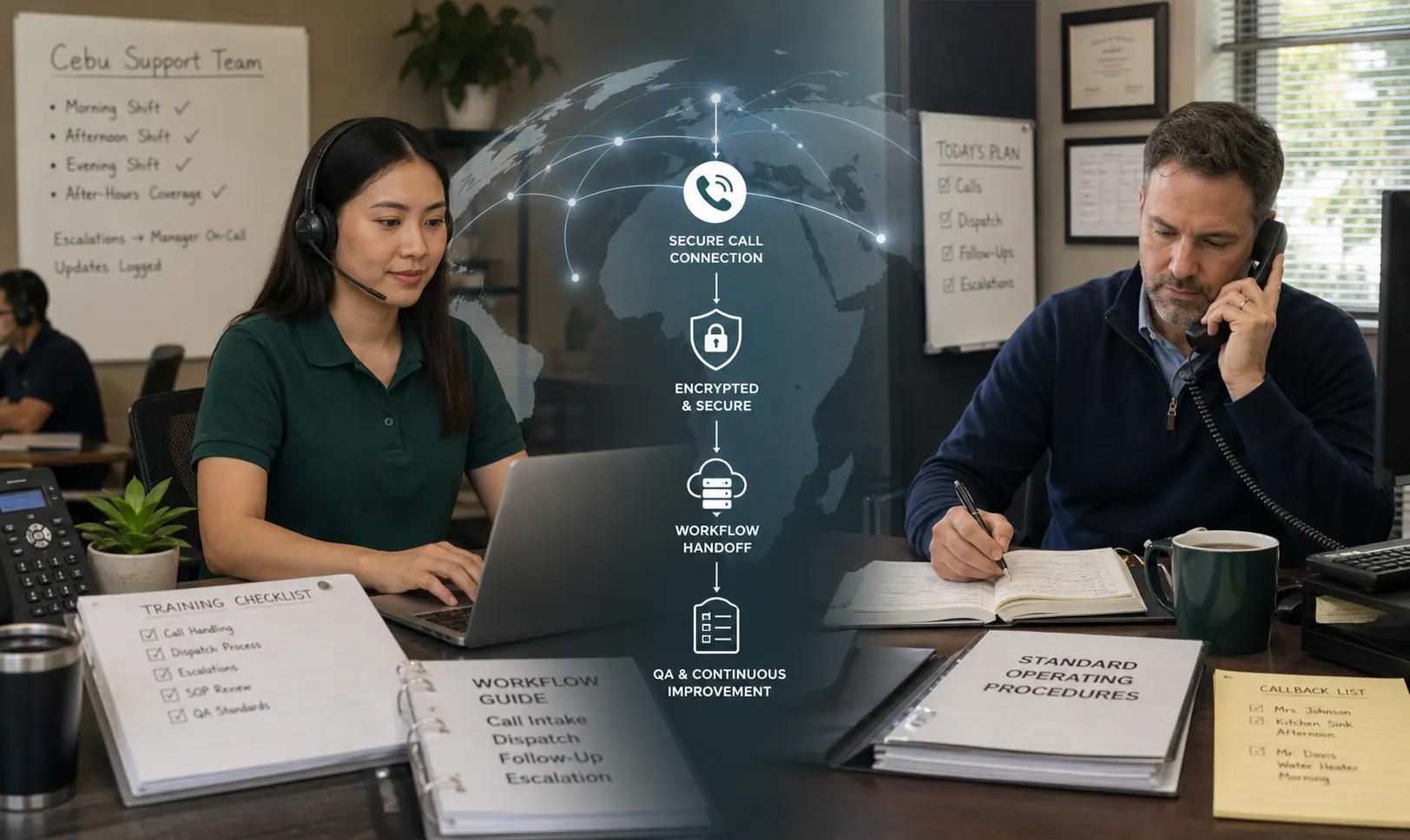
Cebu support agent and client operations manager connected by a secure global workflow bridge with tools, training, phone, and QA cues.
The goal is not to throw people at the problem. The goal is to teach the team how your business actually works before customers depend on them.

Operating model

Outsourcing works when the process is trained before the team carries volume.

The safest path is managed onboarding, not a blind handoff. Remote Partners AI maps one workflow, turns it into training, sets QA and escalation rules, and uses AI only where it helps draft, summarize, or review work without taking control from people. This is the operating idea behind AI-assisted customer support outsourcing and AI-managed remote operations.

  • Start with one measurable workflow, such as call answering, chat triage, ticket follow-up, dispatch notes, or CRM cleanup.
  • Turn the workflow into training: scripts, required fields, examples, tool walkthroughs, blocked actions, and escalation rules.
  • Launch with QA review so calls, notes, tickets, follow-up, and handoffs improve before volume expands.
Remote Partners AI

Explains and scopes the workflow model.

This site is the marketing and hybrid workflow front door. It helps buyers understand the support options, AI-assisted steps, handoff rules, QA expectations, and the first workflow that should move into coverage.

Delivery Team

Runs the approved support operation.

The delivery layer covers staffing, training support, team leadership, operations management, QA routines, and escalation discipline for workflows approved by the client.

The setup truth

Most outsourcing fails before the first call is answered.

The issue is usually not that people cannot do the work. It is that the work was never explained in a way a new person could learn: which tool to use, what to say, what to check, what to avoid, and when to ask your team.

SOP simply means the instructions your team follows. If those instructions are thin, outdated, or stuck in someone's head, we help make them usable.

What we help create

  • Plain-language instructions for common customer situations
  • Examples of good calls, notes, updates, and follow-up
  • Checklists for your tools and process
  • Practice scenarios before agents touch real volume
  • Review rules for mistakes, unclear cases, and customer-sensitive work

Managed BPO onboarding

What gets built before a Cebu support team handles customer work.

A useful offshore support launch is not only recruiting. It is a small operating system: workflow map, training material, approved tool behavior, QA checks, and clear escalation.

Workflow map

Identify where customer work enters, which tool owns the record, what information agents must collect, and where the work gets stuck today.

Training package

Convert your process into scripts, examples, checklists, roleplay scenarios, QA scorecards, and escalation rules that an offshore support team can learn.

AI-assisted drafting

Use AI to help draft SOPs, summaries, training checks, and missing-answer lists, then have your team approve anything that affects customers or tools.

Supervised launch

Start with narrow coverage, review real work samples, correct training gaps, and expand only after quality and escalation are visible.

How we prepare the team

Step 1

Measure the leak

We start with the support pressure costing revenue or manager time: missed calls, dispatch notes, ticket backlog, callbacks, or admin follow-up.

Step 2

Map the first lane

We turn one repeatable workflow into scripts, required fields, tool access, blocked actions, escalation rules, and QA expectations.

Step 3

Train the Cebu team

Azpired's Cebu operation trains agents on your examples while AI helps structure notes, routing, drafts, and reviewable support steps.

Step 4

Launch with QA

After launch, managers can inspect notes, QA samples, escalations, exceptions, and follow-up outcomes before expanding scope.

Your process may live in people's heads

A lot of companies have the work figured out, but it is scattered across employees, notes, old scripts, inbox habits, and tool shortcuts.

Training is usually the bottleneck

Hiring people is not the hard part. Getting them to understand your customers, tools, rules, exceptions, and tone is where outsourcing usually breaks.

We can help draft what is missing

If your instructions are incomplete, we can use AI, your examples, and our internal support knowledge to propose training material for your team to correct.

You stay in control

We propose. You approve what matters.

If your team is busy, we can draft a first version of the process using your examples, AI, and our support operations knowledge. Your team still approves the rules that affect customers, tools, and decisions.

Approval points

  • What agents can answer, book, update, or follow up on
  • What agents should not touch without approval
  • Where notes go in your tools
  • When a customer issue should be sent back to your team
  • How calls, chats, tickets, and follow-up get reviewed

FAQ

How do you outsource customer support to the Philippines without losing control?

Start with one documented support workflow, define the tools and allowed actions, train the Cebu support team on real examples, set escalation rules, and review early work through QA before expanding volume or authority.

How does Remote Partners AI train offshore customer service teams?

Training starts from the client's actual process: scripts, tool walkthroughs, required fields, good and bad examples, tone guidance, blocked actions, roleplay scenarios, and QA scorecards. Live work then feeds coaching and SOP updates.

Where does AI fit in an outsourced support workflow?

AI can help draft SOPs, summarize calls or tickets, suggest missing fields, prepare training checks, and support QA review. Trained people still own customer tone, approved actions, judgment, and escalation.

What does managed BPO onboarding include?

Managed BPO onboarding usually includes workflow mapping, secure tool access planning, scripts, required fields, escalation paths, training material, practice scenarios, QA rules, launch review, and a process for improving the workflow after real customer work begins.

What should stay with the internal team after outsourcing starts?

Pricing exceptions, refunds, account authority, legal or compliance questions, regulated decisions, security-sensitive changes, angry customers, and unclear promises should stay with internal owners unless a written approval path exists.

Start simple

Bring us one process your team is tired of explaining.

We will help identify what needs to be taught, what can be drafted, what your team should approve, and how support should be reviewed after launch.