Adobe Says 78% of Firms Expect AI Agents to Handle Customer Support
The viral number is automation ambition. The buyer lesson is readiness: AI support fails when data, escalation, and human coverage are not already governed.

Direct answer
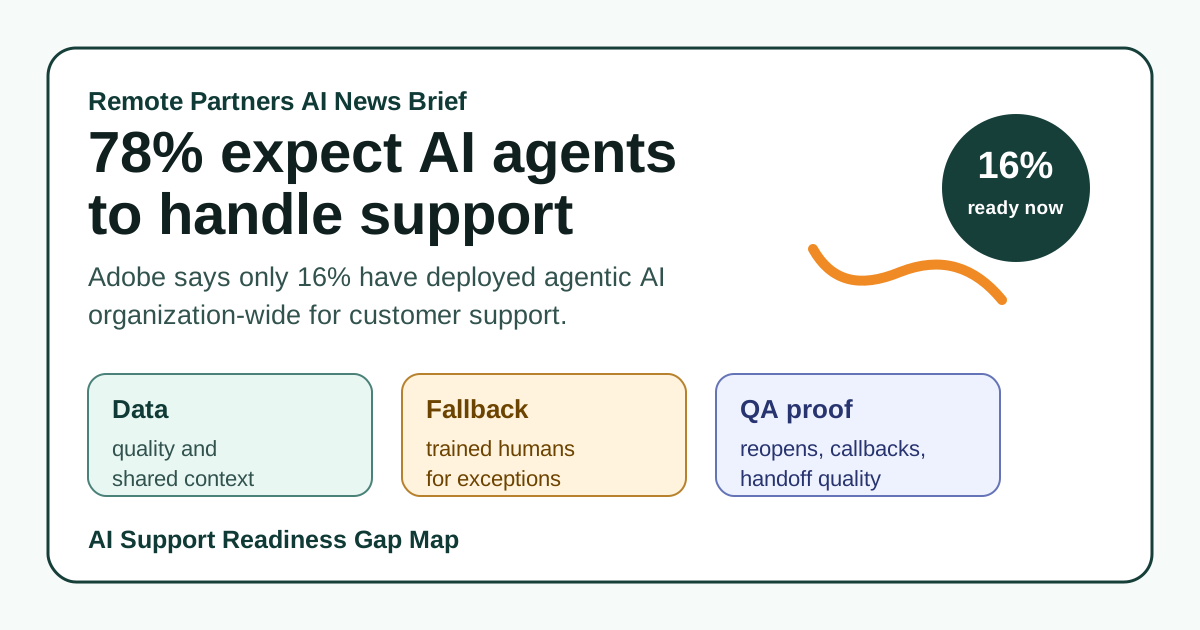
Adobe’s 2026 AI and Digital Trends research says 78% of organizations expect agentic AI to directly handle customer support interactions within the next 18 months. The same research says only 16% have embedded agentic AI organization-wide for customer support.
That gap is the news. The market wants autonomous service fast, but many teams still lack the data quality, trust, escalation rules, and human coverage model needed to make AI support work safely.
What happened
The Economic Times covered Adobe’s findings on June 25, 2026, focusing on the gap between customer-support automation ambition and operational readiness.
Adobe’s primary report says its research surveyed 3,000 customer experience executives and practitioners plus 4,000 consumers globally. It found that organizations expect agentic AI to handle large portions of customer-facing work soon, including customer support, post-purchase support, sales interactions, account management, and customer engagement.
The same report surfaces the bottleneck: customer data, governance, measurement, and customer trust are not keeping up. Adobe reports that only 39% of organizations have a shared customer data platform capable of supporting agentic AI, and 75% cite data integration and quality as the top challenge for implementing agentic AI.
Why this is trending
The story is easy to share because the number is stark: 78% expect AI agents to take on customer support, but only 16% have deployed them organization-wide for that work.
It also lands while support leaders are being asked to cut wait times, reduce staffing pressure, answer after-hours requests, and prove that AI can improve service without making customers feel trapped in automation.
For buyers, this is not an “AI or humans” decision. It is a coverage design problem.
The Remote Partners AI take
Do not buy AI support as a staffing replacement until the support map is clear.
AI can be useful for simple answers, intake, routing, summaries, reminders, and first-response coverage. It is weaker when the request needs judgment, empathy, billing discretion, field-specific policy, fraud handling, regulated data, or a customer who expected a person.
The practical move is to pair automation with trained remote humans who own the exceptions and keep the customer experience coherent.
AI Support Readiness Gap Map
Use this map before moving support work to an AI agent, remote assistant, or blended support team.
| Support layer | AI can own when | Human must own when | Proof to request |
|---|---|---|---|
| Basic questions | Answers are approved, stable, and low risk | The answer depends on policy exceptions or customer context | Knowledge source, last updated date, and QA sample |
| Intake and triage | The agent only collects details and routes the case | The customer is angry, urgent, vulnerable, or confused | Escalation trigger list and transcript handoff |
| Appointment or callback | Slots, scripts, and confirmation rules are fixed | A schedule change creates cost, safety, or customer trust risk | Calendar permissions and owner approval rule |
| Account and billing | The agent can explain status without changing records | Refunds, cancellations, disputes, or account access are involved | Human-only action list and access controls |
| CRM notes and summaries | The summary is reviewed before it drives action | The note changes owner, status, priority, or next step | QA process, correction log, and data-retention rule |
| After-hours coverage | AI can acknowledge, classify, and queue requests | Emergency, high-value lead, or complaint handling is needed | Backup coverage rule and time-to-human SLA |
| Customer trust | AI disclosure and transfer paths are clear | The customer asks for a person or rejects automation | Disclosure copy, transfer log, and no-charge/error policy |
What buyers should do next
Start with one support queue: missed calls, after-hours intake, appointment reminders, first-response chat, ticket triage, or CRM note cleanup.
Then define:
- Which requests AI may resolve.
- Which requests AI may only collect.
- Which requests must go to a trained person.
- Which data the AI can see.
- Which actions are human-only.
- How reopens, callbacks, complaints, and customer satisfaction will be measured.
Use the support coverage calculator to estimate the human capacity required after automation, not before it.
The real takeaway
Adobe’s data shows that support automation ambition is ahead of support operating readiness.
The winning model is not a chatbot dropped on top of a messy queue. It is a governed support layer: clean data, narrow AI scope, visible handoff, trained humans for exceptions, and QA that measures customer outcomes rather than automation volume.
Buyer FAQs
- What did Adobe report about AI agents and customer support? - Adobe's 2026 AI and Digital Trends research says 78% of organizations expect agentic AI to directly handle customer support interactions within the next 18 months, while only 16% have deployed agentic AI organization-wide for customer support.
- Why is the readiness gap important? - Automation ambition is moving faster than data quality, customer trust, escalation design, measurement, and human fallback. Those gaps can create poor experiences even when the AI tool sounds capable.
- Should small businesses replace support staff with AI? - Not by default. They should split work by risk: routine answers may move to AI, judgment-heavy requests need trained people, and every handoff needs clear ownership.
- What should buyers check before scaling AI support? - Buyers should check data quality, approved scripts, escalation rules, QA sampling, customer disclosure, human fallback, and whether the retained team can handle harder cases.
Sources
- Economic Times coverage - June 25, 2026 independent coverage of Adobe's customer-support AI-agent findings.
- Adobe 2026 AI and Digital Trends report - Primary report source for agentic AI support expectations, organization-wide deployment, data readiness, trust, and measurement gaps.
- Adobe customer engagement spotlight - Adobe report spotlight with customer-interaction categories and agentic AI customer engagement context.