Big Companies Are Hiring Again After the AI Wipeout Scare
The news hook is July 27, 2026 Wall Street Journal coverage, syndicated by Livemint and The Times, reporting that major employers including CSX, Alphabet, and Booz Allen Hamilton are selectively hiring again after a year of restraint and AI-replacement anxiety. The Guardian separately reported that small businesses are using AI to keep people productive rather than cut them, while Business Insider covered the Wharton/Boston University AI Layoff Trap paper warning that competitive automation can push companies toward collectively damaging workforce cuts. The buyer issue is practical: remote support buyers need proof for retained human coverage, AI-assisted work, escalation staffing, recovery cost, and surge capacity before they assume automation can replace people.

Direct Answer
The AI jobs story is no longer a clean replacement narrative. Recent reporting says some large employers are hiring again after a period of restraint, while small businesses are using AI to help lean teams keep work moving. The buyer lesson is not that AI is harmless. The buyer lesson is that AI savings have to be proven against the human coverage still required to answer customers.
Remote support buyers should treat the rebound as a coverage test. Before accepting an AI-heavy staffing plan, require proof of which support tasks disappeared, which judgment-heavy tasks remain, how escalations are staffed, how queues behave under load, and how much recovery work appears after automation fails.
The lead image for this article is a synthetic representative editorial scene created for Remote Partners AI. It does not depict the Wall Street Journal, Livemint, The Guardian, Business Insider, CSX, Alphabet, Booz Allen Hamilton, any named employer, or any real workplace event.
What Happened
The Wall Street Journal reported on July 27, 2026 that big companies are starting to hire again after months of holding back on headcount. Livemint’s syndication of the report says companies including CSX and Alphabet have told investors they plan to hire to meet growth goals or capture emerging technology opportunities.
The Guardian separately reported on July 26 that small businesses are using AI differently from many large-company layoff narratives: to automate admin work, improve customer support, and help existing staff stay productive rather than simply remove people.
Business Insider covered the AI Layoff Trap paper from Brett Hemenway Falk and Gerry Tsoukalas. The paper argues that even rational firms can be pushed by competition into over-automation, because each firm captures the cost saving while the broader demand damage is shared across the market.
That combination creates a practical operating signal. AI may change the support org, but it does not eliminate the need to prove coverage, escalation, recovery, and customer trust.
Why It Is Trending
The story is moving because it punctures the simple claim that AI automatically means fewer people. Employers are discovering that growth, supervision, customer judgment, and AI-native operations still require staffed teams.
It also lands after weeks of headlines about customer-service cuts, chatbot laws, and AI support failures. Buyers are seeing both sides of the ledger: automation can reduce repetitive handling, but weak coverage creates reopens, complaints, missed handoffs, and expensive repair work.
For remote support, the timing matters. If a buyer waits until after a staffing cut to discover that AI cannot handle exceptions, the provider is already rebuilding the human layer under customer pressure.
The Remote Partners AI Take
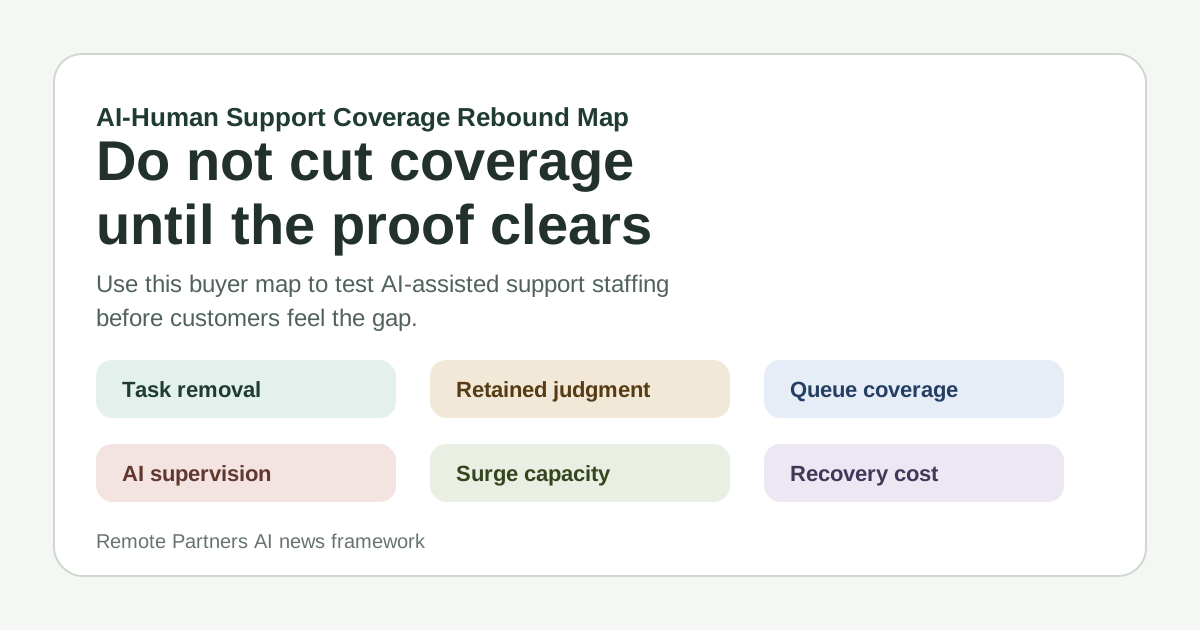
Use an AI-Human Support Coverage Rebound Map before approving AI-driven support staffing changes. The map turns a broad hiring story into buyer evidence.
| Proof layer | Buyer question | Evidence to request |
|---|---|---|
| Task removal | Which contacts or back-office steps does AI actually remove? | Baseline volume, AI-assisted volume, resolution rate, exception rate, and retained-review rule. |
| Retained judgment | Which contacts still need people? | Escalation taxonomy for complaints, billing, cancellation, safety, fraud, accessibility, VIPs, and ambiguous intent. |
| Queue coverage | Does staffing still match customer demand after automation? | Queue load, wait time, callback capacity, abandonment, language coverage, and after-hours coverage by channel. |
| AI supervision | Who checks summaries, drafts, routing, and failed automation? | QA samples, supervisor hours, correction logs, prompt-change approvals, and model-change notes. |
| Surge capacity | What happens when volume spikes or AI quality drops? | Backup staffing plan, reroute triggers, overflow partners, channel priority, and next-shift recovery rules. |
| Recovery cost | Do reopens and complaints erase the savings? | Reopen rate, refunds, credits, manual corrections, complaint signals, churn flags, and remediation owner. |
Buyer Bridge
Do not ask a provider whether it “uses AI.” Ask where AI changed the work, which people still own customer outcomes, and what evidence proves coverage did not shrink below demand.
The strongest support packet compares before-and-after work at the intent level. For each major support reason, request handled volume, AI assist rate, human transfer rate, first-contact resolution, reopen rate, wait time, escalation hours, and recovery cost.
That evidence separates practical AI support from an underfunded queue with better wording. It also helps buyers choose providers that use AI to make people more effective, not to hide missing coverage until customers complain.
Next Steps
- List every task AI is expected to draft, route, summarize, classify, resolve, or escalate.
- Mark contacts that still require judgment, empathy, compliance review, language skill, or customer recovery.
- Compare staffing and queue capacity before and after the proposed AI workflow change.
- Ask for recent evidence on wait time, abandonment, reopens, callbacks, complaints, and manual corrections.
- Set surge triggers for volume spikes, provider outages, model-quality drops, and high-risk customer intents.
- Review AI supervision hours so hidden QA work is counted in the staffing model.
- Use Remote Partners AI’s support coverage calculator and AI back-office workflow support when you need measurable human coverage behind AI-assisted support.
Buyer FAQs
- What changed in the AI jobs story? - Recent coverage says some large employers are selectively hiring again after a year of restraint and AI-replacement anxiety, while smaller businesses are using AI to help existing staff rather than simply cut roles.
- Why does this matter for outsourced support buyers? - Support buyers need evidence that automation removes specific tasks without erasing human coverage for judgment-heavy contacts, escalations, language needs, after-hours work, and customer recovery.
- What proof should buyers request first? - Ask for a task inventory, retained-human workload model, queue and escalation staffing plan, AI failure recovery process, surge coverage plan, and monthly proof that customer experience did not degrade.
Sources
- Wall Street Journal - Original July 27, 2026 report on large employers selectively hiring again and reassessing AI replacement assumptions.
- Livemint - Accessible syndication of the WSJ report naming CSX, Alphabet, and other large employers as examples of renewed hiring alongside AI.
- The Guardian - Independent July 26, 2026 coverage on small businesses using AI to support and retain staff rather than remove them.
- Business Insider - Coverage of the AI Layoff Trap paper and the economic risk of competitive AI-driven workforce cuts.
- The AI Layoff Trap - Research paper by Brett Hemenway Falk and Gerry Tsoukalas modeling the incentives that can push firms toward over-automation.