AI Support Layoffs Are Creating Bot-Unblocker Coverage Gaps
TechTarget reported on July 15, 2026 that AI job replacement will not hit contact centers evenly, with Forrester expecting fewer routine support seats but new specialist roles to monitor, update, and manage AI agents. CX Dive separately described emerging roles such as bot unblockers, judges, experts, and value-building representatives. The buyer issue is not whether AI can remove simple tickets. It is whether a remote or outsourced support team can prove who watches the AI, who handles the hard customer, and who owns recovery when the handoff fails.

Direct answer
AI is not just cutting routine contact-center work. It is changing the shape of the human work that remains.
TechTarget reported on July 15, 2026 that Forrester expects AI to eliminate some customer-service jobs while creating fewer new specialist roles to monitor, update, and manage AI agents. The same report says highly skilled and empathetic human agents remain necessary for complex cases AI cannot solve. CX Dive separately described emerging roles such as bot unblockers, judges, experts, and customer-value representatives.
For outsourcing buyers, the proof test is simple: if automation answers the easy questions, who owns the harder ones?
The lead image for this article is a synthetic representative editorial scene, not a photo of any named company or news event.
What happened
TechTarget framed the current contact-center workforce shift around two pressures happening at the same time. AI can absorb lower-complexity questions, especially in high-volume sectors such as retail, hospitality, and food service. But customers are also showing low tolerance for incorrect or off-target AI service, making handoff quality a business risk rather than a back-office staffing detail.
The July 15 coverage cited Forrester’s July 1 report on the quantitative employment impact of AI on customer-service jobs. It described uneven job replacement by industry, fewer entry-level paths, and the need for new roles that keep AI agents updated and on point.
CX Dive’s June coverage put names on some of those jobs. Frontline representatives may become bot unblockers who manage AI agents and intervene when a judgment call is required. Higher-tiered representatives may become judges and experts for technical, policy, or sensitive issues. Some service talent may also shift toward customer value and revenue work.
Gartner’s April survey adds the buyer context. It found 85% of service and support leaders are adding responsibilities to frontline roles, while 31% have implemented or plan AI-driven layoffs through the first quarter of 2027. Gartner’s June AI insights abstract also warns that an agentless contact center is the least likely and least desirable outcome.
Why this is trending
AI layoff headlines are easy to understand. The operating model underneath is harder.
If a contact center removes the easy work, it also removes the old training ground for new agents. The remaining queue becomes heavier: angry customers, broken bot loops, policy exceptions, refunds, urgent callbacks, high-value saves, and cases where AI confidently gave the wrong answer.
That is why the “bot unblocker” idea matters. It is not a cute job title. It is a coverage layer that decides whether AI support gets better over time or simply hides frustrated customers behind automation metrics.
The Remote Partners AI take
Outsourcing buyers should not buy fewer human hours just because an AI vendor reports containment.
The better question is whether the team has a designed human layer around the AI: people who unblock failed automation, specialists who handle difficult cases, supervisors who protect policy judgment, and reporting that shows recovery work beside cost savings.
If those roles are missing, the buyer may save on routine answers while losing customers in the moments that still need a person.
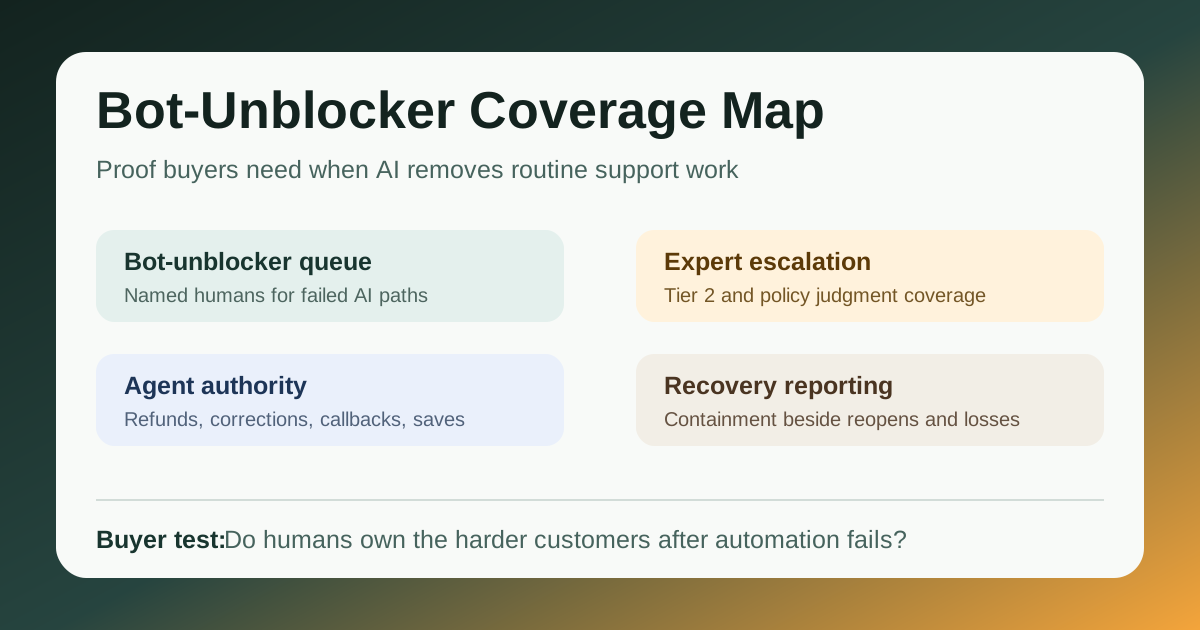
Bot-Unblocker Coverage Map
Use this map before approving AI-first support redesign, offshore or remote headcount changes, chatbot expansion, AI agent pilots, or outsourced coverage reductions.
| Proof layer | Buyer question | Weak signal | Evidence to require |
|---|---|---|---|
| AI-owned work | Which exact questions, tickets, summaries, routes, and updates does AI own before a human joins? | The vendor reports broad deflection without naming intents and excluded cases. | Intent inventory, volume baseline, excluded cases, test transcripts, and owner for each AI-owned step. |
| Bot-unblocker queue | Who watches AI failures and makes judgment calls when the bot gets stuck? | Handoffs exist, but no named person is accountable for correcting the AI path. | Queue design, staffing window, trigger rules, correction log, and sample cases where humans unblocked automation. |
| Expert escalation | Which cases require policy, technical, regulated, emotional, or high-value specialist handling? | Tier 2 work is treated as overflow instead of a protected role. | Expert roster, skill tags, escalation rules, callback SLA, authority limits, and training samples. |
| Agent authority | Can humans fix the issue after the AI hands it off? | Agents can apologize but cannot refund, reschedule, correct records, or save the customer. | Permission map, supervisor route, exception playbook, refund or correction rights, and recovery examples. |
| Apprenticeship path | How will new agents learn hard cases when AI removes entry-level tickets? | Leaders cut routine seats without a training plan for future specialists. | Shadowing plan, case library, QA rubric, mentor roster, and staged authority milestones. |
| AI-output QA | Who checks bad summaries, wrong classifications, hallucinated answers, and failed handoffs? | QA measures only human handle time and AI containment. | AI-output sample, correction tags, reopen analysis, handoff defects, and weekly model-feedback report. |
| Outcome reporting | Are savings shown beside manual recovery work? | Dashboards celebrate containment while hiding complaints, reopens, callbacks, and churn risk. | Weekly report with containment, handoffs, reopens, complaints, callbacks, saves, corrections, and final outcomes. |
What buyers should do next
- Pick the highest-volume workflow where AI is expected to remove routine support work.
- List the exact intents AI may answer and the cases it must never finish alone.
- Assign bot unblockers for failed automation, uncertain answers, emotional customers, sensitive topics, and policy exceptions.
- Protect expert escalation coverage for complex, regulated, high-value, or customer-retention cases.
- Confirm agents have authority to repair the issue, not only receive the transfer.
- Build an apprenticeship path so new support staff can still learn difficult work.
- Use the support coverage calculator before reducing human coverage, and review AI back-office workflow support if the AI handoff needs remote operators.
The real takeaway
AI can remove simple support work. It cannot remove accountability for the customer after automation fails.
Before buying a smaller support team, ask for the bot-unblocker coverage map.
Buyer FAQs
- What is a bot unblocker in customer support? - A bot unblocker is a human support role that supervises AI agents, steps in when automation needs judgment, and feeds corrections back into the AI workflow instead of answering every routine customer question directly.
- Why does this matter to outsourced support buyers? - If AI removes simple tickets, the remaining work is harder, more emotional, and more consequential. Buyers need proof that the support team has people assigned to AI handoffs, expert escalation, authority, QA, and recovery.
- Does this mean all support roles disappear? - No. TechTarget, CX Dive, and Gartner point to a shift rather than a clean elimination story: fewer routine roles, more technical and expert work, and a continuing need for human judgment in complex or high-stakes service.
- What proof should buyers ask for? - Ask for a bot-unblocker queue design, escalation triggers, expert roster, agent authority map, apprenticeship plan, AI-output QA sample, and weekly reporting that puts containment beside reopens, complaints, callbacks, and saved customers.
Sources
- TechTarget - July 15, 2026 reporting on uneven contact-center AI job replacement, Forrester's July 1 customer-service employment report, emerging AI specialist roles, apprenticeship gaps, and customer impatience with poor AI service.
- CX Dive - June 10, 2026 coverage of emerging customer-service roles including bot unblockers, judges, experts, and value-building representatives.
- Gartner - April 28, 2026 survey finding 85% of service and support leaders are expanding human-agent responsibilities, while 31% have implemented or plan AI-driven layoffs through 1Q27.
- Gartner - June 24, 2026 Gartner abstract saying an agentless contact center is the least likely and least desirable outcome of customer-service AI.