AI Support Backlash Makes Human Access an Acceptance Test
Alchemer's new consumer survey and October 2 coverage shift the buyer question from whether a bot answers to whether a customer can reach a person without starting over.

Direct Answer
Alchemer’s September 29 survey of 2,009 U.S. consumers found that 44% said AI made reaching a person harder, while 43% said they would pay more for guaranteed human support. Independent October 2 coverage brings that finding back into the current service debate. For a buyer combining AI with remote support, the useful response is a Human Access Acceptance Scorecard: test the customer route, the available person, the context transfer and the completed outcome.
What Changed
The survey also reports that 29.7% experienced having to repeat information. Its findings describe respondent experience, not measured failure rates for a named provider. A stated willingness to pay is not evidence of an actual premium or a recommendation to charge customers for escalation.
The news value is the gap between automation’s efficiency promise and what customers report at the transition to people. It gives buyers a concrete reason to inspect that transition before renewing or expanding a support arrangement. It does not establish that all automation is harmful.
Why This Matters Now
A containment metric can reward an interaction ending inside a bot even when the customer leaves without help. That creates a blind spot for procurement: a demo can show fluent answers while omitting after-hours coverage, queue capacity, access permissions and unresolved work.
This article differs from a legal human-handoff requirement or an AI-agent liability story. Its question is operational acceptance: can the contracted support route actually receive the exception and resolve it under the conditions the buyer expects?
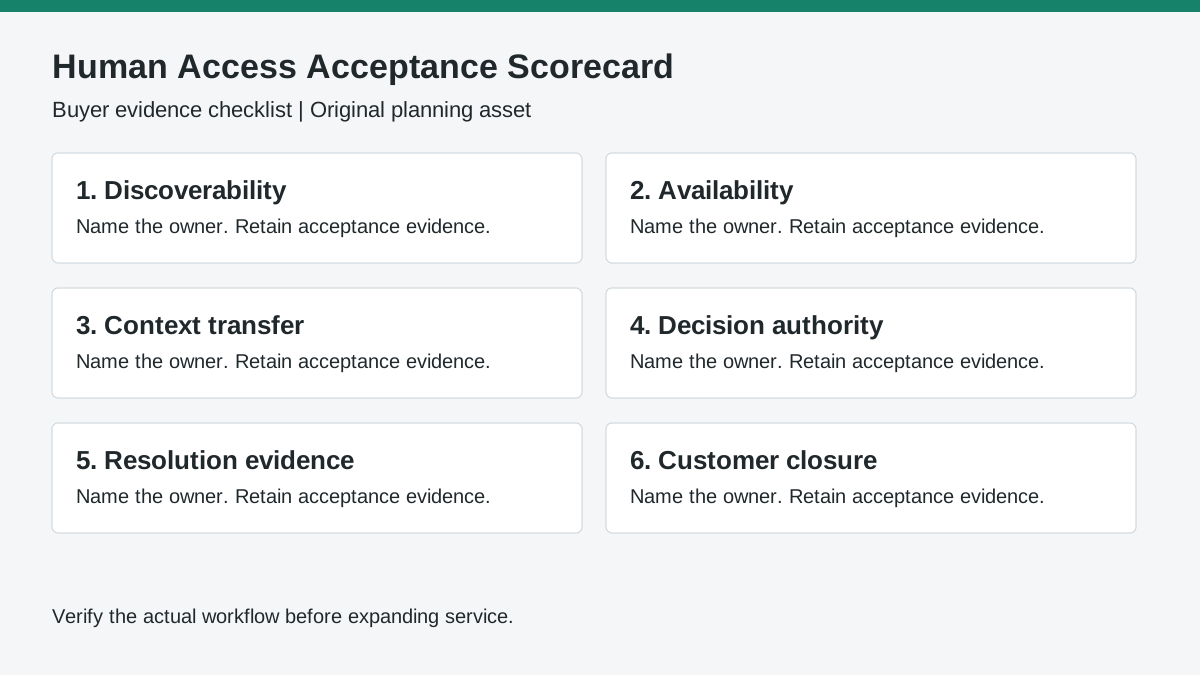
Human Access Acceptance Scorecard
| Test | Buyer question | Evidence to retain |
|---|---|---|
| Discoverability | Can the customer request a person without guessing a phrase? | Approved journey and observed transfer steps |
| Availability | Is someone reachable during the agreed hours and demand? | Coverage schedule, queue owner and exception plan |
| Context | Does the person receive the issue and prior attempted fixes? | Redacted transfer record and repeat-question review |
| Authority | Can the receiving person take the required decision? | Permission scope, escalation owner and decision log |
| Resolution | Does the fix hold after the interaction closes? | Repeat contact, reopen and unresolved-work sample |
| Closure | Does the customer know the outcome and next step? | Case-specific explanation and review route |
This is our original planning asset. The rows are proposed acceptance questions, not Alchemer’s certification program, universal thresholds or evidence of a supplier’s performance.
Worked Example
Consider an illustrative retailer with an automated order assistant and a remote team handling exceptions. The buyer selects a small approved test set: a delayed delivery, a repeated request, an unclear refund rule and an after-hours case. Testers record whether the request reaches the right queue, whether the next person repeats unnecessary questions and whether an authorized owner decides the exception.
An immediate bot acknowledgment may be useful, but it should not be counted as resolution while a human decision is pending. A transfer also is not complete simply because the system displays a queue message. The receiving team must be available, informed and authorized.
Buyer Bridge
Before buying more automation, define the exceptions a person will own and the conditions under which that work arrives. Ask the delivery provider to confirm coverage, data access, decision limits and escalation contacts in writing. Keep acceptance tied to the actual scope instead of a general promise that people remain available.
Remote Partners AI is a marketing partner of Azpired. Azpired confirms, contracts and delivers selected services. This article does not promise staffing capacity, response times, certifications or client outcomes.
Next Steps
- Select representative exception journeys and agree what a successful outcome means.
- Test the route to a person during the actual coverage conditions.
- Check context transfer and remove unnecessary repeated questions.
- Verify decision authority and ownership of unresolved cases.
- Inspect repeat contacts and reopens before extending the rollout.
Use the support coverage calculator to organize the capacity discussion, then confirm the proposed service scope with the delivery provider.
Buyer FAQs
- Does the survey prove AI caused every bad experience? - No. It reports respondents' experiences and preferences. It is not a randomized causal study or a forecast of every buyer's results.
- Does stated willingness to pay establish a premium buyers can charge? - No. A survey response about willingness is not observed purchasing behavior, a contract commitment or a justified price increase.
- Who confirms delivery through Remote Partners AI? - Remote Partners AI is a marketing partner of Azpired. Azpired confirms, contracts and delivers selected services; scope and availability require confirmation.
Sources
- Alchemer research report - Primary survey methodology and findings; self-reported experiences are not a causal experiment.
- Alchemer September 29 announcement - Primary release date and 2,009 U.S. consumer sample.
- CX Dive via Yahoo - Independent October 2 reporting on the consumer-service findings.