Allianz Partners' AI Cuts Made Support Coverage the Buyer Test
Reuters-carried July coverage says Allianz Partners will cut up to 1,800 travel-insurance jobs as AI takes on call-center and claims work. The buyer issue is not the layoff headline. It is whether AI-assisted support still has human coverage for stranded travelers, claims exceptions, emotional calls, language gaps, escalation authority, and recovery proof.

Direct answer
The Allianz Partners story is a buyer warning about support coverage proof. AI can handle high-volume, repeatable calls and claims steps, but the operating risk appears when staffing is reduced before the business can prove who handles stranded travelers, disputed claims, emotional callers, language gaps, bad AI summaries, and urgent recovery work.
The buyer question is not whether AI can automate part of the contact center. It is whether the human support layer remains visible, authorized, and measurable when automation reaches its limit.
What happened
Reuters-carried coverage on July 8, 2026 reported that Allianz’s travel-insurance division will cut up to 1,800 jobs because of growing AI use. The report said Allianz Partners CEO Tomas Kunzmann confirmed the plan after earlier reporting on the restructuring.
CNA and Euronext both carried the Reuters update. TNW separately framed the cuts as AI taking over call-center and claims work in the travel arm, where routine phone inquiries and claims status work are especially exposed to automation.
Earlier insurance-industry coverage reported the same 1,500 to 1,800 job-cut range and said Allianz Partners had around 22,600 staff, with about 14,000 handling customer inquiries and claims by phone.
Why this is trending
This is not a speculative vendor demo. It is a major insurer changing support staffing around AI in a high-volume, customer-critical operating unit.
Travel insurance is also a useful stress test. Customers call when flights are canceled, luggage is missing, medical help is urgent, documents are confusing, claims are disputed, or language support matters. Routine automation can help, but customers judge the support system by the cases that are not routine.
That makes the Allianz story relevant to ecommerce, healthcare, home services, financial services, SaaS, and any company considering AI-assisted support reductions. If the business removes coverage faster than it proves recovery, the savings can become customer risk.
The Remote Partners AI take
The weak version of AI support is a staffing reduction plan justified by automation volume.
The stronger version is a coverage model. AI can triage, summarize, translate, classify, draft, and answer repeatable questions. Remote support agents can own exceptions, claims notes, callbacks, language review, customer reassurance, data correction, and escalation packages. The model only works if the business names the human owner for every case that AI cannot safely close.
Before reducing agent coverage, buyers should require the same evidence they would require from any outsourced support team: scope, authority, QA, escalation, recovery, and reporting.
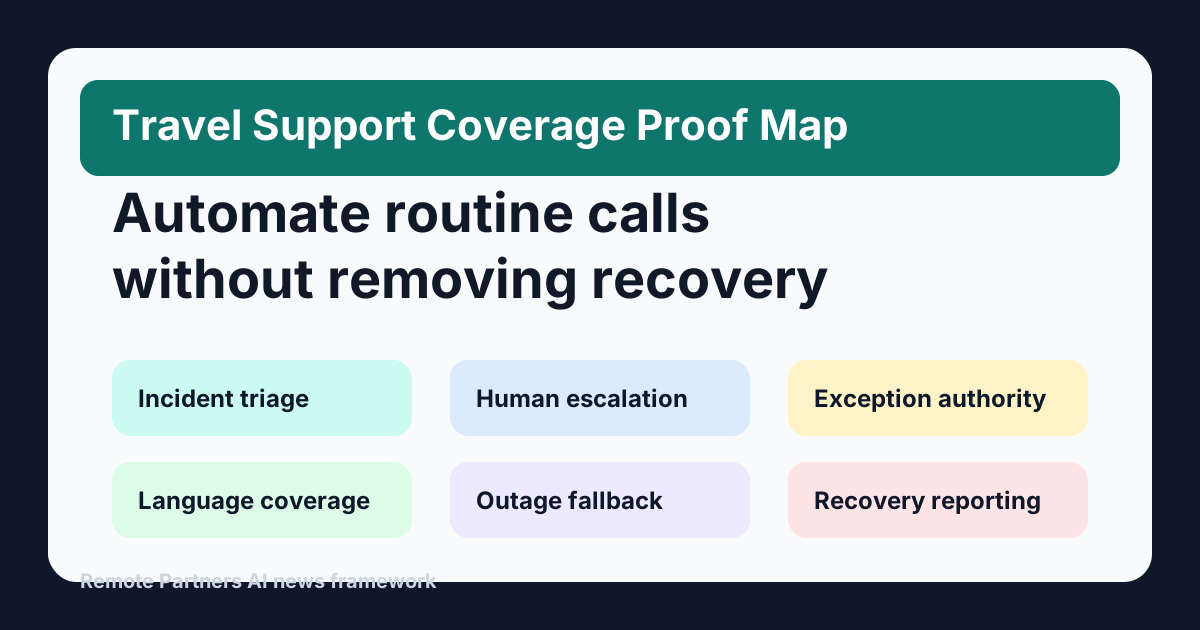
Travel Support Coverage Proof Map
Use this map before replacing live support coverage with AI in travel, claims, assistance, or high-volume service workflows.
| Coverage layer | Buyer question | Weak signal | Evidence to require |
|---|---|---|---|
| Incident triage | Can the workflow separate routine status from urgent disruption, medical, safety, or stranded-customer cases? | AI closes cases based on keywords while urgent context is buried in the call. | Triage rules, sensitive-case tags, sample calls, blocked automation actions, and QA review. |
| Human escalation | Can the customer reach a trained person before frustration becomes abandonment or complaint risk? | Escalation exists in a policy deck, but live callers repeat the story or wait without ownership. | Transfer test, callback SLA, context handoff, queue owner, and failed-handoff review. |
| Exception authority | Can the human fix the case instead of only apologizing for the AI path? | Agents can explain a policy but cannot correct records, approve next steps, or route urgent claims. | Authority matrix, approval thresholds, supervisor path, repair workflow, and decision log. |
| Language coverage | Can multilingual AI output and agent notes be checked when meaning changes the outcome? | Translation is trusted without review for claims, medical, billing, or travel-disruption details. | Language QA samples, human review triggers, glossary, transcript audit, and correction log. |
| Outage fallback | What happens when AI tools, claims systems, or portals fail during peak disruption? | Leaders promote automation while the manual fallback is informal or understaffed. | Manual playbook, reroute plan, status notice, staffing trigger, and post-incident report. |
| Recovery reporting | Are AI savings reported beside customer recovery work? | Automation rate goes up while reopens, complaints, bad summaries, and missed callbacks are hidden. | Weekly report with AI volume, escalations, reopens, complaints, corrections, callbacks, and recovery notes. |
What buyers should do next
- Pick one AI-assisted support workflow and list the cases where a wrong automated answer would create customer harm.
- Separate repeatable requests from incidents requiring judgment, authority, language review, or empathy.
- Define the human owner for stranded customers, complaints, claims exceptions, callback recovery, and failed-AI sessions.
- Test live transfer and callback completion before reducing agent capacity.
- Report AI containment and human recovery in the same operating review.
- Use the support coverage calculator before cutting coverage hours or headcount.
- If you need a managed recovery layer, review AI back-office workflow support and make escalation proof part of the scope.
The real takeaway
AI can reduce routine support work. It cannot remove accountability.
The Allianz Partners story shows what buyers should test before they let automation replace coverage: which customer moments still require a person, what authority that person has, and what evidence proves customers were recovered instead of deflected.
Buyer FAQs
- What happened at Allianz Partners? - Reuters-carried July 2026 coverage reported that Allianz's travel-insurance division will cut up to 1,800 jobs because of growing AI use. The reports identify call-center and claims work as the most exposed workstream.
- Does this prove AI should not be used in travel support? - No. AI can help with repeatable status, routing, claims intake, and language support. The risk is reducing human coverage before the business has proof for exceptions, emotional callers, disputes, urgent travel incidents, and recovery work.
- Why does this matter to support outsourcing buyers? - The Allianz story is a concrete example of support leaders using AI to change staffing. Buyers should require evidence that a trained human still owns the cases automation cannot safely close.
- What proof should buyers request? - Ask for incident triage rules, human escalation triggers, exception authority, language coverage, failed-AI queues, outage fallback, callback completion, and weekly recovery reporting.
Sources
- Euronext / Reuters - July 8, 2026 Reuters-carried report saying Allianz's travel insurance division will cut up to 1,800 jobs because of growing AI use, confirmed by Allianz Partners CEO Tomas Kunzmann.
- CNA / Reuters - Independent Reuters syndication with the July 8, 2026 update, timestamp, and Allianz Partners confirmation.
- TNW - Independent July 8, 2026 coverage connecting the Allianz Partners cuts to call-center and claims automation pressure.
- Insurance Business - Earlier insurance-industry coverage describing the same 1,500-1,800 job-cut range, Allianz Partners staffing scale, and call-center exposure.