
AT&T's U.S.-Care Pledge Makes Support Transition Proof a Buyer Test
AT&T says U.S.-based care teams will serve its home internet, home phone and postpaid wireless customers by the end of 2027. Buyers should treat the shift as a transition-proof question, not a claim that onshore support is automatically better.

Direct Answer
AT&T’s stated plan to serve home internet, home phone and postpaid wireless customers through U.S.-based care teams by the end of 2027 makes support-location changes a due-diligence issue. A buyer should ask for transition proof: the affected queues, retained knowledge, AI permissions, human escalation, quality checks, callback rules and recovery triggers.
Remote Partners AI is the marketing partner of Azpired. Azpired confirms, contracts and delivers the services a buyer selects. This is a public-information planning framework, not a claim about AT&T’s implementation or a service guarantee.
What Happened
CX Dive reported on November 4 that AT&T plans to serve its home internet, home phone and postpaid wireless customers through care staff located in the United States by the end of 2027. The report says the company is still determining its workforce mix and expects it to include union employees and U.S.-based contractors. Broadband Breakfast separately reported the public 2027 target.
The reporting also makes the boundary clear: the commitment is a future transition target, and public reporting does not provide a final count of affected roles or establish a completed move for every product and interaction. That distinction matters when a support buyer translates a headline into a staffing or sourcing decision.
Why It Is Trending
The announcement sits at the intersection of customer-service sourcing, regulatory attention and AI-enabled workflow redesign. CX Dive reported that AI is expected to take more routine work while the remaining human work becomes more complex. A change in support location therefore also changes the questions about knowledge access, escalation skill, queue design and cost assumptions.
For buyers, neither an onshore label nor an AI label proves service quality. The operating evidence does.
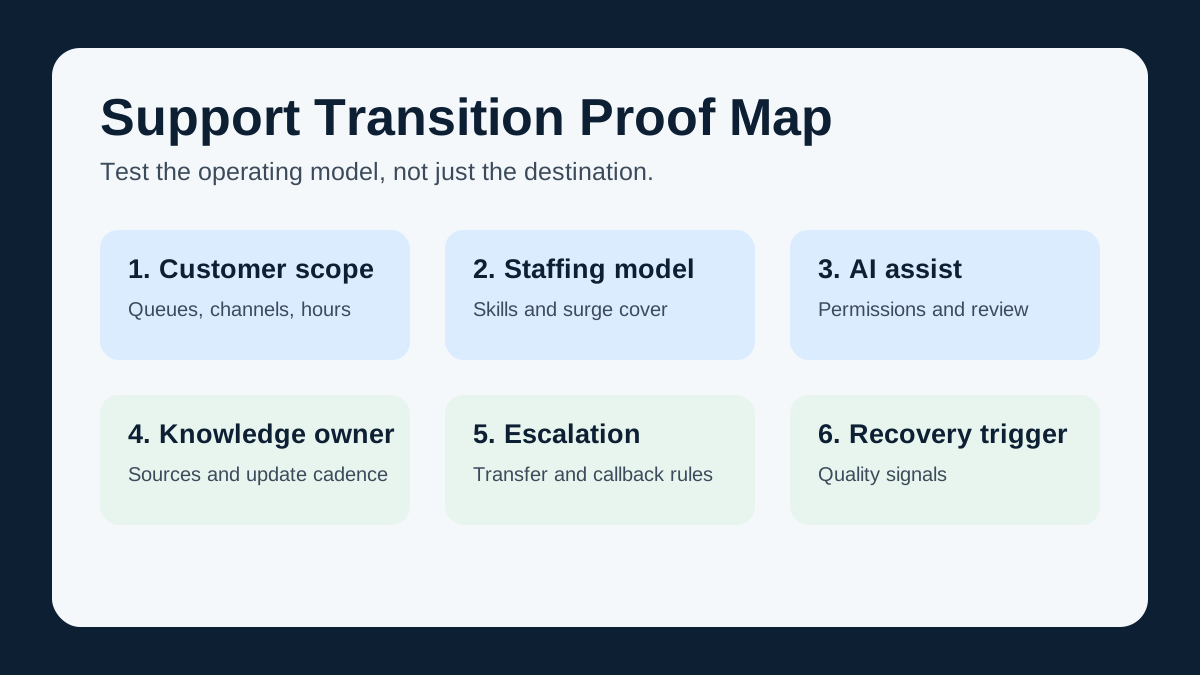
The Support Transition Proof Map
| Transition area | Evidence to request | Buyer risk if absent |
|---|---|---|
| Customer scope | Products, channels, hours and customer groups covered | A public commitment is incorrectly applied to an excluded queue |
| Staffing model | Roles, language coverage, contractor model and surge plan | Coverage drops when volume or complexity rises |
| AI assist | Allowed tasks, sources, review rules and failure path | Automation creates unsupported answers or hidden handoffs |
| Knowledge ownership | Named owners, update cadence and source controls | Agents and AI use stale or conflicting guidance |
| Escalation | Transfer rules, specialist coverage and callback ownership | Customers repeat themselves or cases stall |
| Quality and recovery | QA sample plan, service thresholds and correction triggers | A transition appears successful until complaints compound |
Worked Example
Suppose a provider says a billing queue will move from a mixed delivery model to U.S.-based specialists supported by AI summaries. A weak plan stops at the new location and the expected handle-time gain. A stronger plan shows which requests AI can summarize, which billing changes require human approval, where the agent sees the prior conversation, who owns a broken handoff, and which repeat-contact or callback threshold triggers a review.
That evidence lets a buyer evaluate continuity before the change reaches customers.
Buyer Bridge
Use the news as a procurement question: “Show us the transition proof for our queues, not just the destination.” Ask a provider to map location, staffing, AI permissions, data access, knowledge ownership, escalation, QA and recovery for the specific support work it will handle.
Next Steps
- List the support queues where a wrong answer, transfer or delay can affect money, access, retention or trust.
- Ask for the transition map for those queues, including what changes and what remains human-owned.
- Run test contacts through self-service, AI assist, frontline support and escalation before a staffing change goes live.
- Set a written recovery trigger for repeat contacts, abandoned calls, backlog age, complaints and failed callbacks.
Lead image: synthetic representative editorial scene; it does not depict AT&T, its employees or an actual customer-support event.
Buyer FAQs
- Has AT&T already moved all customer care to the United States? - No. Public reporting describes a goal to serve home internet, home phone and postpaid wireless customers through U.S.-based care teams by the end of 2027. It is a transition target, not proof that every interaction has already moved.
- Does onshore support automatically improve customer service? - No. Location alone does not prove resolution quality. Buyers should test staffing, knowledge access, transfer rules, escalation ownership, callback performance, quality assurance and surge coverage.
- Where does AI fit in a support-location transition? - AI can reduce navigation and after-call work or handle defined routine intake, but the plan still needs named humans for exceptions, customer harm, policy judgment, knowledge maintenance and recovery.
Sources
- CX Dive - November 4, 2026 reporting on AT&T's announced goal for U.S.-based care coverage by the end of 2027, the workforce mix, and the role of AI in the transition.
- Broadband Breakfast - October 30, 2026 independent reporting on the stated 2027 timeline and planned U.S.-based customer-service staffing.
- AT&T - October 2026 customer-care context on callback and transfer commitments; it does not establish the 2027 workforce commitment by itself.
