AWS's CEO Pushed Back on AI Job Panic for Entry-Level Workers
The headline is about Amazon hiring interns and new grads. The buyer lesson is broader: AI support plans still need a talent pipeline, supervised automation, escalation coverage, and recovery ownership.

Direct answer
AWS CEO Matt Garman’s entry-level hiring comments are trending because they run against the simplest AI-labor narrative. In a Platformer interview, he argued that AI changes work rather than making junior workers unnecessary, and he pointed to Amazon’s plan to hire 11,000 interns and new college graduates this year.
For support buyers, the lesson is practical: AI can reduce repetitive work, but it should not erase the training lanes that create future queue owners, QA reviewers, escalation leads, and customer-recovery specialists.
What happened
Platformer published an interview with Garman about AI, AWS, enterprise adoption, and the future of work. The most shareable section was his pushback against the idea that AI will wipe out entry-level white-collar jobs.
Garman said many jobs will change, and he described learnability as a key hiring trait in the AI era. He also said Amazon is hiring 11,000 interns and new college graduates this year.
Fortune, People Matters, TechRadar, Times of India, and other outlets picked up the same workforce signal because it lands in the middle of a live debate over AI agents, junior roles, and whether companies should keep hiring early-career workers when automation is improving quickly.
Why this is trending
The story is high-momentum because it combines a major AI infrastructure company, a clear hiring number, and a direct challenge to the fear that junior work is about to disappear.
It also has obvious tension. AWS sells AI tools that can automate pieces of recruiting, coding, security, and business workflows. Amazon has also been under scrutiny for automation-linked workforce changes. That makes Garman’s argument more useful for operators: the answer is not “ignore AI” or “cut trainees.” It is to redesign the work with proof.
Support teams face the same tension. AI can summarize tickets, draft replies, classify intent, route cases, search knowledge bases, and clean up routine records. But those tasks are also where new operators learn policy, customer context, tone, edge cases, and escalation judgment.
The Remote Partners AI take
The risky move is treating junior support work as disposable because a model can draft a first response or categorize a ticket.
In real support operations, the entry-level lane is also the learning ladder. It teaches agents how customers describe problems, which promises the company can keep, when a policy needs judgment, how a handoff should be written, and when a supervisor needs to intervene.
AI should compress low-value repetition. It should not remove every path by which new support staff learn the business.
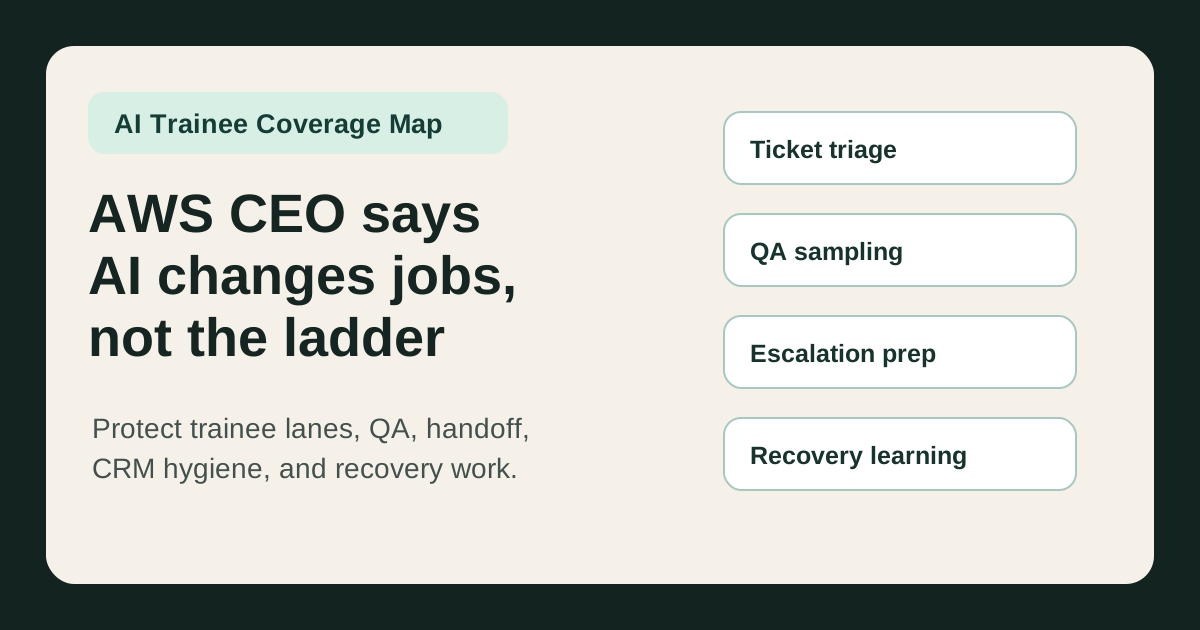
AI Trainee Coverage Map
Use this map before replacing junior support, back-office, or queue-cleanup work with AI agents.
| Coverage layer | What AI can take on | What trainees still learn | Proof to require |
|---|---|---|---|
| Ticket triage | Intent labels, sentiment flags, priority suggestions, duplicate detection | How customers describe real issues and when labels are wrong | Daily aging review, sample audits, and exception owner |
| Draft replies | First-draft answers, tone suggestions, policy snippets, summary notes | Brand voice, policy limits, empathy, and when a scripted answer is unsafe | QA rubric, approval thresholds, and failed-reply review |
| CRM hygiene | Field suggestions, task creation, contact matching, missing-data prompts | Account context, ownership rules, entitlement details, and cleanup discipline | Record-change audit, duplicate review, and supervisor sign-off |
| Follow-up work | Reminders, callback tasks, status summaries, next-step prompts | Closing loops, confirming outcomes, and recovering missed commitments | Callback completion, task SLA, and reopen monitoring |
| Escalation prep | Case summaries, risk flags, transcript highlights, recommended route | What deserves escalation, what evidence matters, and how to brief a senior owner | Warm handoff notes, escalation criteria, and manager QA |
| Customer recovery | Failure clustering, complaint summaries, repair-task creation | How to apologize, correct, refund, replace, or retain a frustrated customer | Recovery playbook, authority limits, and customer-outcome tracking |
What buyers should do next
- List the tasks currently handled by junior support staff, remote operators, VAs, QA assistants, and queue coordinators.
- Mark which tasks AI can perform without customer risk, which tasks AI can assist, and which tasks remain training-critical.
- Keep supervised human lanes for escalation prep, recovery work, CRM judgment, high-risk customers, billing exceptions, callbacks, and QA sampling.
- Track reopen rates, missed follow-ups, escalations, supervisor rework, QA misses, and customer complaints after automation changes.
- Use the support coverage calculator to size the human coverage that should remain behind AI workflows.
- Document a training path so today’s AI-assisted junior work still produces tomorrow’s senior support operators.
The real takeaway
The AWS story is not a reason to romanticize old support workflows. AI should remove needless manual work.
But buyers should be careful about removing the whole learning lane. If AI handles the simple work and nobody trains on the messy work, the support operation eventually runs out of people who understand customers well enough to supervise the automation.
Buyer FAQs
- What did AWS CEO Matt Garman say about AI and entry-level work? - In a Platformer interview, Garman argued that AI will change many jobs but should not be treated as a reason to stop hiring junior workers. He said Amazon plans to hire 11,000 interns and new college graduates this year.
- Why does this matter to support teams? - Support teams often use junior roles for queue cleanup, CRM updates, QA review, follow-up, and escalation learning. If AI removes those lanes without replacing the training path, the operation can lose future senior talent and recovery coverage.
- Should buyers replace junior support work with AI agents? - Only after the buyer proves which tasks AI can own, which tasks still need supervised trainees, and which escalation or customer-recovery work must remain human-owned.
- Where can remote operators help? - Remote operators can hold supervised coverage lanes: backlog cleanup, customer follow-up, failed AI handoffs, CRM hygiene, QA sampling, escalation prep, and after-hours continuity.
Sources
- Platformer - Primary interview where AWS CEO Matt Garman discussed AI, entry-level work, and Amazon's plan to hire 11,000 interns and new college graduates.
- Fortune - Independent coverage of Garman's argument that replacing junior workers with AI is bad long-term business and weakens the talent pipeline.
- People Matters - Independent HR coverage connecting the 11,000-intern-and-graduate hiring plan to the broader AI disruption debate.
- TechRadar - Technology coverage summarizing the same AWS hiring signal and the argument that AI changes the work rather than removing the need for early-career staff.
- Times of India - Current coverage resurfacing Garman's pushback against AI job-loss predictions and the 11,000-intern-and-graduate hiring plan.