Bloomberg Says AI Call-Center Cuts Have Begun
The news hook is Bloomberg's July 28, 2026 report that AI is replacing customer-service jobs at companies including Commonwealth Bank of Australia, Microsoft, Uber, and Hyatt. Business Insider separately reported Uber cut 10% of its community operations team while citing AI and requiring some remote support employees to relocate near offices. The buyer issue is practical: do not count automation savings until coverage, escalation, exception handling, QA, and customer recovery are proven.

Direct Answer
Bloomberg’s July 2026 call-center story is a buyer-risk signal, not just a labor headline. If AI is replacing support work at large companies, every support buyer should ask what coverage remains when the easy contacts are automated and the difficult contacts still need a trained person.
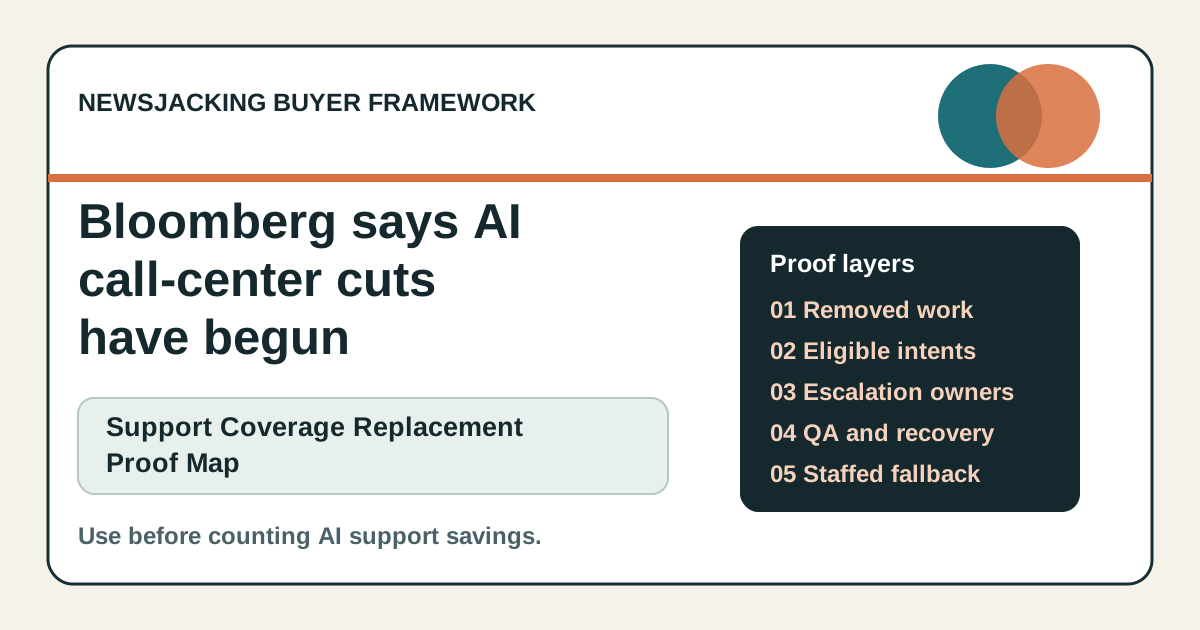
The practical answer is a Support Coverage Replacement Proof Map. Before approving an AI-led staffing cut, require evidence for the removed work, eligible intents, excluded intents, language and hours coverage, escalation ownership, QA sampling, fallback staffing, customer notices, and recovery cost.
The lead image for this article is a synthetic representative editorial scene created for Remote Partners AI. It does not depict Bloomberg, CBA, Microsoft, Uber, Hyatt, Business Insider, or any real customer-service incident.
What Happened
Bloomberg reported on July 28, 2026 that AI is replacing customer-service jobs at companies including Commonwealth Bank of Australia, Microsoft, Uber, and Hyatt. The report framed the pattern as AI moving from support experiments into chat and phone workflows that previously required large human support teams.
Uber adds a concrete operating example. Business Insider reported in July that Uber laid off about 10% of its community operations team while citing AI and also required some remote employees in that group to relocate near offices. CX Dive covered the same customer-experience story and noted the company’s stated goals around simplified operations, in-person collaboration, and AI adoption.
For buyers, the important fact is not one company’s headcount plan. The important fact is that AI support replacement is becoming a current operating decision. That puts proof on the buyer’s side of the table.
Why It Is Trending
The story is moving because it combines recognizable brands, support jobs, AI automation, and customer-facing risk. Customer service is one of the first functions where executives can see a direct line between AI answers, labor cost, ticket containment, and support coverage.
It is also trending because the savings case is easy to oversell. A chatbot can absorb a high volume of routine contacts, but the hidden cost often appears in repeat contacts, wrong handoffs, incomplete refunds, poor language coverage, missed VIPs, and customers who need a person after the automation path fails.
Remote support buyers feel that gap quickly. If a client removes seats before the replacement workflow is proven, the support partner may inherit the exceptions without enough staffing, authority, or recovery budget.
The Remote Partners AI Take
Use a Support Coverage Replacement Proof Map before reducing staffed coverage or approving an AI-first support plan.
| Proof layer | Buyer question | Evidence to request |
|---|---|---|
| Removed work | Which human tasks, queues, languages, and hours are being replaced? | Baseline volume, staffing roster, queue mix, handle time, language coverage, and affected SLA. |
| Eligible intents | Which contacts can AI fully resolve without a person? | Intent list, sample transcripts, confidence thresholds, blocked actions, and containment QA. |
| Exception handling | Which contacts must move to a person? | Refund, cancellation, safety, billing dispute, fraud, legal, accessibility, VIP, and unclear-intent rules. |
| Escalation ownership | Who takes over when AI fails or the customer asks for help? | Named owner, transfer path, callback SLA, after-hours coverage, supervisor authority, and urgent-stop rule. |
| QA and monitoring | How does the team catch bad automation before it repeats? | Transcript samples, reopen rate, repeat contact, complaint tags, wrong-summary rate, and correction log. |
| Recovery cost | What does the business do when coverage breaks? | Customer-save workflow, credit or refund rules, incident review, staffing fallback, and post-change evidence. |
Buyer Bridge
Do not ask only whether a provider can add AI to support. Ask which human coverage the AI is replacing and what proof shows the replacement is safe.
The first procurement question should be concrete: “Show us the work removed by queue, channel, language, hour, and risk tier.” The second should be harder: “Show us where a person remains accountable when the customer is angry, confused, vulnerable, high-value, regulated, or outside the script.”
That turns AI support from a savings claim into an operating contract. If the provider cannot show transcripts, escalation logs, QA samples, staffing fallback, and recovery evidence, the savings case is not ready.
Next Steps
- Export the last 60 to 90 days of support volume by channel, queue, language, hour, and contact reason.
- Mark each contact reason as AI-resolve, AI-draft, AI-route, human-only, or refuse.
- Define mandatory human takeover for disputes, refunds, cancellations, safety, fraud, accessibility, legal, VIP, and unclear-intent contacts.
- Compare containment against reopens, repeat contacts, complaints, bad summaries, transfer defects, and supervisor corrections.
- Keep a staffed fallback plan for the first 30 days after any automation-led coverage reduction.
- Use Remote Partners AI’s AI back-office workflow support, support coverage calculator, and contact intake to test whether the human operating layer is strong enough before the cut.
Buyer FAQs
- What did Bloomberg report about AI and call-center jobs? - Bloomberg reported on July 28, 2026 that AI is replacing customer-service work at companies including Commonwealth Bank of Australia, Microsoft, Uber, and Hyatt.
- Why should support buyers care about AI job cuts? - A staffing cut does not prove customer coverage is safe. Buyers need evidence that automation handles routine work without hiding exceptions, transfers, complaints, wrong answers, and recovery labor.
- What proof should a buyer request before approving support automation savings? - Request a support coverage replacement map covering eligible intents, excluded intents, language and hours coverage, human escalation, QA sampling, staffing fallback, and customer recovery.
Sources
- Bloomberg Law - July 28, 2026 Bloomberg News coverage of AI replacing customer-service and call-center work at major companies.
- Yahoo Finance - Accessible Bloomberg republication of the July 28 customer-service AI replacement story.
- Business Insider - Independent July 2026 coverage of Uber cutting 10% of its community operations team while citing AI.
- CX Dive - Customer-experience coverage of Uber's customer-service cuts, AI framing, and remote-staff office requirement.