British Gas Call-Centre Cuts Put AI Support Coverage on Trial
The news hook is The Guardian's July 23, 2026 report that British Gas owner Centrica plans to cut 800 more call-centre jobs as it deploys AI tools, taking reported call-centre cuts to 1,300 after 500 cuts confirmed in June. Centrica's chief executive Chris O'Shea said customers increasingly start in digital channels and said AI was not the direct driver of the reductions. ITV separately reported union objections to the earlier 500-job move. The buyer issue is practical: any remote support team using AI deflection needs proof that digital adoption, staffing coverage, escalation, outage recovery, vulnerable-customer handling, and complaint outcomes will not degrade as phone coverage shrinks.

Direct Answer
British Gas is a support-coverage warning. The Guardian reported that Centrica plans 800 more British Gas call-centre job cuts while deploying AI tools, after 500 cuts confirmed in June. Centrica’s chief executive said customers increasingly use digital channels first and said AI was not the direct cause of those reductions.
Buyers should not treat this as a simple “AI replaces agents” story. The diligence question is whether a support operation can prove that chatbot, app, and web deflection actually reduce recoverable phone demand without increasing complaint risk, repeat contacts, vulnerable-customer failures, or hidden manual recovery work.
The lead image for this article is a synthetic representative editorial scene created for Remote Partners AI. It does not depict British Gas, Centrica, The Guardian, ITV, any affected site, or any named person.
What Happened
The Guardian reported on July 23, 2026 that Centrica, the owner of British Gas, plans to cut 800 more call-centre roles as it deploys AI tools. The same report said 500 cuts had already been confirmed in June, bringing the reported total to 1,300 call-centre jobs.
The article said the planned reductions would affect customer-service teams in Glasgow, Edinburgh, Cardiff, Leicester, Stockport, and Leeds over two years. It also reported that O’Shea said more than 90% of customers use digital channels first and that calls had fallen by 20%.
Centrica’s official investor page confirms that its 2026 interim results were published on July 23, 2026. ITV News reported in June that unions objected to the earlier 500-job move and argued that workers were being replaced by AI.
The buyer-relevant fact pattern is not only the headcount number. It is the combination of AI deployment, digital-channel migration, phone-staffing reduction, union concern, and a high-stakes customer-service category where bad self-service can become a complaint, safety, billing, or hardship problem.
Why It Is Trending
The story is moving because it puts a familiar executive claim into a concrete service environment: customers use digital channels more, so phone staffing can shrink. That claim may be true in part, but it is easy to overstate if the buyer only looks at top-line call volume.
AI support tools often remove simple contacts first. The remaining phone contacts can become more complex, more emotional, more regulated, or more costly to recover. If a buyer cuts phone coverage at the same time, the average case left for humans may be harder than the historical average.
The live question is therefore not whether chatbots are useful. The live question is whether support leaders can prove which contacts disappeared, which contacts moved channels, which contacts repeated, and which customers still need a human path when the digital path fails.
The Remote Partners AI Take
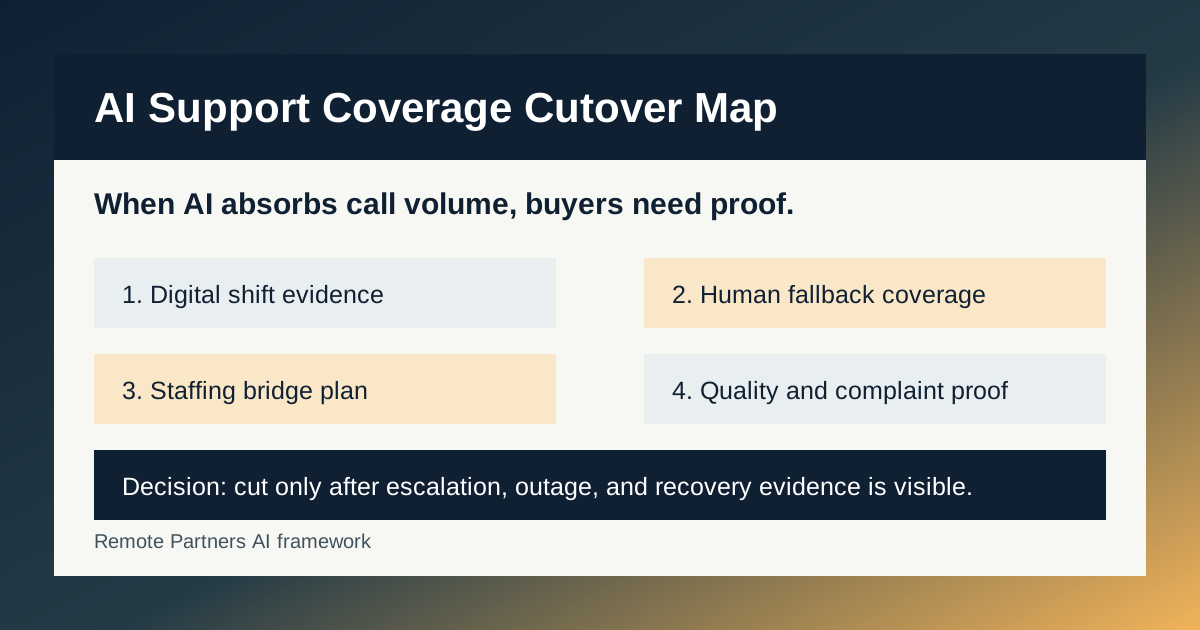
Remote support buyers should require an AI Support Coverage Cutover Map before approving chatbot-led staffing cuts. The map should connect digital adoption to real queue outcomes and customer recovery evidence.
| Proof layer | Buyer question | Evidence to request |
|---|---|---|
| Digital shift | Which contacts moved from phone to app, web, chatbot, email, SMS, callback, or proactive notification? | Channel-level volume, intent mix, containment, repeat-contact rate, and failed-deflection examples. |
| Phone coverage | Which phone queues, hours, skills, languages, and escalation tiers lose coverage? | Before-and-after staffing plan, skill matrix, schedule coverage, abandon targets, callback capacity, and surge plan. |
| Failed deflection | What happens when the chatbot cannot solve the problem? | Transfer rule, context handoff, escalation SLA, transcript retention, and customer notice language. |
| Sensitive cases | Which cases should bypass automation or receive faster human review? | Vulnerability, hardship, safety, outage, complaint, regulator, cancellation, and payment-risk exception rules. |
| Quality proof | Did service quality hold after the cut? | Complaint rate, repeat contact, reopen rate, CSAT, abandon rate, wait time, manual recovery hours, and manager review. |
| Recovery cost | Where did work reappear after phone staffing changed? | Back-office corrections, credits, social escalations, regulatory complaints, callbacks, and retained-agent overtime. |
Buyer Bridge
If you are buying remote support, do not accept a high digital-adoption percentage as proof that headcount can fall. Ask for the cases that did not resolve digitally.
The strongest packet shows the last 30 to 60 days of failed deflection by intent. For each high-risk contact, the provider should show the original channel, bot outcome, transfer time, human staffing path, customer wait, resolution, repeat contact, complaint signal, and recovery work.
That evidence is what separates productive AI support from a cost shift. It lets the buyer see whether phone volume truly disappeared or whether unresolved work simply moved into callbacks, complaints, supervisor queues, social media, and back-office repair.
Next Steps
- Pull a channel-by-intent report for the last 60 days.
- Separate resolved digital contacts from failed, repeated, transferred, abandoned, and complaint-generating contacts.
- Build exception rules for vulnerable customers, billing hardship, service outage, payment risk, complaints, cancellation, and safety cases.
- Compare proposed staffing cuts against queue skill, language, hours, callback capacity, and surge coverage.
- Run a two-week cutover pilot before permanent staffing changes.
- Monitor repeat contacts, wait time, abandonment, complaint rate, recovery credits, and manager escalations after launch.
- Use Remote Partners AI’s support coverage calculator and AI back-office workflow support when you need measurable support coverage without hiding recovery work.
Buyer FAQs
- What did The Guardian report about British Gas and AI chatbots? - The Guardian reported on July 23, 2026 that Centrica plans 800 additional British Gas call-centre job cuts while deploying AI tools, after 500 cuts were confirmed in June, and that CEO Chris O'Shea said customers increasingly prefer digital channels.
- Did Centrica say AI directly caused the job cuts? - The Guardian reported that O'Shea said AI was not driving those particular reductions and framed the change as a response to customer behavior moving toward digital channels.
- What should support buyers audit first? - Start with contacts that failed self-service or AI deflection, then compare staffing, escalation, wait time, complaint, vulnerable-customer, and recovery evidence before reducing phone coverage.
Sources
- The Guardian - July 23, 2026 report on Centrica's British Gas call-centre cuts, AI-tool deployment, digital-channel comments, customer-call reduction claim, and affected UK teams.
- Centrica - Official investor page confirming Centrica's 2026 Interim Results were published on July 23, 2026.
- ITV News - June 2026 reporting on union objections after British Gas confirmed 500 job cuts in customer-facing teams.