California AB 1609 Put Human Support Coverage on the Clock
The news hook is renewed coverage of California AB 1609, a customer-service chatbot bill now in the Senate Appropriations Committee. SFGate reported that the proposal would require large companies to provide a human customer-service option within 15 minutes and make accessible service numbers available. CalMatters and LegiScan show the bill was re-referred to Senate Appropriations on July 1, 2026. The Senate Judiciary analysis says the bill applies to large private businesses with more than $500 million in gross annual revenue, requires chatbot disclosure and human support access, and carries civil penalties. The buyer issue is practical: remote support teams need proof for live-agent capacity, chatbot transfer rules, wait-time evidence, exceptions, logging, and recovery before automation becomes a compliance gap.

Direct Answer
California AB 1609 is a human-support coverage test for AI customer service. The bill does not ban customer-service chatbots. It would make covered large businesses disclose chatbot use, avoid presenting a chatbot as a human, and give customers a way to reach a human support agent within the bill’s timing rules.
Remote support buyers should treat the story as a compliance and operating-readiness prompt. If a provider uses AI chat, app self-service, IVR, or automated ticketing, the buyer needs proof that a customer can still reach a human, that wait-time evidence is retained, and that high-risk cases do not get trapped inside automation.
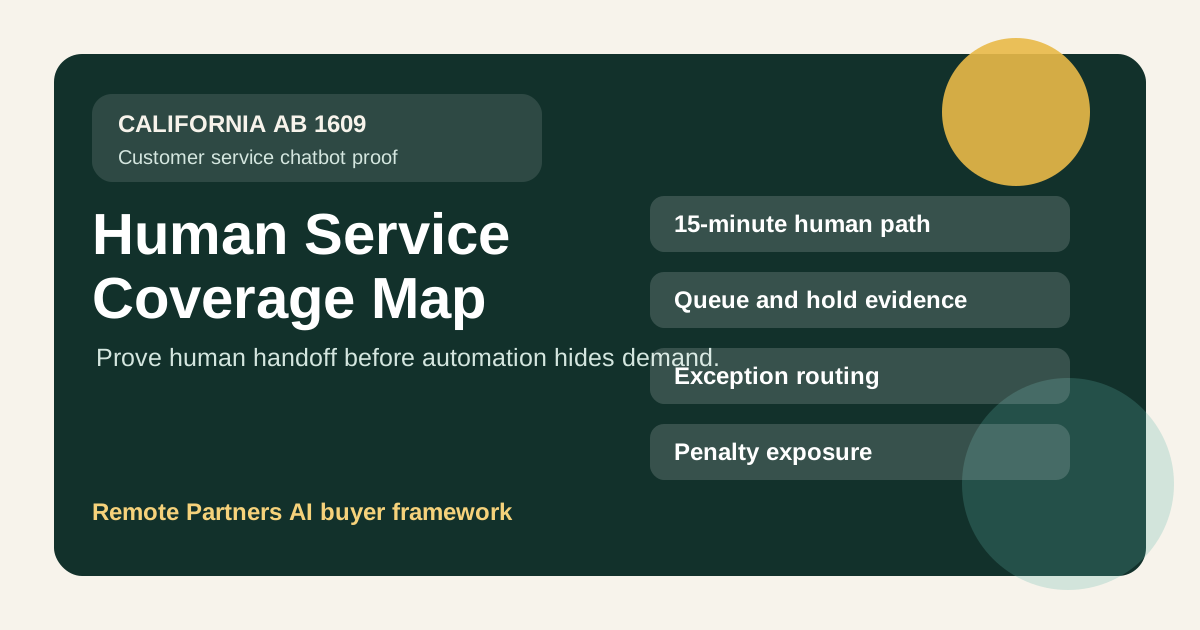
The lead image for this article is a synthetic representative editorial scene created for Remote Partners AI. It does not depict the California Legislature, SFGate, CalMatters, LegiScan, any covered company, any affected customer, or any named person.
What Happened
SFGate reported renewed attention on California AB 1609, a customer-service chatbot bill that would require covered large businesses to provide a human customer-service option within 15 minutes and make service numbers accessible.
CalMatters Digital Democracy shows AB 1609 remains in progress. Its tracker lists the latest version date as June 25, 2026 and says that on July 1, 2026 the bill was re-referred to the Senate Appropriations Committee after committee action.
LegiScan’s bill page also lists the measure as pending in Senate Appropriations and shows the July 1 action history. The amended text and bill summaries describe chatbot disclosure, a human customer-service feature, good-faith connection requirements, hold-time limits, enforcement by public prosecutors, and civil penalties.
The Senate Judiciary Committee analysis says the measure targets large private businesses with more than $500 million in gross annual revenue, requires timely access to human customer service, and allows civil penalties of up to $5,000 for a first violation and $10,000 for subsequent violations.
Why It Is Trending
The story is moving because it turns general frustration with chatbots into a measurable operating rule: how fast can a customer reach a human when the automated path fails?
It also lands in a moment when companies are using AI to deflect service demand, shrink phone queues, and move customers into lower-cost digital channels. Those moves can be legitimate, but only if unresolved work does not reappear as complaints, repeated contacts, abandonment, public escalation, or regulatory exposure.
For buyers of remote support, the useful lesson is not that California’s exact rule will apply everywhere. The useful lesson is that AI support now needs auditable human fallback. A provider should be able to show transfer paths, queue capacity, wait-time logs, exception rules, and recovery evidence without rebuilding the process under deadline pressure.
The Remote Partners AI Take
Use a Human Service Coverage Compliance Map before approving chatbot-heavy support automation. The map connects regulatory language to the actual support workflow a customer experiences.
| Proof layer | Buyer question | Evidence to request |
|---|---|---|
| Human path | Where can a customer request a human from chat, app, IVR, phone, email, SMS, or ticket flow? | Channel map, button labels, phone number placement, callback route, and escalation rule. |
| Capacity | Can live agents handle the requests created when customers leave automation? | Staffing model, queue load, language coverage, coverage hours, backup staffing, and surge plan. |
| Time evidence | Can the provider prove request time, transfer time, hold time, appointment offer, and abandonment? | Event logs, contact IDs, transcript timestamps, CDRs, callback records, and QA samples. |
| Exceptions | Which contacts bypass automation or receive faster human review? | Vulnerable-customer, hardship, safety, accessibility, outage, complaint, cancellation, and payment-risk rules. |
| Customer notice | Does the customer know when they are interacting with automation and how to reach a person? | Disclosure wording, UI screenshots, IVR prompts, agent scripts, and approved customer-facing copy. |
| Penalty exposure | Who owns remediation if logs show missed handoff, excessive waits, or repeated failures? | Escalation owner, root-cause process, refund or recovery policy, and legal/compliance review cadence. |
Buyer Bridge
Do not accept “we have live chat” as proof of human support. In chatbot-era support, the buyer needs to know how the system behaves when the customer asks for a person, when the bot fails, when the customer repeats the request, and when the queue is overloaded.
The strongest packet shows the last 30 to 60 days of AI-to-human transfers by intent. For each contact, request the original channel, transfer trigger, request timestamp, human queue, wait time, abandonment status, callback record, resolution, and complaint signal.
That evidence helps separate useful automation from hidden support denial. It also gives procurement, legal, and operations teams a simple way to test whether service promises still hold if AB 1609 or a similar rule becomes law in a buyer’s market.
Next Steps
- List every place a customer can interact with a chatbot, IVR, app workflow, AI assistant, or automated ticket response.
- Add the exact customer action that requests human support from each channel.
- Pull transfer and wait-time evidence for the last 30 to 60 days.
- Compare live-agent staffing against transfer volume, language demand, callback capacity, and peak load.
- Write exception rules for hardship, safety, outage, accessibility, complaint, cancellation, payment risk, and vulnerable-customer cases.
- Assign an owner for missed transfer, excessive wait, abandonment, and complaint recovery.
- Use Remote Partners AI’s support coverage calculator and AI back-office workflow support when you need measurable human coverage behind AI support automation.
Buyer FAQs
- What is California AB 1609 about? - AB 1609 is a California customer-service chatbot bill that would require large private businesses to disclose customer-service chatbot use and provide customers a path to human customer service within specified timing rules.
- Which businesses does the bill target? - The Senate Judiciary analysis describes the bill as applying to large private businesses with more than $500 million in gross annual revenue that provide goods or services to consumers, with specified exemptions.
- What should support buyers audit first? - Start with live-agent capacity and transfer logs. Buyers should prove that chatbot users can reach a human, that wait-time evidence is retained, and that high-risk cases bypass automation when needed.
Sources
- SFGate - Current coverage of California AB 1609, including the 15-minute human-service requirement, covered-company threshold, exceptions, penalties, and Senate Appropriations status.
- CalMatters Digital Democracy - Bill tracker showing AB 1609 status, June 25 version, July 1 re-referral to Senate Appropriations, and summary of chatbot disclosure, human-service access, and penalties.
- LegiScan - Independent legislative tracker showing AB 1609 status, pending Senate Appropriations, action history, and latest amended bill text.
- California Senate Judiciary Committee - June 30, 2026 committee analysis describing covered businesses, chatbot disclosures, human-service access within 15 minutes or by appointment, and civil penalties.