Call-Center Stocks Fell as AI Made Support Proof the Test
The market story is about call-center stocks being treated as AI-exposed. The buyer issue is more useful: outsourced and AI-assisted support models now need proof of workflow demand, human coverage, QA, escalation, and customer recovery before they replace people or partners.

Direct answer
Call-center stocks fell because investors saw fresh evidence that AI and client spending pressure could weaken traditional customer-service outsourcing demand. MarketWatch reported Teleperformance share pressure after Concentrix lowered full-year revenue expectations, and Bloomberg-sourced coverage framed the broader concern as AI making the sector harder to own.
For support buyers, the answer is not to rush from people to bots. The answer is to require proof before changing coverage: which customer work still exists, which tasks AI can safely assist, which exceptions humans own, and what evidence shows customers recover faster rather than disappear from the queue.
What happened
Concentrix reported second-quarter 2026 results on June 29, 2026 and lowered its full-year revenue outlook. The company also said its blended AI and services approach was helping clients lower costs and increase revenue.
The market reaction became larger than one company. MarketWatch reported on June 30 that Teleperformance shares fell after Concentrix cut guidance and clients reevaluated service needs. BusinessMirror carried Bloomberg coverage the same day describing a call-center stock selloff tied to fear that AI could make the sector less investable. TNW also covered the selloff as an AI pressure story for call-center outsourcing.
That is why the story is still useful for support buyers. The financial market is testing whether traditional outsourced support demand is durable. Operators need to test something more concrete: whether the customer workflow still has human work that cannot be safely removed.
Why this is trending
The selloff lands in the middle of a larger support-automation argument. AI tools can summarize calls, draft replies, classify intent, route tickets, search knowledge bases, and produce coaching notes. Those capabilities make some support work cheaper or faster.
But they do not automatically remove the need for people. A customer still needs someone accountable for billing exceptions, policy judgment, refunds, appointment edge cases, complaint recovery, callbacks, CRM cleanup, and high-value escalations.
The story is trending because it challenges both sides of the market. Outsourcing firms cannot rely on seat counts alone. AI vendors cannot rely on demos alone. Buyers need operational proof.
The Remote Partners AI take
The weak response to this news is to ask whether AI will replace call centers.
The stronger response is to ask which support model has evidence. A remote team, an AI workflow, or a blended partner should be able to show where demand is changing, where automation is safe, where human coverage remains necessary, and how customers are recovered when the workflow breaks.
That is the proof gap buyers should close before reducing staff, switching vendors, or letting automation own more of the queue.
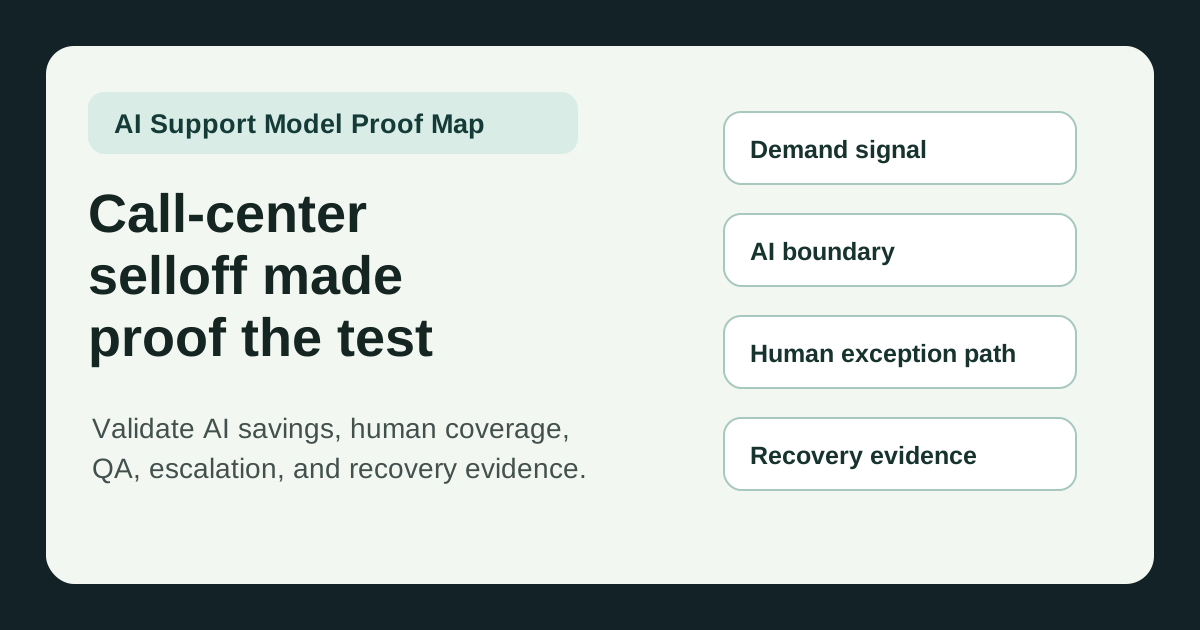
AI Support Model Proof Map
Use this map before cutting support coverage, replacing an outsourced team, or approving a blended AI and remote-support model.
| Proof layer | Buyer question | Weak signal | Evidence to require |
|---|---|---|---|
| Demand signal | Is support demand actually gone, or did customers abandon a broken path? | Lower volume is treated as success with no reopen, complaint, or missed-callback review. | Queue volume, abandoned contacts, reopens, complaints, backlog, callback completion, and customer-recovery notes. |
| AI task boundary | Which work can AI assist without owning the customer outcome? | The vendor says AI handles support without naming blocked actions. | Task list, allowed actions, blocked actions, source controls, review rules, and failure examples. |
| Human exception path | Which cases still require trained people? | Seat reduction removes the people who resolve refunds, edge cases, escalations, and account-specific issues. | Exception matrix, escalation triggers, supervisor owner, after-hours rules, and recovery playbooks. |
| Quality proof | Does the new model improve outcomes after failure work is counted? | The business case counts handle-time savings but ignores QA misses and reopened cases. | QA samples, reopened case review, bad-record cleanup, escalation quality, and customer outcome reporting. |
| Partner accountability | Who owns the workflow when AI and humans both touch it? | AI vendor, outsourcing partner, and internal team each assume someone else owns the result. | Named workflow owner, weekly review cadence, release notes, change log, and repair owner. |
| Recovery evidence | What happens when the customer is wronged or stuck? | Recovery is a vague promise to escalate. | Callback owner, refund/credit rules, complaint path, warm handoff, customer update template, and proof of completed repair. |
What buyers should do next
- Pick one support workflow being considered for AI, outsourcing, or coverage reduction.
- Pull baseline evidence: volume, backlog, reopens, missed callbacks, complaints, bad records, escalations, and recovery work.
- Mark which tasks AI can assist and which customer decisions still need a trained person.
- Ask any partner for QA samples, exception rules, escalation evidence, release logs, and customer-repair examples.
- Use the support coverage calculator before removing human coverage from exceptions, callbacks, or recovery work.
- Review the blended model weekly on outcomes, not only on cost per contact.
The real takeaway
The call-center stock selloff is a market signal, not an operating plan.
For support buyers, the practical lesson is to stop buying any model on narrative alone. AI-assisted support and remote teams both need evidence: demand, safe automation boundaries, human exception coverage, QA, escalation, and customer recovery. The model that can prove those layers is the one worth testing.
Buyer FAQs
- Why did call-center stocks fall? - MarketWatch, BusinessMirror/Bloomberg, and TNW tied the selloff to Concentrix guidance pressure, Teleperformance share weakness, customer pullback concerns, and investor fear that AI could reduce demand for traditional customer-service outsourcing.
- Does the selloff mean companies should replace outsourced support with AI? - No. It means buyers should require better proof before changing coverage. AI may reduce some demand, but customers still need exception handling, policy judgment, escalation, callbacks, complaint recovery, and clean CRM work.
- What should support buyers ask providers for now? - Ask for demand evidence, AI task boundaries, retained human coverage, QA samples, escalation rules, customer-recovery examples, supervisor ownership, and weekly outcome reporting before shifting work.
- When is a blended AI and remote-support model credible? - It is credible when the partner can show which work AI assists, which cases humans own, how quality is reviewed, how exceptions escalate, and how customer outcomes improve after reopens, callbacks, complaints, and repair work are counted.
Sources
- MarketWatch - Dow Jones/MarketWatch coverage of Teleperformance shares falling after Concentrix lowered guidance and investors questioned customer-service outsourcing demand under AI pressure.
- BusinessMirror / Bloomberg - Bloomberg-sourced coverage framing the broader call-center stock selloff around investor fears that AI could make the sector less investable.
- The Next Web - Technology coverage summarizing the AI pressure on call-center and outsourcing stocks and why the story traveled beyond finance desks.
- Concentrix investor relations - Primary Concentrix second-quarter 2026 results, including updated full-year revenue expectations and management's AI-and-services positioning.