CBA's Offshoring Dispute Made Automation Coverage a Support Test
The Finance Sector Union accused Commonwealth Bank of using workflow automation and streamlining explanations while moving work toward India-based teams. CBA disputed the offshoring framing and said the changes reflect broader shifts in how work is organized. The buyer issue is wider than one bank: any AI or offshore support move needs proof of work split, local judgment, failed-handoff ownership, customer notices, and recovery capacity before headcount disappears.

Direct answer
The CBA story is a warning about coverage proof, not a verdict on one disputed restructuring. The Finance Sector Union says Commonwealth Bank proposed hundreds of cuts while pointing to workflow automation, realignment, streamlining, and consolidation; it also alleges some remaining work overlaps with India-based roles. CBA disputes that offshoring is the reason and says the changes reflect broader shifts in how work is organized and delivered.
Support buyers should treat the headline as a practical test: before AI or offshore teams replace local coverage, prove exactly which work moved, which work stayed human-owned, which local judgment remains, who catches failed handoffs, and how customer recovery is measured.
What happened
The FSU’s July update said CBA proposed 274 job cuts, including 176 in technology, with other affected areas including operations, business banking, institutional banking and markets, HR, retail banking, support units, and Bankwest-related support roles.
The union said CBA attributed the cuts to workflow automation, realignments, streamlining, and consolidating functions. It also said 54 of the 176 technology roles had remaining tasks that may be performed across teams located between Australia and India.
The Australian reported the union’s later allegation that the bank was masking offshoring as redundancy and noted the union may lodge a formal dispute. The same report included CBA’s response that it operates integrated teams across Australia and India, and that remaining activities may be redistributed across existing teams but are not the reason for the changes.
Why this is trending
The story lands because it combines four pressure points buyers already feel: automation, labor cost, offshore delivery, and customer trust.
When a company says work is changing because of automation or process improvement, customers and employees still want to know who owns the messy parts. If local expertise disappears, offshore agents inherit unclear work, or AI handles too much without recovery capacity, the savings can turn into delays, rework, complaints, and reputational risk.
That is why the buyer lesson applies beyond banking. Any support organization moving work across countries or behind AI needs operational evidence, not only a lower-cost staffing plan.
The Remote Partners AI take
The weakest version of offshore support is a quiet substitution: cut the experienced people, move the queue, and hope the customer does not notice.
The stronger version is scoped. Offshore and remote teams can handle defined support queues, back-office cleanup, after-hours triage, QA review, and callback recovery. AI can summarize, classify, draft, and answer routine issues. But the buyer still needs a visible coverage model around exceptions, local knowledge, complaints, regulated workflows, and recovery.
The commercial question is not “local or offshore” or “human or AI.” It is whether the buyer can prove customer coverage after the work moves.
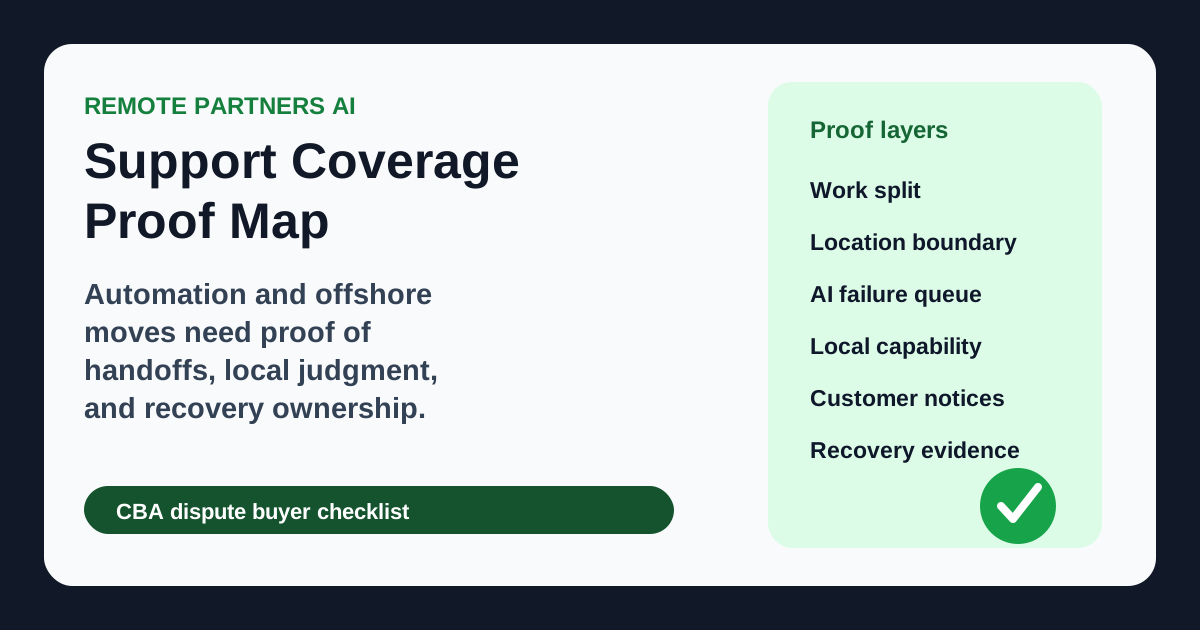
Support Coverage Proof Map
Use this map before replacing local support capacity with AI, offshore teams, or a blended model.
| Coverage layer | Buyer question | Weak signal | Evidence to require |
|---|---|---|---|
| Work split | Which tasks move to AI, offshore teams, remote agents, or retained local staff? | The plan lists roles cut but not the customer workflows they owned. | Queue taxonomy, task owner, allowed AI scope, offshore scope, local owner, and blocked topics. |
| Location boundary | Which work requires local context, licensing, language, timezone, or regulated handling? | ”Global team” language hides who can make decisions for sensitive customers. | Location matrix, escalation rules, timezone coverage, approval authority, and compliance notes. |
| AI failure queue | Where do failed summaries, wrong answers, missed handoffs, and bot escalations go? | AI deflection is reported, but reopened tickets and callbacks are ignored. | Failed-AI tags, exception queue, SLA, owner, QA sample, and callback completion export. |
| Local capability | Who trains, audits, and repairs offshore or AI-assisted work? | The experienced staff who understand edge cases are removed before the new model stabilizes. | Retained expert list, QA cadence, escalation roster, knowledge-change owner, and coaching notes. |
| Customer notices | What will customers be told when routing, language, callback, or response times change? | Customers discover the change through slower answers or repeated explanations. | Notice templates, VIP routing, callback scripts, complaint response, and service-impact thresholds. |
| Recovery evidence | How will the business prove the change did not create hidden rework? | Finance sees lower headcount but support does not report reopens, refunds, complaints, or missed calls. | Weekly recovery report with reopens, callbacks, bad summaries, refunds, escalations, and customer outcomes. |
What buyers should do next
- List the customer workflows currently owned by the team being reduced or redistributed.
- Mark which tasks are routine, which need local judgment, which involve sensitive data, and which create revenue or complaint risk.
- Assign each task to AI, offshore support, remote human support, retained local staff, or a named escalation owner.
- Create a failed-handoff queue before the staffing change goes live.
- Report deflection and recovery together: AI-handled work, reopened tickets, missed calls, callbacks, complaints, refunds, and QA failures.
- Use the support coverage calculator before changing staffing assumptions.
- If you need a managed recovery layer, review AI back-office workflow support and make exception ownership part of the scope.
The real takeaway
Automation and offshore support can reduce cost, but only when the coverage model is explicit.
The buyer should not ask whether the new model is cheaper. The buyer should ask what happens when the new model fails, who notices first, who fixes the customer impact, and what evidence proves the answer.
Buyer FAQs
- Does the CBA dispute prove automation caused the job cuts? - No. The public dispute is contested. The FSU tied the cuts to workflow automation, streamlining, and India-based role overlap, while CBA said the changes reflect broader work-organization shifts. Buyers should focus on the operational lesson: any automation or offshoring move needs coverage proof.
- Why does a bank restructuring story matter to support outsourcing buyers? - It shows how quickly automation, location strategy, job reductions, and customer outcomes can become one governance problem. Support buyers face the same risk when they remove local or experienced coverage before proving handoffs and recovery.
- What proof should a buyer require before moving support offshore or behind AI? - Ask for a work-split map, location boundary, exception queue, local escalation owner, QA sampling, customer notice rules, backup coverage, failed-handoff tags, and recovery reporting.
- Can offshore support still be a good option? - Yes, when the scope is explicit and measured. Offshore support can work well for defined queues, back-office tasks, after-hours coverage, QA, and recovery if local judgment, escalation, and customer-risk ownership are not silently removed.
Sources
- The Australian - July 10, 2026 coverage of the FSU allegation, CBA's response, reported role counts, India hiring references, and possible Fair Work Commission escalation.
- Finance Sector Union - FSU July 3 member update saying CBA proposed 274 job cuts, including 176 technology roles, and attributed the cuts to workflow automation, realignments, streamlining, and consolidation.
- Finance Sector Union CBA archive - FSU CBA workplace archive showing the July 2026 job-cuts update in the broader CBA workplace-change context.