AI Led Layoff Reasons for Four Straight Months
Challenger's June 2026 job-cut report says AI was the top cited layoff reason for a fourth consecutive month, while tech cuts rose sharply in the first half. The buyer issue is not whether AI will keep changing staffing. It is whether companies can prove customer coverage, escalation, exception handling, language support, and recovery remain intact after automation changes the team.

Direct answer
Challenger’s June 2026 layoff report turns AI staffing into a support coverage test. AI was the top cited layoff reason for a fourth consecutive month, and technology cuts were up sharply in the first half of 2026.
For buyers, the operating question is not whether companies will keep automating. It is whether customer coverage is still visible and recoverable after automation changes the team. If AI reduces routine work but the company cannot prove who handles exceptions, escalations, language gaps, reopens, bad summaries, and missed callbacks, the savings can become service risk.
What happened
Challenger, Gray & Christmas reported on July 1, 2026 that U.S. employers announced 45,849 job cuts in June, down 53% from May. The same report said 443,604 cuts were announced through the first half of the year.
The detail that matters for support and back-office buyers is the stated reason. Challenger said AI led layoff reasons in June for the fourth consecutive month, with 14,029 cuts attributed to AI in June and 101,743 year to date.
The report also said the technology sector announced 15,503 June cuts and 139,156 cuts year to date, up 83% from the same point in 2025. HR Dive independently covered the Challenger figures and highlighted AI disruption as the top cited reason. Business Insider added market context around recurring tech layoffs and AI-driven workforce resets.
Why this is trending
The story has momentum because it is not a product launch or executive forecast. It is a labor-market signal tied to reported job-cut reasons across employers.
It also lands in the exact moment buyers are being asked to approve AI support agents, AI workflow tools, automated summaries, offshore support redesigns, and leaner operating models. Those tools can help. But if the business treats the AI trend as permission to remove human recovery capacity without measuring outcomes, buyers inherit the risk.
That is why this belongs in vendor diligence, outsourcing scopes, and AI support rollout plans. A support model is not proven by containment rate alone. It is proven when failures have an owner.
The Remote Partners AI take
The weak version of AI adoption is headcount reduction justified by automation volume.
The stronger version is coverage redesign. AI handles repeatable intake, classification, summaries, translation drafts, FAQ answers, and routing. Remote support agents own judgment calls, frustrated customers, reopens, incorrect AI outputs, missing data, urgent callbacks, and escalation packages.
The buyer should require both sides in the same operating model. Automation can reduce repetition, but human support must still be named, trained, authorized, and measured.
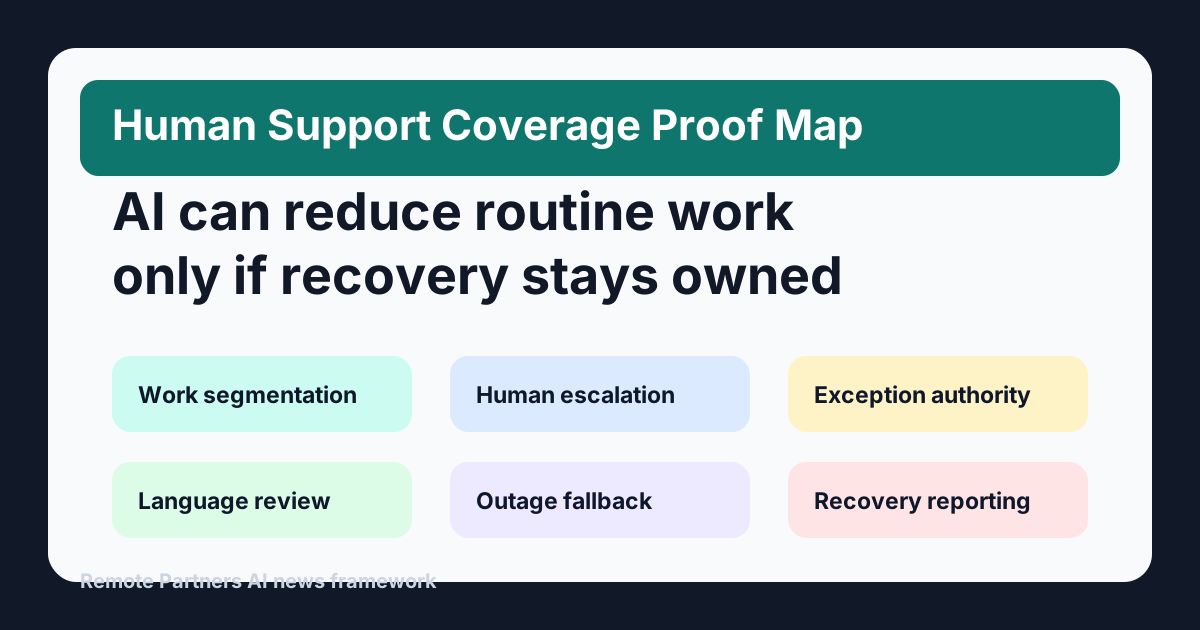
Human Support Coverage Proof Map
Use this map before approving AI-driven support staffing changes, outsourced coverage redesigns, or automation claims from a vendor.
| Coverage layer | Buyer question | Weak signal | Evidence to require |
|---|---|---|---|
| Work segmentation | Which requests are safe for AI, and which require judgment, empathy, authority, or compliance review? | The vendor reports an automation rate without showing excluded case types. | Workflow map, excluded intents, sensitive-case tags, sample tickets, and QA rules. |
| Human escalation | Can a customer reach a trained person before a failed automated path becomes a complaint? | Escalation exists, but customers repeat context or wait without ownership. | Transfer tests, callback SLA, handoff transcript, queue owner, and failed-handoff review. |
| Exception authority | Can the human actually fix the issue, or only apologize for the AI path? | Agents can explain policy but cannot correct records, approve next steps, or reroute cases. | Authority matrix, approval thresholds, repair actions, supervisor path, and decision log. |
| Language review | Are translated AI answers and summaries reviewed when meaning changes the outcome? | Translation and summary quality are assumed from model performance. | Language QA samples, glossary, review triggers, transcript audit, and correction log. |
| Outage fallback | What happens when the AI tool, CRM, ticketing system, or voice stack fails? | Manual fallback is informal, understaffed, or missing from the scope. | Manual playbook, reroute plan, staffing trigger, status notice, and post-incident report. |
| Recovery reporting | Are AI savings reported beside reopens, complaints, bad outputs, and manual repairs? | Leadership sees containment but not customer recovery work. | Weekly report with AI volume, escalations, reopens, complaints, callbacks, corrections, and resolution notes. |
What buyers should do next
- Pick one AI-assisted support workflow and list the customer cases where a wrong automated answer would create harm, churn, or compliance risk.
- Separate repeatable work from exceptions that require human judgment, authority, language review, or empathy.
- Name the human owner for failed AI sessions, reopens, complaints, urgent callbacks, data correction, and sensitive escalation.
- Test live handoff, callback completion, and exception repair before reducing coverage hours or headcount.
- Report automation rate and human recovery work in the same weekly operating review.
- Use the support coverage calculator before cutting coverage hours or moving work to automation.
- If you need a managed human layer around AI workflows, review AI back-office workflow support and include recovery reporting in the scope.
The real takeaway
AI can remove repetitive work. It cannot remove accountability.
The Challenger report shows AI moving from experiment to staffing reason. Buyers should respond by asking for proof that customers still have a human recovery path when automation reaches its limit.
Buyer FAQs
- What did Challenger report about AI and layoffs? - Challenger, Gray & Christmas reported that AI led stated layoff reasons in June 2026 for a fourth consecutive month. The firm counted 14,029 June cuts tied to AI and 101,743 AI-cited cuts year to date.
- Does this mean buyers should avoid AI support automation? - No. It means buyers should require coverage proof before automation changes staffing. AI can handle repeatable work, but a named human layer still needs to own exceptions, complaints, language gaps, failed summaries, and recovery.
- Why does a layoff report matter to support outsourcing? - The report shows AI moving from pilot discussion into staffing decisions. Any buyer depending on outsourced support, back-office help, or AI-assisted coverage should test whether service recovery remains measurable after headcount changes.
- What proof should buyers ask for? - Ask for coverage hours, escalation triggers, exception authority, language review, failed-AI queues, callback completion, QA sampling, and a weekly recovery report that tracks reopens, complaints, manual repairs, and customer outcomes.
Sources
- Challenger, Gray & Christmas - Primary July 1, 2026 report saying June layoff announcements cooled to 45,849, AI led stated layoff reasons for the fourth consecutive month, and tech led all sectors in June cuts.
- HR Dive - Independent July 2026 coverage of the Challenger report, including the 83% first-half rise in tech layoffs and AI as the top cited reason.
- Business Insider - Independent July 2026 context on recurring tech layoffs, AI disruption, and the wider shift from temporary restructuring to persistent workforce reset.