Citizens Advice Chatbot Warning: Human Support Coverage Map
September 21 reporting on Citizens Advice urging UK service providers to stop relying on chatbots turns chatbot frustration into a remote-support buyer question: can the provider prove a human route, accessible contact options, queue ownership, escalation rules and recovery evidence before automation blocks a vulnerable customer?

Direct Answer
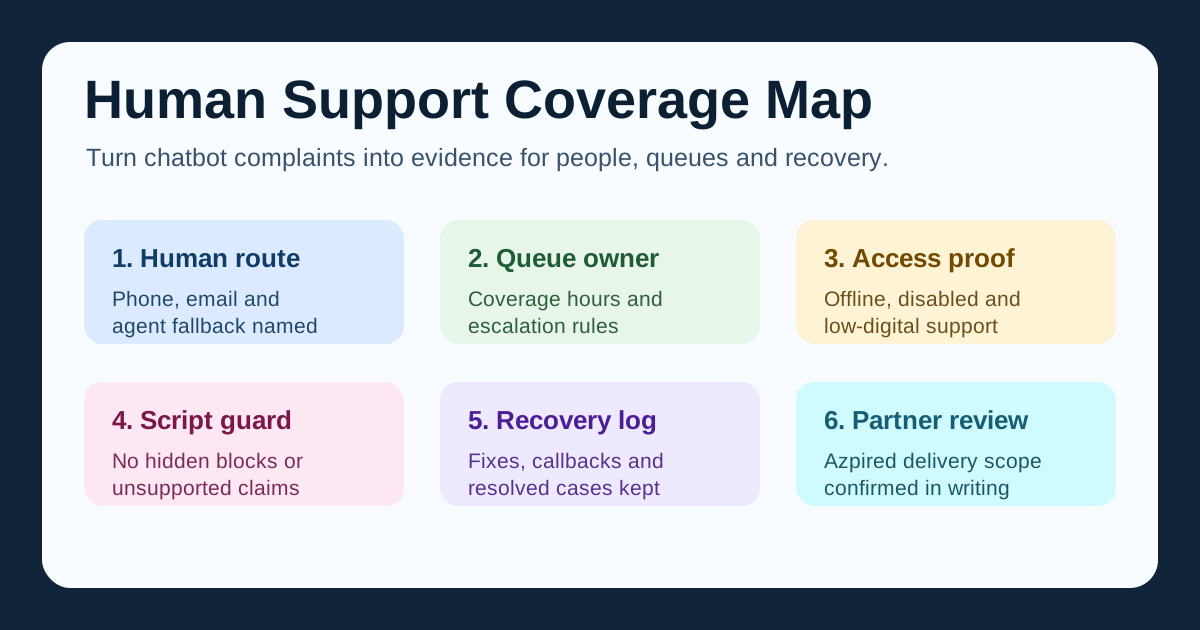
The Citizens Advice chatbot warning is a human-support coverage story, not just a complaint about bad bots. When a customer cannot get past self-service to a person, the operating risk shifts to queue ownership, accessibility, escalation and recovery evidence. Buyers should require a Human Support Coverage Map before approving chatbot-first support: which channels reach a human, which cases bypass automation, who owns each queue, what language is forbidden, and how failed journeys are repaired.
Remote Partners AI is the marketing partner of Azpired. Azpired confirms, contracts, and delivers selected services. This article is a planning framework based on public reporting; it is not a claim about Citizens Advice, Azpired client outcomes, government policy, chatbot replacement or any guaranteed staffing result.
What Happened
The Guardian reported on September 21 that Citizens Advice urged UK service providers to stop relying on chatbots for customer care when people need help with essential services. The coverage framed the issue as access to a human, especially where online self-service creates stress, exclusion or stalled problem resolution.
That matters because chatbot frustration is rarely contained inside the chat window. The same customer may try phone queues, email, complaint forms, social channels and in-person help, while the support team tries to reconstruct what the bot already asked, promised or blocked.
The UK government’s digital-inclusion work keeps the broader access problem visible: not every customer can complete high-stakes service tasks through web forms, portals or automated flows. For remote-support buyers, that means bot coverage must be paired with a named human route.
Why It Is Trending
The story combines three live pressures: AI customer-service cost cutting, digital exclusion and rising expectations that essential-service providers keep a human route open. That is a sharp buyer signal because outsourced support teams are often asked to cover the exact gap automation leaves behind.
The risk is not that every chatbot is bad. The risk is that a provider can show a demo but cannot prove what happens when a customer is confused, vulnerable, offline, angry, disabled, blocked by authentication, or facing an urgent billing or service issue.
The Remote Partners AI Take
Use the Citizens Advice story as a due-diligence prompt: “Can the support model prove that automation does not trap the customer?”
| Coverage layer | Buyer question | Proof to request |
|---|---|---|
| Human route | Which customers can reach a person without repeating the whole case? | Phone, email, callback and assisted-digital paths by queue |
| Accessibility | Which journeys work for low-digital, disabled, elderly, language-limited or urgent customers? | Accessibility test cases, fallback scripts and exception rules |
| Queue owner | Who owns the handoff after the bot, form or portal fails? | Named queue, service hours, service level and escalation owner |
| Script guard | Which bot or agent claims are prohibited? | Restricted topics, refund and legal limits, complaint language |
| Recovery log | How are failed automation paths found and fixed? | Reopened cases, callbacks, complaints, changed answers and QA samples |
| Partner review | Who confirms the delivery model before go-live? | Scope confirmation from Azpired or the selected delivery partner |
Worked Example
Suppose a utility, home-services firm or membership organization moves first contact into chat. A weak plan says the bot will escalate when needed. A stronger plan shows:
- Which phrases, customer types and service topics move straight to a person.
- Which phone and email paths remain open when the portal fails.
- Which queues own urgent service, billing, vulnerable-customer and complaint cases.
- Which answers are blocked because they could overpromise eligibility, timing or legal rights.
- Which callbacks, corrected scripts and reopened cases prove the workflow improved.
The stronger plan is easier to trust because it treats human fallback as an operating control, not a courtesy.
Buyer Bridge
AI-assisted support due diligence should include human access and recovery proof. A buyer still owns the customer promise when a chatbot blocks the path, repeats itself, misunderstands context or cannot handle the exception.
Ask providers to attach a Human Support Coverage Map to the statement of work. It should name the contact routes, human handoff triggers, accessible-service scenarios, queue owners, language limits, complaint and callback paths, QA samples and recovery evidence. That map makes the support model inspectable before customers discover the gap.
Next Steps
- Inventory every route where a customer can ask for help: bot, web form, portal, email, phone, callback, social, postal and assisted digital.
- Mark the journeys where automation must not be the only route: urgent service, billing hardship, complaints, disability access, safety, account lockout and vulnerable-customer cases.
- Name the human owner, service hours and escalation trigger for each exception queue.
- Review bot and agent language for unsupported promises, circular instructions, legal claims and empathy without action.
- Keep evidence of failed automation paths: callbacks, reopened cases, changed answers, complaint themes, queue fixes and follow-up QA.
For sourcing or delivery questions, contact Remote Partners AI and Azpired through the email listed on this site.
Buyer FAQs
- Why does the Citizens Advice chatbot story matter to support buyers? - It shows that chatbot-first service can become a customer access risk when people cannot reach a human, especially in essential-service or vulnerable-customer workflows.
- What proof should a buyer request from a support partner? - Ask for a human support coverage map showing contact channels, fallback rules, queue owners, accessibility coverage, escalation triggers, forbidden claims, callbacks and recovery evidence.
- Does Remote Partners AI directly deliver contracted services? - Remote Partners AI is the marketing partner of Azpired. Azpired confirms, contracts, and delivers the services a buyer selects.
Sources
- The Guardian - September 21, 2026 coverage of Citizens Advice warning that service providers should not rely on chatbots when people need essential customer care.
- UK Government Digital Inclusion Action Plan - Government digital-inclusion context for the importance of accessible routes into essential services.
- Ofcom - Service-quality context for communications providers, complaints and customer support expectations.