Concentrix Q2 Turned AI Support into a Delivery-Mix Test
The earnings story is not just revenue and margin. It is proof that customer service buyers now have to measure AI, offshore delivery, and human ownership together.

Direct answer
Concentrix’s June 29 Q2 2026 results are trending because they show the customer experience market moving into a blended delivery model. The company reported $2.462 billion in revenue, 0.6% constant-currency growth, lower operating income, record second-quarter cash flow, and iX Suite deals up 400% year over year.
For support buyers, the point is not whether AI replaces service teams. The point is whether AI, offshore delivery, supervisors, and trained operators can be measured as one working support system.
What happened
Concentrix reported second-quarter fiscal 2026 revenue of $2.462 billion, up 1.9% as reported from the year-earlier quarter. Constant-currency revenue growth was 0.6%. Operating income fell to $95.4 million from $148.3 million a year earlier, while non-GAAP operating margin was 11.9%.
The company also reported a record second-quarter $257.9 million in cash flow from operations and $242.3 million in adjusted free cash flow.
The AI signal was prominent. Concentrix said iX Suite deals were up 400% year over year, and CEO Chris Caldwell said the company’s blended AI and services approach is lowering client costs and increasing revenue.
MarketBeat’s earnings page showed the release getting immediate investor attention after the close, with a small EPS and revenue miss versus consensus and a sharp extended-hours move.
Why this is trending
Customer service outsourcing is under pressure from two directions at once.
First, AI is changing the economics of repetitive support, summaries, routing, QA, and knowledge retrieval. Second, buyers are still pushing work to lower-cost delivery locations. Concentrix explicitly described restructuring related to accelerating movement of work offshore and aligning cost structure for higher-growth areas while automating other parts of the business.
That combination matters because support leaders can no longer evaluate a vendor only by hourly rate, seat count, or chatbot demo quality. They have to know which work is automated, which work is moved, which work stays human, and which outcomes prove the customer did not lose continuity.
The Remote Partners AI take
The practical lesson is simple: do not buy AI support or offshore support as separate promises.
Buy a delivery model that names the work, the owners, the measurements, and the fallback path. AI can reduce repetitive work, offshore teams can extend coverage and lower cost, and remote operators can provide steady human judgment. But if those lanes are not mapped, the buyer inherits fragmented accountability.
The goal is not fewer agents on a slide. It is fewer unresolved customer issues after the new model goes live.
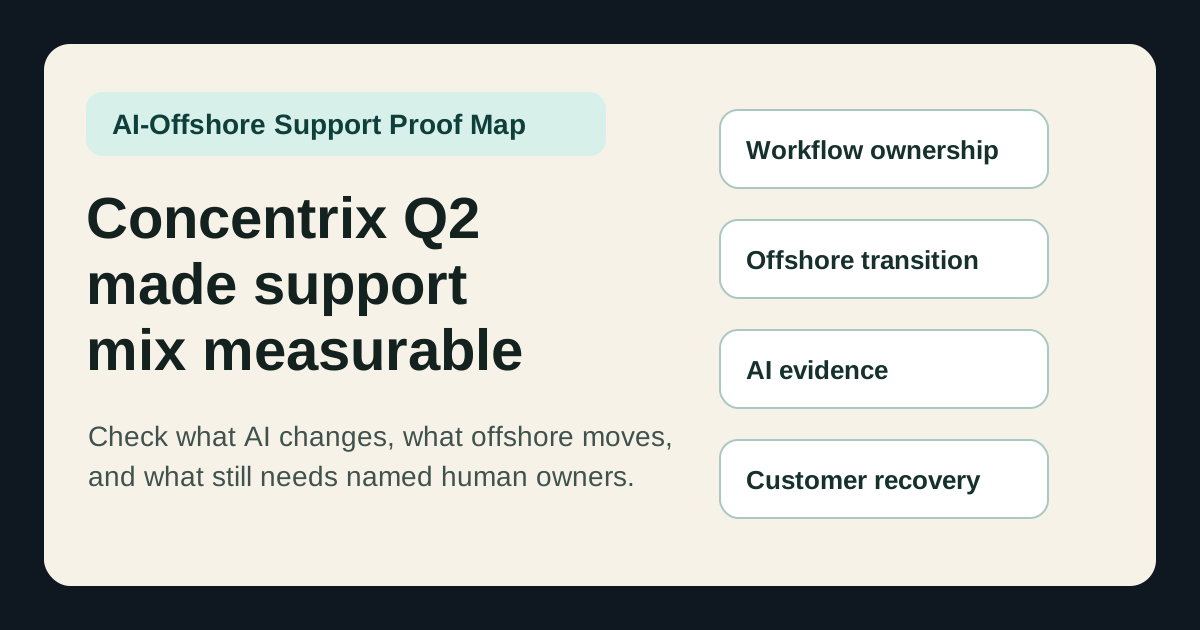
AI-Offshore Support Proof Map
Use this map before changing support delivery because an earnings story, vendor proposal, or AI demo made the cost case look obvious.
| Support layer | What AI may change | Offshore or delivery risk | Proof buyers should request |
|---|---|---|---|
| Basic requests | Deflect FAQs, order status, appointment reminders, and password-like repetitive questions | Customers may get stuck when the request is emotional, unusual, or account-specific | Containment rate, failed-chat samples, escalation reasons, and human fallback speed |
| Agent assist | Draft replies, summarize cases, retrieve policy, and classify intent | Operators may approve weak AI drafts without enough account context | QA rubric, sample transcripts, correction workflow, and supervisor review logs |
| Offshore transition | Move repeatable queues, after-hours coverage, back-office updates, and overflow work | Process memory can break when knowledge, access, and account history are thin | Training plan, queue-by-queue scope, knowledge-base owner, and transition quality metrics |
| Escalation | Detect angry customers, high-risk cases, repeat contacts, and unresolved issues | A blended model may not know who owns recovery once automation fails | Named escalation owners, warm handoff notes, recovery SLA, and complaint outcomes |
| Data and access | Restrict sensitive fields, summarize safe context, and flag missing data | Broad AI or offshore access can expose customer data or create bad CRM updates | Permission map, redaction rules, audit logs, and approved write actions |
| Economics | Lower repetitive labor and improve routing speed | Savings can disappear into rework, supervision, customer recovery, and vendor management | Before-and-after cost per resolved issue, reopen rate, QA time, and retained staffing |
What buyers should do next
- Pick one support queue and classify its work before asking for AI or offshore pricing.
- Require a before-and-after model that includes rework, QA, supervision, customer recovery, and retained human coverage.
- Ask vendors to show where AI writes to CRM, tickets, order systems, calendars, or customer messages.
- Keep trained operators and supervisors responsible for complaints, account-sensitive decisions, billing issues, and policy exceptions.
- Measure the first rollout by customer outcome, not just cost per contact or agent headcount.
- Use the support coverage calculator to size the human layer that should remain behind AI.
The real takeaway
Concentrix’s Q2 is a useful market signal because it refuses the simple story. AI is real. Offshore transition is real. Human support is still real.
Buyers who treat those as a governed operating model will have a stronger support system than buyers who chase the cheapest version of each part separately.
Buyer FAQs
- What did Concentrix report for Q2 fiscal 2026? - Concentrix reported $2.462 billion in Q2 revenue, up 1.9% as reported and 0.6% in constant currency, with operating income down year over year and iX Suite deals up 400%.
- Why does this matter to support outsourcing buyers? - The results show customer experience delivery is becoming a mix of AI tooling, offshore transitions, services, and retained human judgment. Buyers need proof across the full delivery model, not only a lower cost quote.
- Is AI replacing outsourced support? - Concentrix said AI and technology are being sold with services and that client environments are getting more complex, not less. Buyers should expect blended operating models rather than a clean replacement story.
- What should a buyer ask before changing support delivery? - Ask for before-and-after metrics on workload, quality, escalation, rework, customer recovery, offshore transition risk, AI write permissions, and named human ownership.
Sources
- Concentrix Q2 2026 results - Primary earnings release with Q2 revenue, operating income, cash flow, guidance, iX Suite deal growth, and AI-services commentary.
- Concentrix investor relations - Company investor page linking the Q2 2026 conference call, results PDF, and earnings presentation.
- MarketBeat earnings page - Independent market page summarizing Q2 EPS, revenue, expectations, extended-hours move, and call transcript highlights.