Conifer's 1,037 Remote Layoffs: Revenue Cycle Transition Proof Map
Conifer's September 2026 WARN-backed remote-worker cuts turn revenue-cycle outsourcing changes into a buyer question: can the provider prove workflow ownership, data access, queue transfer and continuity before a major contract ends?

Direct Answer
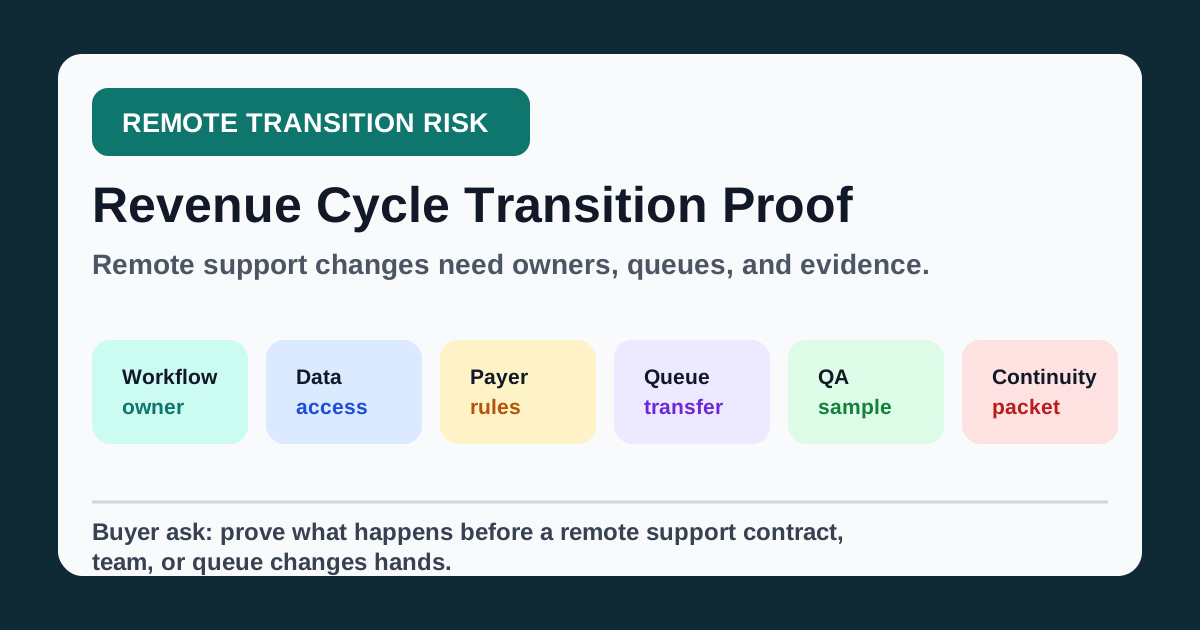
Conifer’s September 2026 layoff notice is a remote-support transition warning, not just a healthcare workforce headline. When a major revenue-cycle service agreement ends, buyers should ask for a Revenue Cycle Transition Proof Map that shows who owns each workflow, which systems and customer records remain accessible, how queues move, how QA is sampled, and how exceptions are recovered.
Remote Partners AI is the marketing partner of Azpired. Azpired confirms, contracts, and delivers selected services. This article is a planning framework based on public reporting; it is not a claim about Conifer, Tenet, CommonSpirit, Azpired client outcomes, or any guaranteed staffing result.
What Happened
Healthcare Dive reported September 14 that Conifer Health Solutions, Tenet Healthcare’s revenue-cycle subsidiary, will lay off 1,037 primarily remote employees by November 2, 2026. The article cited a Texas WARN notice and said the layoffs are expected to be permanent.
The same report tied the cuts partly to CommonSpirit Health’s earlier decision to end its service contract with Conifer. Healthcare Dive reported that CommonSpirit’s service contract expires October 30 and that Tenet regained full ownership of Conifer after CommonSpirit moved to insource revenue-cycle functions.
Chron reported September 15 that the affected employees are primarily remote-based across the United States but organizationally report to a Dallas office. Chron also cited the WARN notice’s explanation that the action relates to restructuring, technology initiatives and no longer providing services to CommonSpirit after October 30.
Tenet’s investor materials describe Conifer as a revenue-cycle management and value-based care services subsidiary serving hospitals, health systems, physician practices, employers and other clients. That makes the story especially relevant for buyers who rely on remote teams to handle sensitive, rule-heavy operational work.
Why It Is Trending
Revenue-cycle work is operationally dense: payer rules, payment status, denials, patient communication, account notes, billing exceptions, privacy boundaries and escalation timing all sit inside the workflow. When a contract ends or work moves in-house, those details do not move cleanly unless someone has already mapped them.
The remote-worker angle matters because distributed teams can make transitions smoother or riskier. A remote model works when documentation, data access, QA and escalation ownership are explicit. It becomes fragile when the buyer only knows the seat count and not the operating evidence behind each queue.
The Remote Partners AI Take
Use the Conifer/CommonSpirit story as a vendor-screening prompt: “If this support or back-office workflow had to move next quarter, what proof would survive the transition?”
| Transition layer | Buyer question | Proof to request |
|---|---|---|
| Workflow ownership | Which team owns each queue, report, customer promise and exception? | Owner matrix, backup owner and transition calendar |
| Data access | Which records, fields, files and exports can each role touch? | Permission export, field scope, audit trail and approval rule |
| Payer or policy rules | Which rules decide what the team can say, change, bill or escalate? | Rule register, exception matrix and reviewer notes |
| Queue transfer | How does work move when the current team exits or shrinks? | Open-work inventory, routing test and backlog age report |
| QA evidence | How are errors found before customers or patients feel them? | Sample rate, defect categories, coaching log and correction owner |
| Continuity packet | What can a replacement team use on day one? | Runbook, access checklist, escalation tree and recovery drill |
Worked Example
Suppose a healthcare services company moves billing support from an outsourced remote team to an internal shared-services group. A weak transition plan lists staff names, termination dates and systems. A stronger plan shows:
- Which open accounts, tickets and exceptions remain unresolved.
- Which fields and attachments the outgoing team can still access.
- Which payer rules and customer scripts are current.
- Which queues have backup owners before the contract ends.
- Which QA samples prove the new team is handling edge cases correctly.
The second plan is easier to trust because the buyer can inspect continuity before the support model changes.
Buyer Bridge
Remote support due diligence should include exit and transition evidence, not only onboarding evidence. If the contract changes, the buyer still owns the customer experience.
Ask providers to attach a transition proof map to the statement of work. It should name workflow owners, system boundaries, sensitive data, queue routing, QA samples, exception owners, customer communication rules and recovery steps. That map makes the support model auditable when the vendor, team, tool or country mix changes.
Next Steps
- Inventory the five support or back-office workflows where a transition would affect money, access, compliance or customer trust.
- Ask each provider to name the current owner, backup owner, system permissions and exception path for those workflows.
- Require a queue-transfer packet before contract changes: open work, age, next action, customer promise, system owner and escalation status.
- Test a small continuity drill before changing staffing levels or vendor ownership.
- Keep QA samples and recovery evidence tied to the transition so the buyer can prove what changed and what remained controlled.
For sourcing or delivery questions, contact Remote Partners AI and Azpired through the email listed on this site.
Buyer FAQs
- Why do Conifer's layoffs matter to remote support buyers? - They show that a major service-contract transition can affect primarily remote operational roles. Buyers should verify how work, data access, queues, QA, escalation and continuity transfer before approving a remote or outsourced support model.
- What proof should a buyer request before moving revenue-cycle or support work? - Ask for a transition proof map covering task owners, systems, data permissions, payer or customer rules, queue routing, QA samples, exception owners, customer communication and recovery procedures.
- Does Remote Partners AI directly deliver the contracted services? - Remote Partners AI is the marketing partner of Azpired. Azpired confirms, contracts, and delivers the services a buyer selects.
Sources
- Healthcare Dive - September 14, 2026 coverage of Conifer's WARN-backed plan to lay off 1,037 primarily remote employees by November 2 after the CommonSpirit service contract ends.
- Chron - September 15, 2026 Texas coverage noting the Dallas-linked WARN notice, permanent layoff, remote workforce and contract-transition rationale.
- Tenet Healthcare - Tenet investor overview describing Conifer Health Solutions as its revenue-cycle management and value-based care services subsidiary.