
AI Grew While Customer Service Job Posts Sank
Customer Experience Dive tied the AI boom to a contracting customer-service labor market, and Forrester expects AI to erase nearly half of current customer-service jobs by 2030. The buyer issue is not whether every support role disappears. It is whether support leaders can prove which work stays human, which work can be automated, and who owns recovery when AI fails.

Direct answer
The new customer-service labor-market signal is not a simple “AI replaces agents” story. Customer Experience Dive reported that AI’s role is expanding while customer-service job postings contract, and Forrester expects AI to eliminate 49% of current customer-service jobs by 2030. Buyers should treat that as a coverage-planning warning: automate routine work only after proving humans still own exceptions, QA, escalations, callbacks, and customer recovery.
If AI reduces the visible ticket queue but creates hidden rework, the buyer has not saved money. The buyer has moved labor into unmeasured cleanup.
What happened
Customer Experience Dive’s July 9 coverage framed the labor-market shift as uneven: AI is already changing customer service work, but the effect is not identical across every role or industry.
The article cites Forrester’s forecast that AI will cause 49% of current customer-service jobs to disappear by 2030. Forrester’s analysis says the human mandate changes from reacting directly to customers toward managing the AI that interacts with them.
The job-market signal is also visible in public data. FRED’s Indeed customer-service job-postings series showed a June 26, 2026 reading below the February 2020 baseline.
Why this is trending
Support leaders are under pressure from both sides. AI vendors promise lower cost and faster response. Finance teams see headcount reduction. Customers still expect a competent person when the bot misunderstands, when a refund is disputed, when a booking is urgent, when the customer is angry, or when a workflow crosses sensitive data.
That is why the story has buyer momentum. It connects macro labor pressure with the practical reality inside contact centers: fewer human roles can make AI cheaper on a spreadsheet but riskier in production if no one funds exception handling.
The Remote Partners AI take
The wrong move is to cut people first and hope AI maturity catches up.
The better move is to build a human coverage model around AI. Routine questions, status updates, appointment reminders, and low-risk triage may be good automation candidates. Exceptions, complaints, account recovery, payment or refund disputes, healthcare and financial workflows, VIP customers, and failed handoffs still need trained people.
Remote support can be useful during this transition because it converts “we need humans somewhere” into named operating coverage: queue review, callback recovery, QA sampling, escalation notes, and after-hours ownership.
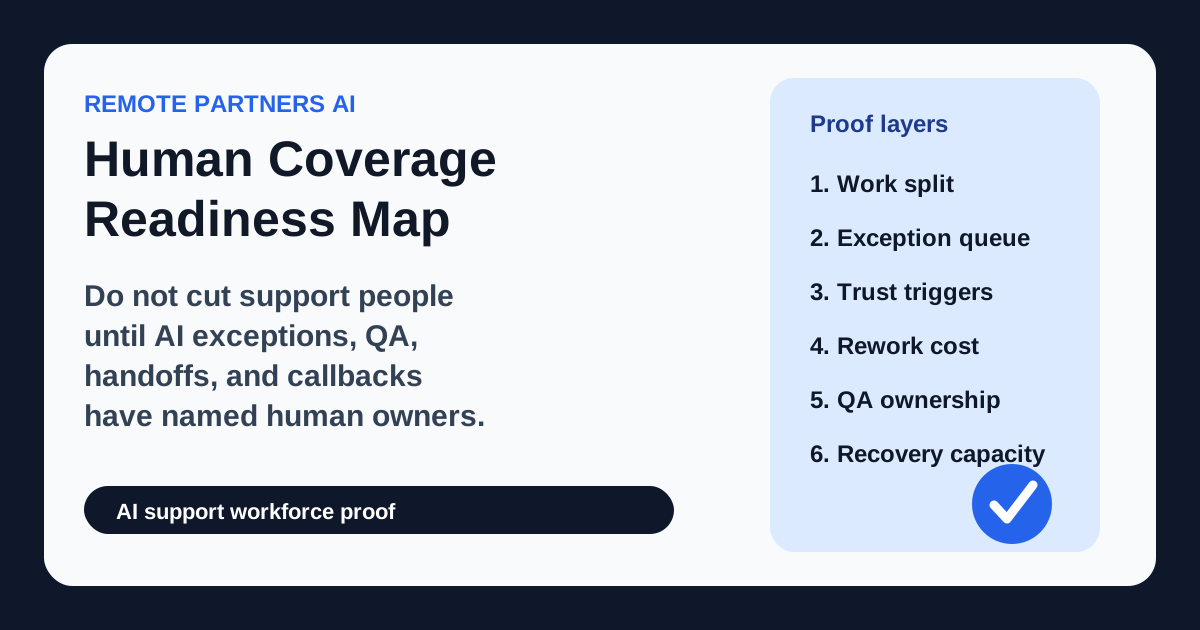
Human Coverage Readiness Map
Use this map before reducing support headcount behind an AI rollout.
| Coverage layer | Buyer question | Weak signal | Evidence to require |
|---|---|---|---|
| Work split | Which contacts are safe for AI and which stay human-owned? | Every FAQ or short call is treated as automatable, regardless of customer emotion or risk. | Contact taxonomy with risk tier, allowed AI scope, blocked topics, and human owner. |
| Exception queue | Where do failed AI sessions go? | Agents are told to “watch the bot” without a queue, SLA, or staffing model. | Failed-AI tags, exception queue, owner, response SLA, callback script, and escalation path. |
| Customer trust | Which moments require a person for reassurance or judgment? | Automation handles complaints, disputes, vulnerable callers, or high-value customers without review. | Human-trigger list, QA recordings, supervisor review, VIP routing, and complaint escalation. |
| Hidden rework | How much labor does AI create after the first response? | Deflection is reported, but reopened tickets and callbacks are ignored. | Reopen rate, refund rework, callback completion, bad-summary tags, and weekly cleanup hours. |
| Knowledge control | Who updates scripts, prompts, macros, and policy answers? | AI answers drift faster than the support team can verify. | Change log, policy owner, QA sample, approval process, rollback owner, and review cadence. |
| Recovery capacity | Who repairs customer impact when automation fails? | Finance removes headcount but does not fund recovery coverage. | Named human recovery team, after-hours coverage, queue limits, incident notes, and customer outcome report. |
What buyers should do next
- Export the top 50 customer-service contact reasons by volume, revenue impact, complaint risk, and sensitivity.
- Mark which reasons AI can answer, which it can only triage, and which require a person from the start.
- Add tags for failed AI sessions, reopened tickets, incorrect summaries, missed handoffs, callbacks, refunds, and complaints.
- Staff an exception queue before reducing frontline coverage.
- Require weekly reporting on AI deflection and AI-created rework side by side.
- Use the support coverage calculator before changing headcount assumptions.
- If you need a human recovery layer, review AI back-office workflow support and make exception ownership part of the scope.
The real takeaway
AI may reduce the number of traditional customer-service jobs. That does not remove the need for customer-service judgment.
The companies that get this right will not ask whether AI or humans should own support. They will decide which work belongs to each, prove the handoff, and keep enough trained people available when automation meets the messy parts of customer reality.
Buyer FAQs
- Does this mean buyers should stop using AI in customer service? - No. It means buyers should stop treating AI as a clean headcount swap. AI can handle routine work, but the buyer still needs human coverage for exceptions, complaints, trust repair, sensitive workflows, QA, and recovery.
- Why does the job-posting trend matter to support outsourcing buyers? - If the market reduces experienced support headcount while customer expectations stay high, buyers need a deliberate coverage model. The risk is not only fewer agents; it is fewer trained people available to supervise AI, handle edge cases, and recover customers.
- What proof should an AI support plan include before reducing staff? - Ask for a work-split map, exception taxonomy, AI failure tags, human handoff SLAs, QA sampling, callback capacity, escalation ownership, recovery scripts, and weekly reporting on rework caused by automation.
- Can outsourced support help during an AI transition? - Yes, when the scope is explicit. A managed remote support team can own exception queues, callback recovery, QA reviews, escalation notes, and after-hours coverage while AI handles lower-risk repetitive work.
Sources
- Customer Experience Dive - July 9, 2026 coverage connecting expanded AI use with a contracting customer-service labor market and citing Forrester's customer-service job-loss forecast.
- Forrester - Forrester's June 2026 analysis predicts AI will cause 49% of current customer-service jobs to disappear by 2030 and shift remaining work toward AI supervision, judgment, and exception handling.
- Federal Reserve Bank of St. Louis FRED - FRED's Indeed customer-service job-postings index showed a 2026-06-26 reading of 87.83, below the February 2020 baseline of 100, with the series updated July 1, 2026.