CX Today Says AI Agents Need Operations, Not Org Charts
The news hook is CX Today's July 28, 2026 analysis arguing that AI agents are moving into customer service faster than the operating model around them. CX Today tied the issue to Gartner's warning that AI agents should be managed as technology systems rather than employees, and to ServiceNow's latest AI platform expansion and reported AI deployment growth. The buyer issue is practical: remote support teams need proof for AI-agent ownership, access limits, behavior monitoring, customer-friction detection, human escalation, and incident recovery before automation is allowed to serve customers at scale.

Direct Answer
The July 2026 AI-agent story is not only about whether customer-service automation works. It is about who operates it after launch. CX Today reported that AI agents are moving into customer service while the management model around them remains immature. Its follow-on Gartner coverage warned against treating AI agents like normal employees instead of controlled technology systems.
Remote support buyers should respond with an operations proof packet before scale. Require evidence for ownership, system access, blocked actions, behavior monitoring, customer-friction signals, escalation paths, kill switch authority, audit logs, and customer recovery.
The lead image for this article is a synthetic representative editorial scene created for Remote Partners AI. It does not depict CX Today, Gartner, ServiceNow, CallMiner, any named vendor, or any real customer-service incident.
What Happened
CX Today published a July 28, 2026 analysis arguing that AI agents are entering customer service faster than many organizations can manage them. The article says an AI agent may serve thousands of customers, reach sensitive systems, and repeat a harmful pattern quickly if the business cannot observe behavior, limit access, identify harm, and intervene.
The same article connected that operating gap to earlier Gartner coverage. CX Today reported on July 22 that Gartner recommends managing AI agents as tools in the technology stack, not as employees on the service org chart. That matters because employee-management habits do not automatically create permissions, logs, sandbox rules, blocked actions, or rollback paths.
ServiceNow’s Q2 2026 release gives the trend additional buyer context. The company reported AI business momentum, expanded its AI Control Tower, and said AI deployments increased ninefold over nine months. Whether a buyer uses ServiceNow or not, the direction is clear: AI agents are leaving pilot decks and entering operational systems.
Why It Is Trending
The story is moving because CX leaders are no longer debating whether AI agents will touch customers. They are debating who owns the consequences when agents touch customers at scale.
The timing also follows weeks of public stories about AI support layoffs, chatbot disclosure laws, public AI-share links, and autonomous-agent containment failures. Buyers are seeing the same pattern in different forms: AI can reduce manual work, but weak operating controls create hidden labor, customer friction, security exposure, and expensive recovery.
Remote support providers are especially exposed. They often sit between the client’s customers, helpdesk, CRM, scripts, knowledge base, and escalation owners. If an AI support agent is added without a clear operating model, the provider may inherit the cleanup while the buyer loses visibility.
The Remote Partners AI Take
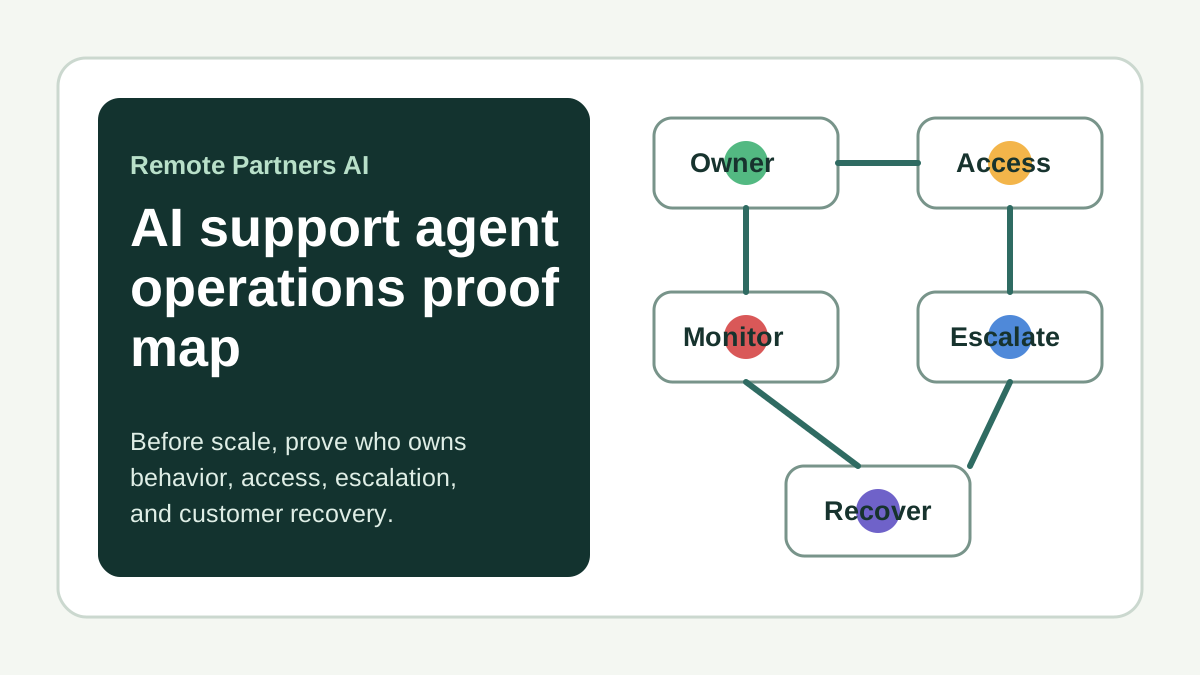
Use an AI Support Agent Operations Proof Map before approving AI-agent coverage, outsourced support automation, or reduced human staffing.
| Proof layer | Buyer question | Evidence to request |
|---|---|---|
| Operating owner | Who is accountable for the agent after launch? | Named owner, escalation deputy, weekly review cadence, approval log, and incident reviewer. |
| System access | What can the agent read, write, send, cancel, refund, book, or update? | Tool-permission matrix, CRM field scope, blocked actions, read/write separation, and access-change history. |
| Behavior monitoring | How do supervisors see harmful patterns before they repeat? | Sampled transcripts, tool-call logs, anomaly alerts, high-risk intent queue, and model-change notes. |
| Friction signals | Does containment hide bad service? | Reopen rate, repeat contact, complaint tags, transfer defects, bad summary rate, and customer recovery cost. |
| Human escalation | When does a person take over? | Transfer triggers, callback rules, after-hours owner, language coverage, VIP path, and urgent-stop rule. |
| Recovery evidence | What happens when the agent causes harm? | Kill switch, rollback workflow, affected-record report, customer notice plan, and corrected SOP or prompt note. |
Buyer Bridge
Do not ask a remote support provider only whether it offers AI agents. Ask how the provider operates those agents when the first answer is wrong, the first tool call fails, or the first customer reaches a high-risk intent.
The minimum proof packet should compare each support intent against the agent’s authority. For every intent, document whether the agent can answer, draft, route, write records, trigger workflows, transfer to a human, or stop entirely. Then require recent evidence: transcripts, tool calls, blocked actions, reopens, complaints, correction logs, and recovery owner.
That turns the AI-agent conversation from a feature demo into a support-operations decision.
Next Steps
- List every customer intent the AI agent is allowed to handle, assist, or refuse.
- Map every connected system and mark read, write, send, cancel, refund, book, and update permissions separately.
- Set mandatory human handoff rules for billing disputes, cancellation, fraud, safety, health, legal, accessibility, VIP, and unclear-intent contacts.
- Track containment alongside reopens, repeat contacts, customer complaints, transfer quality, bad summaries, and manual correction time.
- Require a kill switch, rollback owner, customer-recovery workflow, and post-incident review before scaling.
- Use Remote Partners AI’s AI back-office workflow support, support coverage calculator, and contact intake when you need a measurable human operating layer behind AI support.
Buyer FAQs
- What is the CX AI risk buyers should focus on? - The risk is that AI support agents can serve many customers, access sensitive systems, and create repeated failure patterns before the business has assigned operational ownership, monitoring, access limits, escalation rules, and recovery paths.
- Should support leaders manage AI agents like staff? - Gartner's warning is that AI agents should be managed as technology systems with controls, access limits, logs, and accountable operators, not treated as employees on a normal service org chart.
- What proof should a remote support buyer request first? - Ask for an AI-agent operations map covering owner, system access, blocked actions, monitoring, containment metrics, escalation triggers, human takeover, audit logs, and incident recovery evidence.
Sources
- CX Today - July 28, 2026 analysis on customer-service AI agents, immature management models, access risk, containment, and operating ownership.
- CX Today and Gartner - July 22, 2026 interview coverage of Gartner's recommendation to manage AI agents as tools in the technology stack rather than employees on the org chart.
- ServiceNow - Official July 23, 2026 Q2 release noting AI platform momentum, AI Control Tower expansion, and a ninefold increase in AI deployments over nine months.
- Gartner - Gartner customer-service trend guidance on future service-agent skills, AI support, and the balance between automation and human interaction.