Entain's Customer Care Cuts: Support Coverage Proof Map
Entain's September 2026 consultation over 400 customer-care roles turns workforce cuts into a buyer question: can the support model prove queue ownership, peak cover, QA and recovery before capacity changes?

Direct Answer
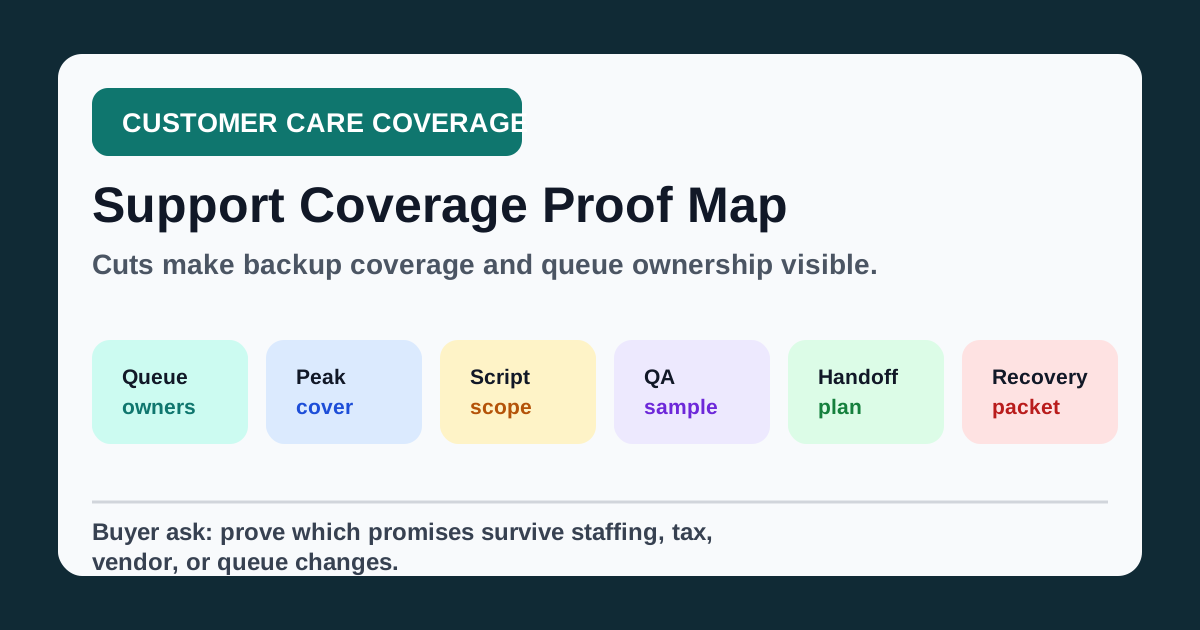
Entain’s September 2026 customer-care consultation is a support-coverage warning, not only a gambling-sector workforce headline. When a company proposes cutting a fifth of a customer-care group, buyers should ask for a Support Coverage Proof Map that shows who owns each queue, how peak demand is covered, which scripts and escalation paths are current, how QA is sampled, and what recovery evidence proves customers will not feel the capacity change first.
Remote Partners AI is the marketing partner of Azpired. Azpired confirms, contracts, and delivers selected services. This article is a planning framework based on public reporting; it is not a claim about Entain, Azpired client outcomes, gambling-sector compliance, or any guaranteed staffing result.
What Happened
The Guardian reported September 16 that Entain, owner of Ladbrokes, Coral and BetMGM, had started a consultation process that could remove 400 customer-care jobs. The report said that would represent about one in five of Entain’s 2,000 customer-care roles.
The same article said Entain had recently reported better-than-expected first-half profit and tied the proposed changes partly to a tougher UK tax environment. Guardian coverage quoted Entain’s chief executive framing the decision as part of keeping the business competitive and financially resilient.
Morningstar, carrying Alliance News, also reported that Entain planned to cut around 400 customer-care jobs worldwide. Racing Post covered the same proposed reduction and described the customer-care changes as part of a division simplification.
Entain’s own site describes the company as one of the world’s largest sports betting and gaming groups, with more than 28,000 colleagues and operations across more than 30 regulated markets. That scale makes the support-planning question useful beyond one sector: when a high-volume customer-care operation changes capacity, buyers need proof that queues, scripts and escalation ownership have been stress-tested.
Why It Is Trending
Customer-care reductions are not just headcount news. They change wait times, backlog risk, escalation pressure, QA coverage, customer promises and the amount of work pushed to self-service or outsourced partners.
The timing also matters. A support organization can look stable during ordinary volume and fail during a tax-change announcement, regulatory change, peak season, payment issue, fraud spike, outage or media cycle. The buyer risk is not only whether fewer agents remain. It is whether anyone has mapped what those agents own.
The Remote Partners AI Take
Use the Entain story as a due-diligence prompt: “If customer-care capacity changed next quarter, what proof would show that customer promises are still covered?”
| Coverage layer | Buyer question | Proof to request |
|---|---|---|
| Queue ownership | Which team owns each call, chat, email, refund, dispute and escalation queue? | Queue owner matrix, backup owner and escalation route |
| Peak cover | What happens during promotions, outages, regulatory changes, billing spikes or media attention? | Forecast, staffing model, shrinkage assumptions and overflow plan |
| Script scope | Which issues can frontline agents resolve and which need supervisor or specialist review? | Approved script packet, forbidden promises and exception rules |
| QA sample | How will quality be checked when volume rises or staffing changes? | Sample rate, defect categories, calibration notes and coaching owner |
| Handoff plan | What work moves to self-service, automation, a partner, or another internal team? | Handoff checklist, data-access rules, ticket tags and acceptance criteria |
| Recovery packet | How will the buyer prove that customers were not harmed by the capacity change? | Backlog age, abandoned contacts, missed SLA review, callbacks and remediation log |
Worked Example
Suppose a regulated consumer business reduces an internal support team and shifts overflow to a managed remote group. A weak plan lists the new staffing number and the target start date. A stronger plan shows:
- Which contact reasons stay internal and which move to the partner.
- Which scripts are approved for billing, refunds, account safety and complaints.
- Which hours need backup coverage because demand spikes after policy changes or media coverage.
- Which QA defects trigger supervisor review before the next shift.
- Which backlog and callback evidence proves the new coverage model works.
The second plan is easier to trust because it treats coverage as an auditable workflow, not a staffing guess.
Buyer Bridge
Support coverage due diligence should include change evidence, not only launch evidence. A buyer still owns the customer experience when taxes, budgets, automation, vendor changes or restructuring change the shape of the team.
Ask providers to attach a support coverage proof map to the statement of work. It should name queue owners, backup coverage, script boundaries, escalation rules, data access, QA sampling, peak-volume assumptions and recovery evidence. That map makes the support model easier to inspect before customers discover the gap.
Next Steps
- Identify the five customer-care queues where reduced coverage would create the most complaints, churn, refunds, fraud risk or compliance pressure.
- Ask each provider or internal team for current owner, backup owner, script, escalation and QA evidence for those queues.
- Compare planned staffing against peak volume, shrinkage, backlog age and supervisor review capacity.
- Separate customer-safe self-service from work that still needs a trained human with escalation authority.
- Keep missed-contact, callback, QA and recovery evidence tied to the capacity change.
For sourcing or delivery questions, contact Remote Partners AI and Azpired through the email listed on this site.
Buyer FAQs
- Why do Entain's customer-care cuts matter to support buyers? - They show that customer-care capacity can change because of tax, cost, restructuring or market pressure. Buyers should verify which queues, scripts, peak periods, QA steps and recovery paths survive before a support model changes.
- What proof should a buyer request before reducing or moving support capacity? - Ask for a support coverage proof map covering queue owners, volume assumptions, peak cover, script boundaries, escalation owners, QA samples, handoff rules and recovery evidence.
- Does Remote Partners AI directly deliver the contracted services? - Remote Partners AI is the marketing partner of Azpired. Azpired confirms, contracts, and delivers the services a buyer selects.
Sources
- The Guardian - September 16, 2026 coverage that Entain started consultation over 400 customer-care jobs, roughly one in five of its 2,000 customer-care roles.
- Morningstar / Alliance News - Alliance News coverage noting the planned reduction of about 400 customer-care jobs worldwide and the tax-pressure context.
- Racing Post - Industry coverage of the proposed cuts and Entain's explanation that customer-care simplification was tied partly to tax burdens.
- Entain results centre - Company investor materials hub for Entain's interim results and official reporting context.