EU AI Act Chatbot Labels Turned Support Disclosure Into a Buyer Test
The news hook is Article 50 of the EU AI Act, which applies from August 2, 2026. The European Commission's Article 50 FAQ and guidelines say providers of interactive AI systems must inform people when they directly interact with AI, including chatbots and AI agents. The Guardian independently reported that AI labels become compulsory for new systems from August 2, with existing systems given four months to adapt. The remote support buyer issue is practical: chatbot labels, EU user scope, human transfer, transcript evidence, vendor responsibility, content marking, and exception handling now need proof before AI support is deployed.

Direct Answer
EU AI Act Article 50 is now a customer-support operating issue, not just a legal headline. From August 2, 2026, providers of interactive AI systems must inform people when they are directly interacting with AI, and the European Commission’s guidance explicitly covers systems such as chatbots and AI agents.
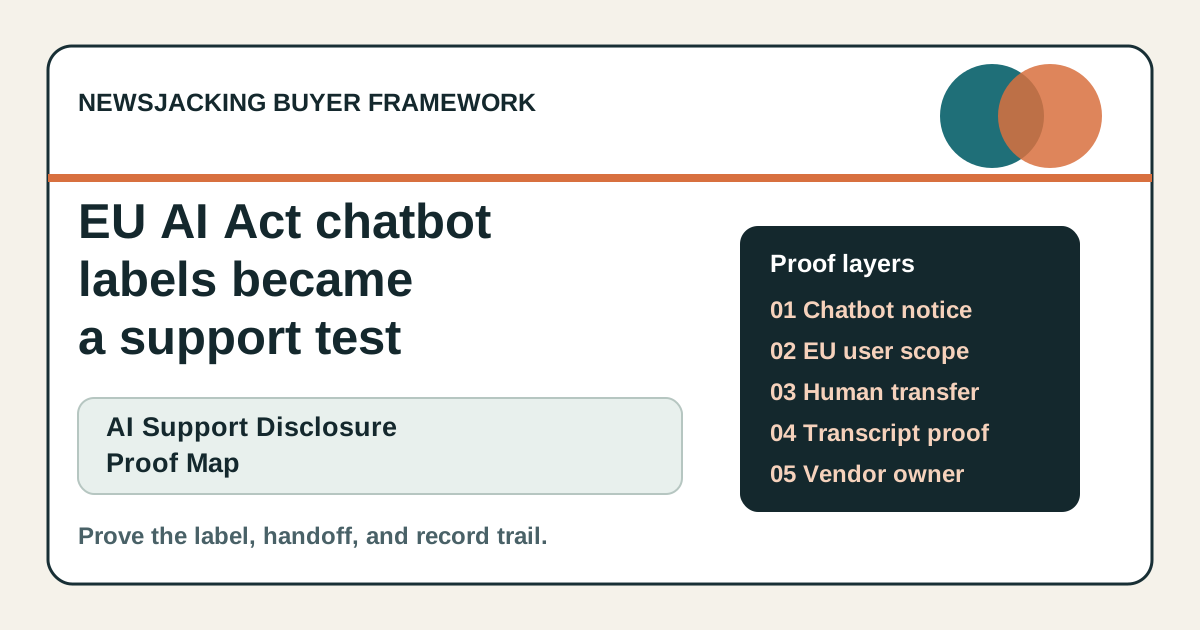
The practical answer is an AI Support Disclosure Proof Map. Before approving an AI support rollout, buyers should ask for evidence that the chatbot notice appears at the right moment, covers EU users, preserves transcript proof, supports human transfer, marks relevant AI-generated content, assigns vendor responsibility, and defines exceptions.
The lead image for this article is a synthetic representative editorial scene created for Remote Partners AI. It does not depict the European Commission, The Guardian, any real regulator, or any real customer-support incident.
What Happened
The European Commission’s Article 50 materials say the AI Act’s transparency obligations apply from August 2, 2026. The official guidance covers providers and deployers of certain AI systems, including generative and interactive systems. For customer support teams, the important line is direct interaction: when people interact with an AI system directly, they need to be informed that they are interacting with AI unless that fact is already obvious from context.
The Guardian independently reported that AI labels become compulsory for new systems from August 2, with existing systems given four months to adapt. The same coverage framed the rules as applying to AI-generated images, audio, video, text, and AI-powered chatbots, with fines possible for non-compliance.
That moves the discussion from AI ethics copy to production support evidence. A support chatbot that answers billing questions, triages cases, handles returns, schedules appointments, or summarizes a handoff needs more than a label in a mockup. It needs a tested operating rule.
Why It Is Trending
The story has momentum because Article 50 is one of the AI Act’s first broad customer-facing milestones. Buyers, vendors, ecommerce teams, travel platforms, support outsourcers, and agencies now need to turn a regulation into actual user-facing behavior.
It is also trending because many companies already use AI chat, AI search, AI triage, agent assist, and automated email drafting in support workflows. The hard question is not whether a disclosure line can be written. It is whether the disclosure survives real channel routing, localization, escalation, and vendor handoff.
For remote support buyers, the risk is operational. If the buyer owns the customer relationship, the vendor owns the helpdesk configuration, and an AI provider owns the agent UI, nobody can assume another party has the evidence.
The Remote Partners AI Take
Use an AI Support Disclosure Proof Map before launching or expanding customer-facing AI support.
| Proof layer | Buyer question | Evidence to request |
|---|---|---|
| Chatbot notice | Where does the customer learn they are interacting with AI? | Screenshot, copy, placement rule, language variants, timestamp, and channel map. |
| EU user scope | Which customers, regions, languages, domains, apps, and partner portals are in scope? | Geo and account routing, localization map, fallback rule, and release checklist. |
| Human transfer | What happens when a customer asks for a person or reaches a sensitive workflow? | Transfer triggers, queue owner, wait-time rule, transcript handoff, and refusal paths. |
| Transcript evidence | Can the buyer prove the disclosure appeared in the live conversation? | Logs, transcript marker, session ID, UI event, version history, and retention period. |
| Vendor ownership | Which party maintains the disclosure and monitors changes? | RACI, SLA, release notes, change approval, incident owner, and rollback path. |
| Content marking | Does the workflow generate or edit public-interest text, summaries, images, audio, or video? | Content inventory, marking rules, machine-readable marks where required, and review owner. |
Buyer Bridge
Do not ask only whether the AI support tool has a disclosure setting. Ask whether the live support workflow can prove the disclosure, preserve the record, and recover when a customer needs a human.
The first procurement question should be: “Show us where a customer sees that this is AI, and show us the transcript evidence after the conversation closes.” The second should be: “Show us who owns the disclosure if the helpdesk channel, language, vendor UI, or AI model changes.”
That turns Article 50 into a practical support checklist. Strong vendors can show production screenshots, logs, escalation rules, and update ownership. Weak vendors will point only to a policy page or a static demo.
Next Steps
- Inventory every customer-facing AI interaction across chat, email, messaging, portal search, appointment intake, returns, and helpdesk triage.
- Write a disclosure rule for each channel, including first-message placement, localization, accessibility, and human takeover state.
- Test EU user routing with real accounts, VPN-free geographic cases, multilingual flows, and embedded partner widgets.
- Require transcript evidence that records disclosure timing, AI-to-human handoff, refusal paths, customer request for a person, and version history.
- Assign vendor and buyer ownership for disclosure copy, UI placement, content marking, release changes, audit logs, and incident response.
- Use Remote Partners AI’s AI back-office workflow support, support coverage calculator, and contact intake to test whether the human operating layer is ready before rollout.
Buyer FAQs
- What changed on August 2, 2026 under the EU AI Act? - Article 50 transparency obligations started applying. Providers of interactive AI systems must inform people when they are directly interacting with AI, and deployers have related transparency duties for certain AI-generated or manipulated content.
- Why does this matter to support chatbot buyers? - Support chatbots, AI agents, and automated help flows can directly interact with customers. Buyers need proof that disclosure, user scope, human handoff, logs, and vendor responsibilities are ready before launch.
- What proof should buyers request first? - Request an AI Support Disclosure Proof Map covering notice wording, EU user routing, human transfer, transcript evidence, vendor ownership, AI content marking, and exception handling.
Sources
- European Commission - Official Article 50 FAQ explaining transparency obligations for providers and deployers, including direct interaction with AI systems.
- European Commission - Commission overview of Article 50 transparency obligations applying from August 2, 2026, including interactive AI systems and generative AI content.
- European Commission - July 2026 guidelines page for providers and deployers of AI systems under Article 50 of the AI Act.
- The Guardian - Independent July 31, 2026 coverage of EU AI label requirements, timing for new and existing systems, and potential fines.