AI Could Cut Half of Customer Service Jobs by 2030
This is not another vendor demo story. It is a workforce shock story: routine support work is being repriced, while complex exceptions still need accountable people.

Direct answer
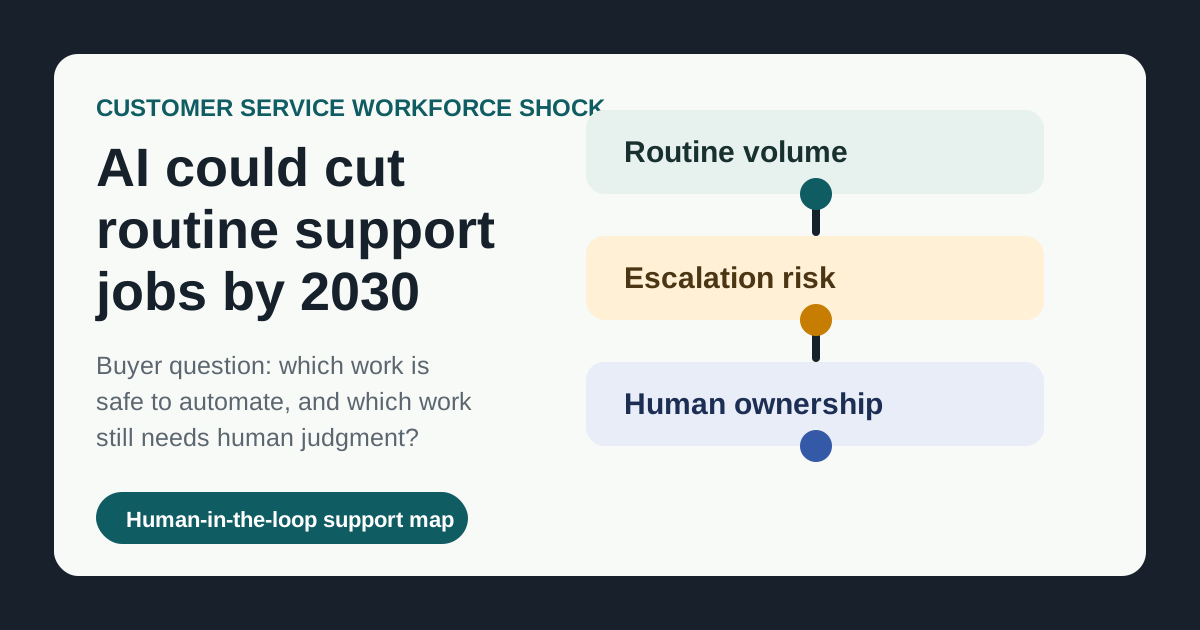
Forrester says AI could cause 49% of current customer service jobs to disappear by 2030. The impact is expected to be sharpest in high-volume, lower-complexity contact centers where many inquiries can be classified, answered, routed, summarized, or coached by AI.
That does not make a fully agentless support model safe. The practical change is that support work splits into two layers: automated routine handling and a smaller, more specialized human layer for judgment, escalation, customer value, QA, and relationship risk.
What happened
Forrester published analysis saying AI will reshape customer service work in dramatic ways, including a forecast that nearly half of current customer service jobs could disappear by 2030.
Customer Experience Dive covered the forecast on June 3, 2026, highlighting that high-volume contact centers handling lower-complexity cases are expected to face the greatest staff reductions. Its reporting also included a counterweight: Gartner expects many organizations planning severe AI-driven contact center cuts to scale those plans back by 2027.
The strongest read is not “humans are gone.” It is “routine volume is no longer enough to justify the old staffing model.”
Why this is trending
Customer service is one of the first places where AI automation has direct labor, cost, and customer-experience consequences. Leaders can see the math: if AI can answer routine questions, summarize calls, route tickets, draft replies, and coach agents, traditional staffing ratios start to change.
The tension is that customers do not experience averages. They experience the one broken order, missed appointment, account lockout, confusing bill, failed delivery, or angry escalation that does not fit the script.
That is why this story has bigger impact than a product launch. It affects hiring, outsourcing, support quality, training, customer trust, and the definition of what a support agent is paid to do.
The Remote Partners AI take
The wrong conclusion is to replace support people with automation wherever possible.
The better conclusion is to redesign the workflow so AI absorbs repeatable handling and trained people own the moments where mistakes are expensive.
For small businesses, the question is not whether AI will reduce some support labor. It will. The question is whether the business knows which work is safe to automate, which work should be outsourced to trained specialists, and which work must stay under direct human approval.
Human-in-the-Loop Support Redesign Map
Use this map before replacing, outsourcing, or automating a support workflow.
| Support layer | Best fit for AI | Human-owned risk | Planning question |
|---|---|---|---|
| Routine status | Order status, appointment reminders, simple policy answers, password reset routing | Wrong customer, stale data, missed exception | Is the source data accurate enough for AI to answer without creating rework? |
| Intake and triage | Classify intent, collect details, summarize context, route by urgency | Misrouted emergencies, angry customers, high-value accounts | Who reviews urgent, sensitive, or unclear cases before the next action? |
| First response | Draft replies, answer FAQs, quote documented policy, translate simple notes | Tone errors, unsupported promises, legal or pricing mistakes | Which statements need human approval before they reach the customer? |
| Escalation | Package transcript, sentiment, prior attempts, and next-step recommendation | Refunds, cancellations, complaints, safety, compliance | What exact trigger moves the customer to a trained person? |
| Relationship work | Prepare account history, summarize open issues, surface renewal or retention signals | Revenue loss, churn, reputation damage | Which customers deserve proactive human ownership even if AI can respond? |
| QA and coaching | Spot repeated failure patterns, summarize call outcomes, flag rework | False confidence from deflection metrics | Are you measuring customer outcome quality, not only labor reduction? |
What small businesses should do next
Start with the work, not the technology.
- List the top 20 customer intents by volume.
- Mark each intent as routine, judgment-heavy, sensitive, or revenue-sensitive.
- Identify which intents depend on accurate CRM, scheduling, order, billing, or ticket data.
- Decide which tasks AI may complete, which it may only prepare, and which it must escalate.
- Assign a human owner for every exception path.
- Track reopened cases, customer effort, complaint rate, transfer accuracy, and missed revenue.
If you are planning support coverage, use the support coverage calculator to estimate human capacity before moving routine work into automation.
The real takeaway
Forrester’s forecast is a warning against lazy support planning.
AI may reduce the need for large teams handling repetitive work, but it increases the need for clean process design, trusted data, escalation rules, QA, and people who can handle the cases customers remember.
The companies that win will not be the ones that cut the fastest. They will be the ones that know exactly where AI should stop.
Buyer FAQs
- What did Forrester predict about customer service jobs? - Forrester predicted that AI could cause 49% of current customer service jobs to disappear by 2030 as routine inquiries, coaching, scheduling, and lower-complexity support work become more automated.
- Does this mean every support team should cut headcount now? - No. The forecast points to role redesign, not a simple layoff plan. High-volume routine work is most exposed, while complex, emotional, regulated, and revenue-sensitive work still needs trained people.
- What support work should remain human-owned? - Complaints, exceptions, retention, refunds outside policy, complex troubleshooting, sensitive accounts, high-value customers, and any decision that affects money, access, safety, or trust should remain human-owned.
- What should small businesses do first? - Map support work by intent, risk, volume, data quality, and escalation ownership before outsourcing or automating more coverage.
Sources
- Forrester analysis - Primary analyst source for the 49% customer service job displacement forecast and the role changes Forrester expects.
- Customer Experience Dive coverage - Independent coverage of the forecast, including context on high-volume contact centers and Gartner's caution that large headcount cuts are not yet the norm.
- Customer Experience Dive workforce context - Broader contact center workforce context on AI, agentless claims, and why human roles remain necessary for complex service work.