G2 Says AI Support Agents Still Have a Proof Gap
The news hook is G2's July 31, 2026 analysis of 7,900-plus AI agent, chatbot, helpdesk, contact-center, and live-chat reviews. G2 reported middling category-level scores for AI agents for customer support, including 6.36 out of 10 for ease of use, 6.34 for meeting requirements, and 6.26 for quality of support. Customer Experience Dive separately reported Gartner survey findings that contact-center leaders are expanding human responsibilities while some also plan AI-linked layoffs. The buyer issue is practical: support AI should not be judged by demo fluency alone. Buyers need review-backed proof for workflow fit, setup effort, vendor support, human handoff, data readiness, QA, and outcome evidence.

Direct Answer
G2’s July 2026 support-agent review analysis is a buyer-risk signal. If review data shows AI agents for customer support scoring only 6.36 out of 10 for ease of use, 6.34 for meeting requirements, and 6.26 for quality of support, buyers should not approve an AI support rollout from a fluent demo alone.
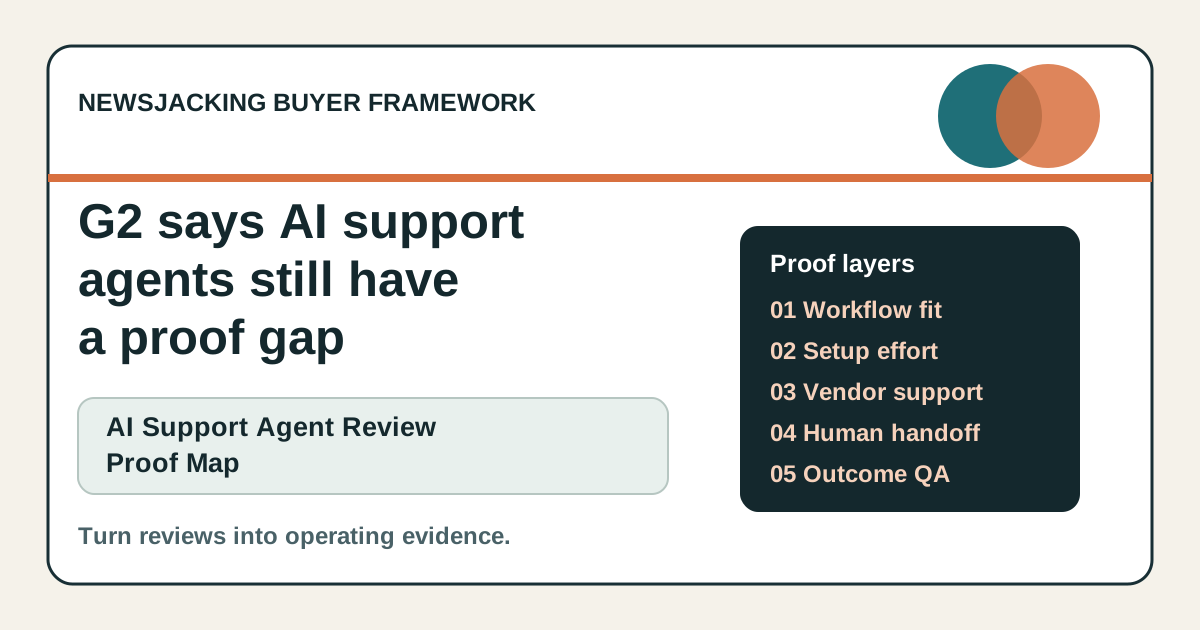
The practical answer is an AI Support Agent Review Proof Map. Use review friction to ask for operating proof: workflow fit, setup effort, integration quality, vendor support, human handoff, data readiness, QA sampling, and outcome reporting.
The lead image for this article is a synthetic representative editorial scene created for Remote Partners AI. It does not depict G2, Gartner, Customer Experience Dive, TechTarget, or any real customer-support incident.
What Happened
G2 published a July 31, 2026 analysis of more than 7,900 reviews across AI agent, chatbot, helpdesk, contact-center, and live-chat software categories. The buyer-relevant finding is not that AI support agents are unusable. The finding is that the review evidence still points to friction in the categories buyers care about most.
G2 reported category-level scores for AI agents for customer support of 6.36 out of 10 for ease of use, 6.34 for meeting requirements, and 6.26 for quality of support. Those numbers matter because customer support is not a sandbox. Support teams need reliable setup, clear routing, accurate answers, escalation ownership, and vendor help when the workflow breaks.
Customer Experience Dive separately reported Gartner survey findings that many contact-center leaders using AI are expanding human responsibilities, while a meaningful share have already implemented or plan AI-linked layoffs. That creates a procurement tension: AI support is moving into production, but human coverage and vendor proof still determine whether it works.
Why It Is Trending
The story has momentum because it turns AI agent hype into review-backed buyer diligence. Many support teams are past the question of whether AI can answer a simple customer question. The harder question is whether the tool fits the messy operating layer: integrations, stale knowledge, agent coaching, returns, billing disputes, angry customers, language coverage, supervisor review, and recovery.
It also arrives after a week of AI support labor and contact-center stories. Buyers are being asked to approve automation savings, but the review signal says the implementation experience is uneven. That makes review proof useful, not merely anecdotal.
For remote support buyers, the risk is amplified. If the buyer, vendor, and outsourced support team all assume the AI agent will absorb routine work, the human team may inherit only exceptions without enough context, authority, or staffing.
The Remote Partners AI Take
Use an AI Support Agent Review Proof Map before choosing, renewing, or expanding a support AI tool.
| Proof layer | Buyer question | Evidence to request |
|---|---|---|
| Workflow fit | Which support intents, channels, languages, and customer tiers are actually covered? | Intent map, excluded-intent list, sample transcripts, routing rules, and acceptance criteria. |
| Setup effort | What does implementation require beyond the demo? | Configuration plan, integrations, knowledge cleanup, sandbox proof, launch timeline, and named owner. |
| Vendor support | What happens when the support AI breaks or misroutes customers? | Support SLA, escalation path, account owner, incident process, release notes, and rollback procedure. |
| Human handoff | When does a person take over? | Transfer triggers, supervisor queue, after-hours rule, customer request rule, and callback SLA. |
| Data readiness | Which knowledge, CRM, helpdesk, order, billing, and policy sources feed the agent? | Source inventory, freshness checks, field exclusions, attachment handling, and data owner. |
| Outcome QA | How does the buyer know the agent improved support? | Containment, reopens, repeat contacts, complaints, transfer defects, QA samples, and recovery cost. |
Buyer Bridge
Do not ask only whether an AI support agent can answer questions. Ask whether the provider can prove where it fits, where it fails, who supports it, and what happens when customers need a person.
The first procurement question should be: “Show us the review friction you have solved in deployments like ours.” The second should be: “Show us the handoff and recovery evidence when the agent misses, escalates, or frustrates a customer.”
That turns review scores into an operating checklist. A strong vendor can explain setup work, support expectations, data readiness, QA thresholds, and post-launch evidence. A weak vendor will talk mostly about automation rate and demo answers.
Next Steps
- Read recent reviews for the exact category and use case, then tag complaints by ease of use, requirements fit, support quality, integrations, and accuracy.
- Build an intent map for the first 60 to 90 days of support automation, including human-only and refuse paths.
- Require implementation proof for helpdesk, CRM, knowledge, order, billing, and contact-center integrations before launch.
- Set human handoff rules for disputes, refunds, cancellations, safety, fraud, accessibility, VIPs, regulated contacts, and unclear requests.
- Track containment alongside reopens, repeat contacts, complaints, bad summaries, transfer defects, and supervisor corrections.
- Use Remote Partners AI’s AI back-office workflow support, support coverage calculator, and contact intake to test whether the human operating layer is strong enough before rollout.
Buyer FAQs
- What did G2 report about AI agents for customer support? - G2 analyzed more than 7,900 reviews across AI agent and customer-support software categories and reported middling category-level scores for AI agents for customer support, including ease of use, meeting requirements, and quality of support.
- Why should support buyers care about review scores? - Review scores can reveal where demos do not match operating reality. Buyers should use them to ask for proof of workflow fit, setup effort, vendor support, handoff quality, data readiness, QA, and outcomes.
- What should buyers request before deploying AI support agents? - Request a proof map covering the supported intents, excluded work, implementation plan, integration evidence, vendor support SLA, human escalation rules, QA samples, data sources, and post-launch outcome reporting.
Sources
- G2 - July 31, 2026 analysis of more than 7,900 AI agent, chatbot, helpdesk, contact-center, and live-chat reviews, including category-level scores for AI agents used in customer support.
- Customer Experience Dive - Coverage of Gartner survey findings on contact-center workforce redesign, including expanded human responsibilities and AI-linked layoff plans.
- TechTarget SearchCustomerExperience - Independent context on AI layoffs and contact-center risk as leaders move support automation into customer operations.