Gartner's AI Rehire Warning: Remote Support Remix Map
Gartner's September 2026 future-of-work warning turns support automation into a buyer staffing question: which human judgment should be retained, reassigned, or added before cuts go too deep?

Direct Answer
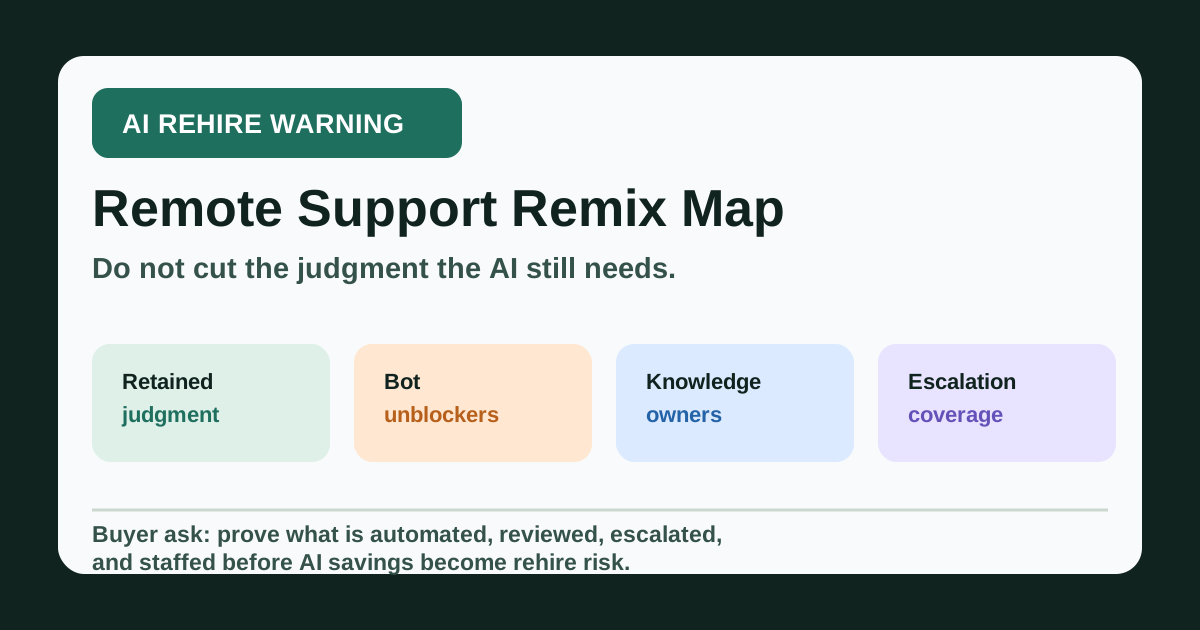
Gartner’s September 2026 AI rehire warning is a practical buying prompt for remote support: do not accept an automation savings model until the provider shows what happens to the human judgment that used to live in the queue. Ask for a Remote Support Remix Map that separates automatable work from retained review, bot-unblocking, knowledge ownership, QA sampling and escalation coverage.
Remote Partners AI is the marketing partner of Azpired. Azpired confirms, contracts, and delivers selected services. This article is a planning framework based on public reporting; it is not a client outcome or staffing guarantee.
What Happened
Gartner said on September 9, 2026, that by 2029, 30% of employees laid off because of AI replacement will need to be rehired, often at a significantly higher cost. Gartner framed the issue as a future-of-work shift: organizations that treat AI only as cost cutting can deplete talent pipelines and institutional knowledge just as AI work becomes more dependent on human context.
CX Dive reported on September 11 that Gartner sees customer service as a bellwether for the broader trend. The article highlighted several reasons organizations may need staff back: AI solutions that fail to deliver, cost assumptions that miss ongoing work, and support responsibilities that no longer align after cuts. It also reported Gartner commentary that service and support organizations have already spent heavily on AI while many use cases show negative, positive or unclear value rather than predictable savings.
TechRadar’s independent coverage made the same buyer-facing point: Gartner is urging companies to redesign how people and AI work together, not simply remove roles and hope the model fills the gap.
Why It Is Trending
Customer support is one of the first places executives expect AI savings. It is also where the missing work becomes visible quickly: policy exceptions, refund judgment, billing disputes, account access, angry customers, multilingual nuance, data cleanup, knowledge-base gaps and escalations that need a human owner.
That makes AI staffing plans a due-diligence issue for remote support buyers. A lower seat count can be real savings, but only if the remaining operating model still has coverage for judgment, quality, training, escalation and recovery.
The Remote Partners AI Take
The buyer question is not “can AI reduce tickets?” The better question is “which work changes hands, and who owns the parts AI cannot safely finish?”
| Support work | Before cutting seats | Remix role to prove | Evidence to request |
|---|---|---|---|
| Simple status replies | Confirm the answer comes from a current source | AI-supervised frontline agent | Source-link sampling and rejected-draft examples |
| Policy exceptions | Identify where the policy needs judgment | Senior support reviewer | Exception matrix and approval notes |
| Broken bot flows | Track where automation stalls customers | Bot unblocker | Escalation reasons, backlog age and recovery notes |
| Knowledge gaps | Assign ownership for missing or stale answers | Knowledge manager | Update log, article owner and review cadence |
| Quality risk | Keep a human eye on customer harm signals | QA reviewer | Scorecards, callouts and correction examples |
| High-impact actions | Limit what AI can approve or change | Escalation owner | Refund, access, cancellation and security approval rules |
Worked Example
Suppose a software company wants to reduce a 12-person support queue after adding AI reply drafting. A weak plan says eight agents can now handle the same volume. A stronger plan shows:
- Which ticket types are safe for AI-drafted replies.
- Which ticket types require human approval before sending.
- Which queues get a bot unblocker when customers loop or stall.
- Which person owns the knowledge base behind AI answers.
- Which quality signals trigger extra staffing, training or rollback.
The second plan gives the buyer a way to monitor risk. It also makes future rehiring less chaotic because the trigger points are defined before service quality slides.
Buyer Bridge
Use Gartner’s warning as a provider-screening question: “If AI savings depend on role redesign instead of simple replacement, show us the redesigned operating model.”
Good answers include task categories, AI permissions, retained judgment, named reviewers, knowledge owners, QA evidence, escalation paths and cost assumptions. Weak answers stay at the level of “our agents use AI” or “automation will reduce headcount.”
Next Steps
- Pick three support queues where bad AI output could affect money, trust, access or retention.
- Ask each provider to classify the queue as automate, draft, review, escalate or human-only.
- Require the provider to name the bot unblocker, knowledge owner and QA reviewer for those queues.
- Define rehire or surge-coverage triggers before launching the reduced-staffing model.
For sourcing or delivery questions, contact Remote Partners AI and Azpired through the public contact form or the email listed on this site.
Buyer FAQs
- Why is Gartner's AI rehire warning relevant to remote support buyers? - It shows that AI-driven cost cuts can remove knowledge, judgment and escalation capacity that buyers still need. Remote support proposals should show which human roles remain, which are redesigned, and which new roles support AI quality.
- What should a buyer request before accepting AI-driven support savings? - Ask for a support remix map covering task inventory, retained human judgment, AI supervision, knowledge ownership, QA sampling, escalation coverage, cost assumptions and rehire triggers.
- Does Remote Partners AI directly deliver the contracted services? - Remote Partners AI is the marketing partner of Azpired. Azpired confirms, contracts, and delivers the services a buyer selects.
Sources
- Gartner - September 9, 2026 press release predicting that by 2029, 30% of employees laid off due to AI replacement will need to be rehired, often at a significantly higher cost.
- CX Dive - September 11, 2026 coverage applying Gartner's rehire warning to customer service, including failed AI delivery, cost miscalculation, unclear ROI and new support roles.
- TechRadar - Independent September 10, 2026 coverage summarizing Gartner's view that human-AI collaboration and role redesign matter more than simple automation.