Google Dialogflow's Rogue Agent Flaw Made AI Support Continuity a Proof Test
Varonis disclosed a Dialogflow CX flaw it calls Rogue Agent after Google patched it. The buyer issue is not whether one patched bug is scary. It is whether AI customer-support agents have isolation, permission review, prompt-change logs, conversation-data controls, and human recovery when an agent workflow is compromised.

Direct answer
The Dialogflow CX Rogue Agent disclosure is a buyer proof test for AI customer support. Google patched the flaw and public reports say there is no evidence it was exploited, but the attack path is exactly the kind of operational risk support buyers need to validate: who can change an agent, what data an agent can see, whether agents are isolated, and who recovers customers if an AI workflow is compromised.
Do not treat the story as a reason to abandon AI support. Treat it as a reason to require continuity evidence before putting AI agents near customer conversations, CRM records, refunds, bookings, health questions, finance workflows, or outsourced support queues.
What happened
Varonis disclosed a Dialogflow CX vulnerability it calls Rogue Agent on July 7, 2026. The research focused on Dialogflow CX Playbooks and Code Blocks, where an agent with update permissions could be manipulated in ways that affected other Code Block-enabled agents in the same Google Cloud project.
Independent coverage from Axios, The Hacker News, and Dark Reading reported that Google patched the issue and found no evidence of exploitation. Dark Reading also reported that Varonis disclosed the issue to Google in late 2025 and that the remediation happened in stages.
The important buyer detail is not the brand name. It is the failure mode: an AI support workflow can become risky when update permissions, executable blocks, conversation data, and neighboring agents are not isolated and reviewed.
Why this is trending
The story is spreading because enterprises are moving customer service, triage, FAQs, booking, billing support, and internal support copilots into agentic systems while the security model is still becoming legible to buyers.
Most support leaders can ask how many tickets an AI agent deflects. Fewer can ask which role can update the agent, whether playbook changes are logged, which transcripts are exposed, whether code execution is enabled, or whether a compromised support agent can affect another workflow.
That gap matters because customer support is not a harmless sandbox. It contains identity hints, customer frustration, refund requests, account recovery paths, regulated questions, and escalation context.
The Remote Partners AI take
The wrong reaction is “Google patched it, move on.”
The better reaction is to convert the disclosure into a support continuity audit. If an AI agent is allowed to answer customers, collect information, write to a CRM, trigger a workflow, or hand off to an outsourced team, the buyer needs proof that the agent can be constrained and recovered.
Remote support teams can help because humans are still the recovery layer. They can review failed sessions, reconcile CRM records, call back customers, repair bad handoffs, and watch for abuse patterns. But the support partner needs a clear scope, not vague instructions to “watch the bot.”
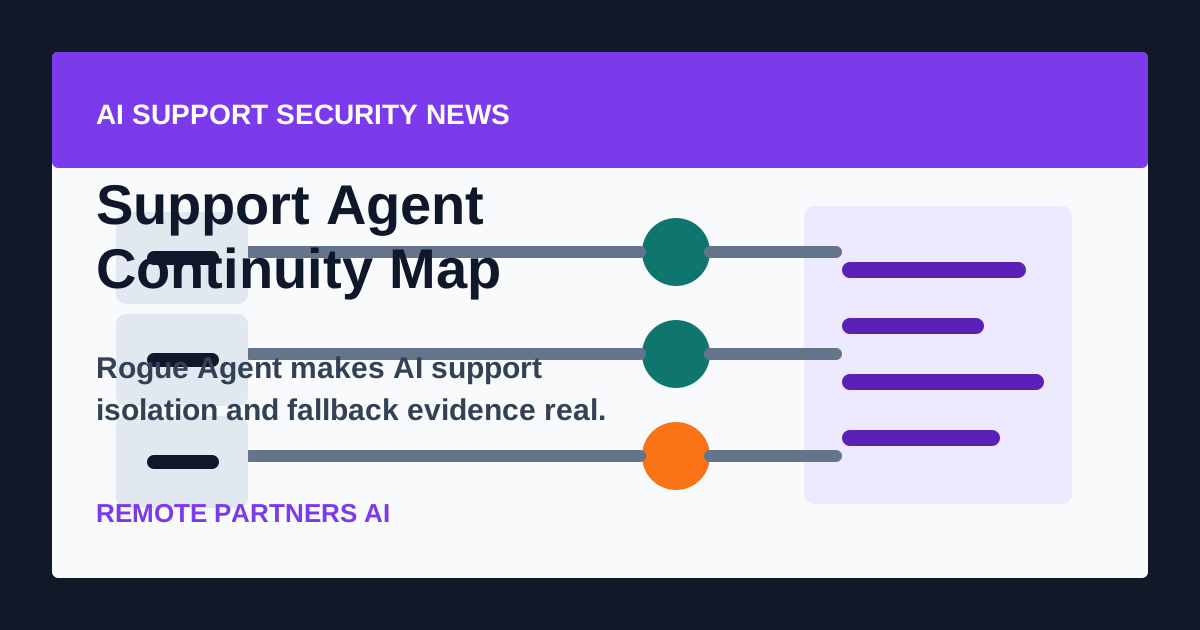
AI Support Agent Continuity Map
Use this map before launching or expanding an AI support agent that touches live customer work.
| Control layer | Buyer question | Weak signal | Evidence to require |
|---|---|---|---|
| Agent inventory | Which agents, playbooks, tools, channels, and support partners touch customer conversations? | AI agents are tracked as experiments, not as production support assets. | Inventory with owner, channel, data scope, tool actions, vendor, environment, and support escalation path. |
| Least privilege | Who can update the agent or give it new tools? | Broad admin roles can edit playbooks, prompts, code blocks, or connectors without change review. | Role list, approval flow, production change log, separation of duties, and emergency rollback owner. |
| Agent isolation | Can one agent or project affect another support workflow? | Sales, support, billing, and internal test agents share permissions or project boundaries. | Project/environment map, isolation rationale, tenant boundary, test-vs-production split, and dependency list. |
| Code and tool controls | Can the agent execute code or trigger external actions? | Code Blocks or tool actions are enabled without a risk tier, test record, or output review. | Allowed-action list, blocked-action list, secrets handling, execution logs, test cases, and owner signoff. |
| Conversation-data scope | Which transcripts and customer fields can be read or exported? | The AI vendor, agents, and outsourced team all have broader access than the workflow needs. | Transcript access policy, retention rule, export controls, redaction, audit logs, and outsourced access limits. |
| Human recovery | Who fixes customer impact after an AI failure or security event? | Security says support owns customers, while support says the vendor owns the bot. | Recovery queue, callback script, escalation matrix, customer-impact report, and weekly failure review. |
What buyers should do next
- List every AI support agent, voice agent, chatbot, copilot, prompt workflow, and code-enabled playbook in production or pilot.
- Match each one to the customer data it can see, the tools it can invoke, and the people who can change it.
- Require a production change log for prompts, playbooks, tool permissions, and code blocks.
- Separate high-risk support workflows from routine FAQ automation where possible.
- Add human recovery queues for failed handoffs, suspicious conversations, transcript review, and customer callbacks.
- Use the support coverage calculator before reducing human coverage behind an AI support workflow.
- If you need a recovery layer, review AI back-office workflow support and make exception ownership part of the scope.
The real takeaway
The Rogue Agent story is not a reason to treat every AI support platform as unsafe. It is a reason to stop treating AI support as a pure deflection metric.
If an AI agent can touch customers, it needs the same operating discipline as any production support system: limited permissions, isolated scope, reviewed changes, logged access, named recovery owners, and evidence that customers are made whole when automation fails.
Buyer FAQs
- Was the Dialogflow CX Rogue Agent flaw reportedly exploited? - The public reports say Google patched the vulnerability and found no evidence of exploitation. Buyers should still use the disclosure as a continuity test because the failure mode touches customer conversations, agent permissions, and cross-agent control.
- Why does this matter to customer-support buyers? - Customer-service AI agents often sit near CRM records, transcripts, identity questions, escalation notes, and refund or booking workflows. A patched bug is still a reminder that buyers need permission scope, change logs, isolation, and human recovery before relying on AI support.
- What proof should an AI support vendor or outsourcing partner provide? - Ask for least-privilege roles, agent/project isolation, code execution controls, prompt and playbook change logs, transcript access limits, security review, escalation owners, rollback steps, and weekly evidence that failed AI interactions are recovered by trained humans.
- Can outsourced support reduce this risk? - Yes, if the outsourced team owns monitored exception queues, human fallback, transcript review, customer recovery, and escalation reporting. Outsourcing does not help if the AI agent, vendor, and support team do not share a visible recovery contract.
Sources
- Varonis - Varonis disclosed the Dialogflow CX Rogue Agent vulnerability on July 7, 2026, describing how excessive playbook update permissions and Code Blocks could let a malicious agent access conversations and manipulate other agents in the same project.
- Axios - Independent July 7 reporting that Google patched the flaw, with no evidence of exploitation, while companies adopt customer-service AI faster than many security reviews mature.
- The Hacker News - Independent security coverage of the flaw's potential to compromise Code Block-enabled agents in the same Google Cloud project and expose conversations.
- Dark Reading - Independent coverage noting Varonis reported the issue in late 2025, Google patched it in stages, and no customer action was required after the fix.