Google Workers Made AI Layoff Protections a Support Coverage Test
The Guardian reported that Google workers delivered a petition calling for job-security protections as the company invests heavily in AI, while the Alphabet Workers Union says more than 4,500 Googlers have signed demands around layoffs, buyouts, redeployment, and worker input on AI. The buyer issue is not Google's internal employment policy. It is whether any AI-assisted support operation can prove what work is removed, which human coverage remains, who owns failed automation, and how recovery is reported before headcount or vendor hours are reduced.

Direct answer
Google workers’ July 2026 petition turns AI workforce pressure into a support coverage proof test. The Guardian reported that workers delivered a petition calling for protections against layoffs as Google increases AI investment. The Alphabet Workers Union says more than 4,500 Googlers signed demands for job-security commitments, including advance notice, voluntary buyouts, redeployment options, and worker input on AI.
For support buyers, the important question is not Google’s labor policy. The practical question is whether any company using AI to reduce work can prove who still owns the customer when automation, lower headcount, or reduced vendor hours removes routine support capacity.
The lead image for this article is a synthetic representative editorial scene, not a photo of Google workers or the petition delivery.
What happened
The Guardian reported on July 16, 2026 that Google workers delivered a petition asking the company to commit to layoff protections as AI investment and automation reshape the workforce conversation.
The Alphabet Workers Union’s job-security campaign page says more than 4,500 Googlers have signed demands for worker input on AI, no layoffs tied to AI or funding AI, voluntary buyouts before layoffs, redeployment options, and advance notice.
Business Insider’s updated 2026 layoff tracker shows the wider market context: AI and automation remain recurring themes in workforce cuts, restructuring, and hiring resets across major employers.
Why this is trending
The story combines three issues buyers already see in support operations: pressure to use AI, pressure to reduce labor cost, and growing worker concern that automation will remove jobs without a visible transition plan.
That tension matters because support coverage is fragile. A company can automate summaries, intake, routing, triage, status updates, password resets, ticket classification, and standard answers. It still needs accountable humans for exceptions, angry customers, urgent callbacks, compliance-sensitive cases, bad AI output, language gaps, and manual repair.
The weak version of AI support measures only hours removed. The buyer-grade version proves what remains covered.
The Remote Partners AI take
AI should remove repetition, not ownership.
Before a buyer accepts an AI savings plan, the vendor or internal team should show exactly what work is being removed, which human coverage remains, how failed automation is escalated, which vendors or contractors are affected, how AI output is sampled, and how recovery work is reported beside savings.
That turns a layoff or automation headline into an operating proof standard.
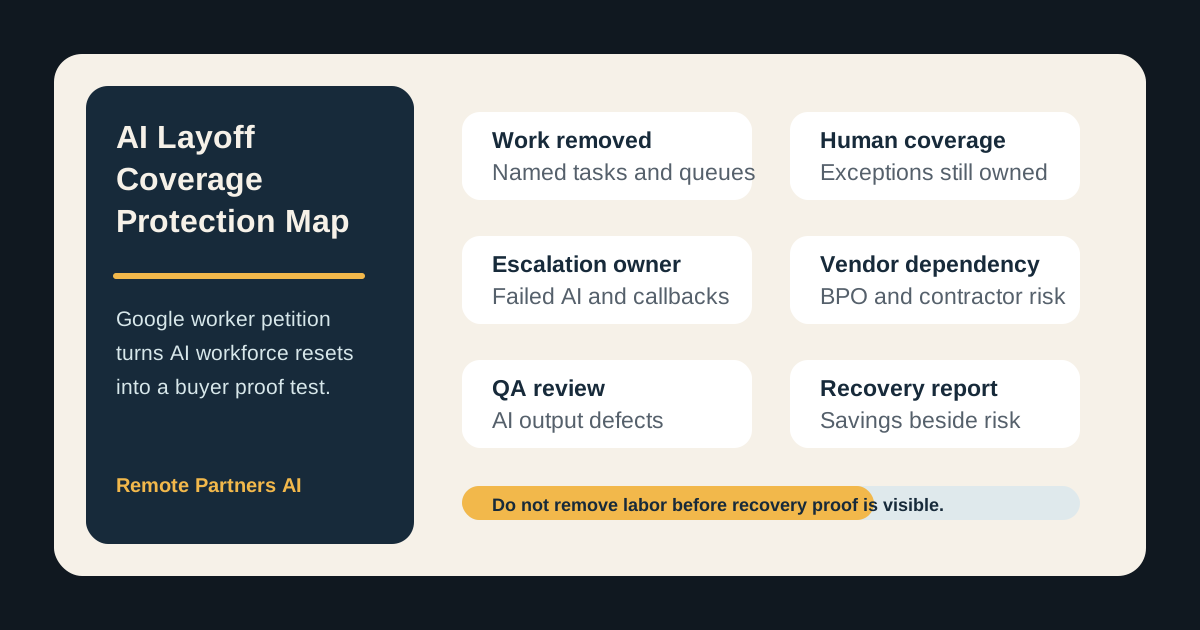
AI Layoff Coverage Protection Map
Use this map before approving AI-driven staffing resets, outsourced support redesigns, contractor reductions, vendor-hour cuts, or internal support headcount changes.
| Proof layer | Buyer question | Weak signal | Evidence to require |
|---|---|---|---|
| Work removed | Which exact tasks, queues, intents, ticket types, or vendor activities are expected to need fewer human hours? | The team reports automation rate without naming the work removed. | Intent map, ticket sample, volume baseline, staffing model, excluded case list, and owner for each removed task. |
| Retained coverage | Which customer paths still require trained humans after AI handles repeatable work? | The plan assumes fewer people can absorb exceptions informally. | Queue roster, escalation hours, language coverage, callback owner, exception tags, and manual repair plan. |
| Failed-automation owner | Who owns the customer when the AI path fails, the caller asks for a person, or a case becomes sensitive? | Escalation exists in the tool, but no team owns the final outcome. | Named owner, transfer test, callback SLA, context handoff, complaint route, and failed-handoff review. |
| Vendor dependency | Which contractors, BPO queues, offshore teams, or third-party tools are reduced or relied on more heavily? | Vendor hours shrink without showing queue impact or replacement coverage. | Vendor role map, queue dependency list, access rights, backup staffing, and transition evidence. |
| QA review | How are AI summaries, resolutions, translations, classifications, and suggested responses checked after launch? | QA samples only human-agent work or only measures containment. | AI-output samples, correction log, language review, reopen analysis, and weekly defect report. |
| Recovery reporting | Are savings reported beside customer recovery work and manual repairs? | Leadership sees reduced hours but not complaints, reopens, bad summaries, and missed callbacks. | Weekly report with AI volume, reduced hours, escalations, reopens, complaints, manual fixes, callbacks, and final outcomes. |
What buyers should do next
- Choose the workflow where AI or cost reduction is expected to remove the most human work.
- List the tasks, queues, vendors, and ticket types expected to shrink.
- Separate cases that still need judgment, empathy, authority, language review, or compliance review.
- Name the team that owns failed AI sessions, bad summaries, urgent callbacks, reopens, and customer complaints.
- Require weekly reporting that puts automation savings and recovery work on the same page.
- Use the support coverage calculator before reducing hours or moving work to automation.
- If you need human coverage around AI workflows, review AI back-office workflow support and include recovery reporting in the scope.
The real takeaway
Google workers’ petition makes the buyer question sharper: if AI and cost targets reduce visible labor, can the support operation still prove who owns the customer when automation fails?
Do not approve an AI support staffing reset until the retained coverage and recovery map is visible.
Buyer FAQs
- What did Google workers do? - The Guardian reported that Google workers delivered a petition calling for layoff protections as Google invests heavily in AI. The Alphabet Workers Union says more than 4,500 Googlers signed related job-security demands.
- Why does this matter to support outsourcing buyers? - AI-related workforce pressure creates a practical coverage question: if routine work, vendor hours, or internal roles shrink, who still owns exceptions, escalations, QA defects, callbacks, and customer recovery?
- Should buyers reject AI support automation? - No. Buyers should require evidence that automation removes repeatable work without removing accountability for failed sessions, sensitive customers, language gaps, and manual recovery.
- What proof should buyers ask for? - Ask for a work-removal inventory, retained human coverage map, failed-automation owner, vendor dependency list, AI-output QA sample, and recovery report that shows savings beside reopens, complaints, and callbacks.
Sources
- The Guardian - July 16, 2026 reporting on Google workers delivering a petition for layoff protections as Google expands AI investment and automation.
- Alphabet Workers Union - Union campaign page stating that more than 4,500 Googlers signed demands around layoff protections, buyouts, redeployment, and worker input on AI.
- Business Insider - Updated 2026 layoff tracker showing AI and automation remain active workforce themes across large employers.