IKEA's AI Retraining Push Made Support Coverage a Buyer Test
The news hook is renewed customer-experience coverage of IKEA's Billie chatbot and the retailer's decision to retrain roughly 8,500 call-center employees as higher-value support and remote interior-design advisors instead of treating routine automation as simple headcount removal. CX Today reported on August 3, 2026 that Billie could assist 47% of customers using the tool in its first two years and that Fortune reported the figure had risen to 74%. Fortune's July 30 Global 500 coverage framed the model as a bet that human interaction can become a revenue driver after AI absorbs routine service. Employer Branding News separately reassessed the case after 2026 IKEA restructuring notices, warning buyers not to turn a good redeployment story into a simplistic no-layoffs myth. The buyer issue is practical: AI support automation needs proof for bot boundaries, human destination roles, retraining, queue coverage, revenue contribution, and recovery loops before routine work disappears.

Direct Answer
IKEA’s Billie chatbot story is trending again because it gives buyers a concrete alternative to the usual AI-support layoff headline. CX Today reported on August 3, 2026 that IKEA retrained roughly 8,500 call-center employees as Billie handled routine inquiries, with the bot assisting 47% of customers using the tool in its first two years and Fortune reporting a higher current share.
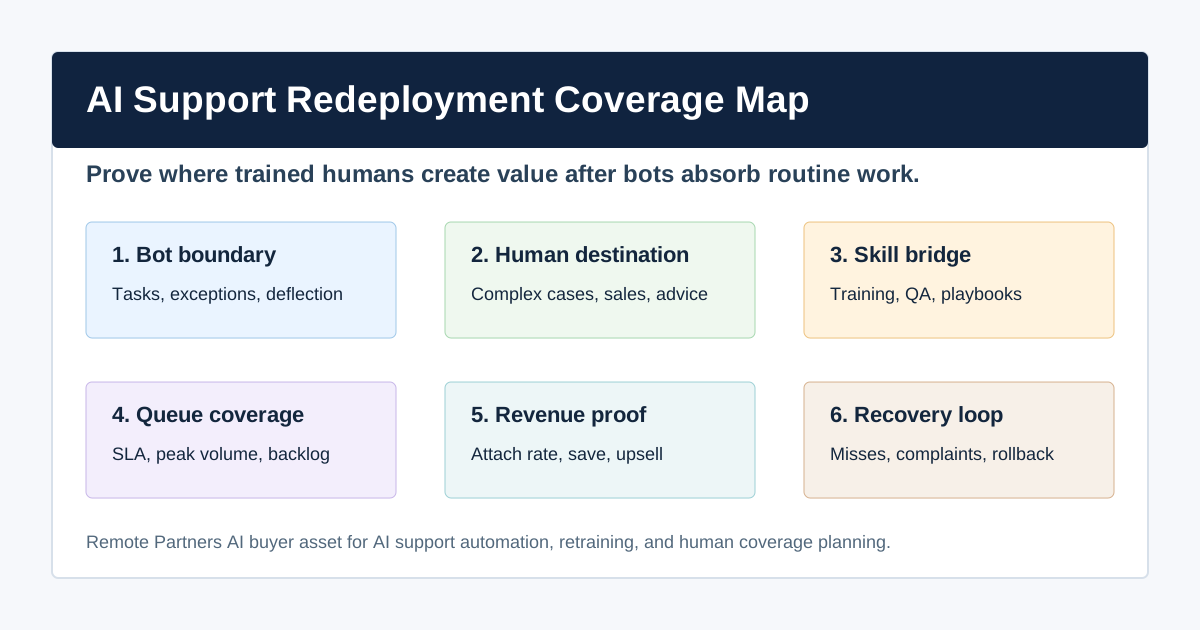
The buyer answer is an AI Support Redeployment Coverage Map. Before approving AI support automation, buyers should require proof for the bot boundary, the human destination role, training and QA, queue coverage, revenue contribution, and recovery metrics.
The lead image for this article is a synthetic representative editorial scene created for Remote Partners AI. It does not depict IKEA, CX Today, Fortune, Employer Branding News, any real employee, or any real customer incident.
What Happened
CX Today reported that IKEA’s AI-powered Billie chatbot took on routine service questions such as order updates, stock checks, and returns while the company retrained roughly 8,500 call-center employees for more complex service and remote interior-design sales work.
Fortune’s July 30, 2026 Global 500 coverage framed the case as a broader bet: if AI absorbs repetitive service work, human interaction can become a revenue driver rather than only a cost center.
Employer Branding News separately reassessed the case after 2026 restructuring notices at IKEA-related entities. Its useful warning for buyers is that the original redeployment story can be true while still being misused as a simplistic claim that AI automation never creates workforce pressure.
Why It Is Trending
The story has momentum because it sits between two louder narratives. One says AI will simply remove service jobs. The other says AI will magically free humans for better work. IKEA’s example forces a better question: what proof shows that human capacity was actually redirected into higher-value customer coverage?
That question matters to support buyers because automation can make dashboards look better while customers feel worse. If routine issues are deflected but complex cases, exceptions, returns, complaints, urgent orders, and handoffs are not staffed, the support operation becomes thinner even if the bot containment rate rises.
The Remote Partners AI Take
Use an AI Support Redeployment Coverage Map before treating support automation as a staffing win.
| Proof layer | Buyer question | Evidence to request |
|---|---|---|
| Bot boundary | Which customer questions can AI resolve without harming trust or policy accuracy? | Intent list, refusal rules, escalation examples, knowledge-source map, and containment QA. |
| Human destination | What work do trained humans own after routine questions move to AI? | Role map, complex-case queues, consultative support tasks, recovery owner list, and staffing plan. |
| Skill bridge | How are agents retrained for higher-value customer work? | Training roster, playbooks, certification rules, QA samples, coaching notes, and ramp timeline. |
| Queue coverage | Can coverage hold during peak volume, exceptions, backlog, and bot failure? | SLA baseline, schedule matrix, backlog triggers, handoff queue, and after-hours coverage plan. |
| Revenue proof | Does redeployment create measurable service or sales value? | Design-advice bookings, saved orders, attach rate, customer satisfaction, and repeat-contact data. |
| Recovery loop | What happens when AI containment hides unresolved customer demand? | Complaint tags, reopened-case report, failed-handoff review, rollback threshold, and weekly owner review. |
Buyer Bridge
Do not ask only whether an AI support bot can answer routine questions. Ask what the support team becomes when those questions leave the human queue.
Strong providers can show the new human role, not just the bot demo. They can prove which issues AI resolves, where it hands off, how agents are retrained, how coverage works during spikes, how consultative or recovery work is measured, and what gets rolled back when customer signals deteriorate.
Weak providers will show deflection rate first and discover the human coverage gap later.
Next Steps
- Inventory the top routine intents, complex exceptions, policy-sensitive cases, complaints, returns, and urgent customer requests before automation expands.
- Write the bot boundary in operational language: allowed answers, blocked answers, data access, escalation triggers, and quality review.
- Define the destination role for human agents after AI containment, including complex support, advice, save work, revenue support, and customer recovery.
- Require retraining proof with completion records, QA samples, coaching loops, and supervisor signoff.
- Track SLA, backlog, reopened cases, repeated contact, complaints, customer satisfaction, sales-assisted outcomes, and rollback triggers.
- Use Remote Partners AI’s AI back-office workflow support, support coverage calculator, and contact intake to pressure-test the human layer before automation changes staffing.
Buyer FAQs
- What is the IKEA AI support story? - Recent CX and business coverage revisited IKEA's Billie chatbot and the retraining of roughly 8,500 call-center workers into higher-value support and remote design-advice roles after routine inquiries moved to automation.
- Why does this matter to remote support buyers? - The story shows that AI support automation is not just a cost-cutting decision. Buyers need to know where customers go when routine questions are automated, what humans are retrained to do, and how coverage is measured.
- What proof should buyers ask for first? - Ask for an AI Support Redeployment Coverage Map that defines bot boundaries, human destination roles, training evidence, queue coverage, revenue contribution, and recovery metrics.
Sources
- CX Today - August 3, 2026 coverage of IKEA retraining roughly 8,500 call-center employees as Billie handles routine queries, including the 47% and reported 74% automation figures.
- Fortune - July 30, 2026 Global 500 coverage framing IKEA's AI customer-service model as a bet on human interaction and remote design advice after routine automation.
- Employer Branding News - July 2026 reassessment that keeps the 8,500-reskilling case intact while warning that later restructuring means buyers should not overclaim a no-layoffs narrative.