India's BPM 3.0 Shift Made Outcome Ownership the Outsourcing Test
The headline is about India's BPM sector moving beyond back-office execution. The buyer lesson is sharper: AI-assisted remote operations should prove ownership, domain judgment, QA, and escalation coverage before a contract is signed.

Direct answer
India’s BPM 3.0 story is trending because it reframes outsourcing as outcome ownership rather than low-cost transaction handling. Economic Times and Nasscom described a sector moving from back-office execution into AI-enabled process transformation, with domain expertise, engineering skill, agility, and credibility now carrying more weight.
For support buyers, the answer is practical: do not buy a remote team or AI-assisted support partner only on hourly rate. Buy the ability to own a workflow, prove quality, escalate exceptions, recover customers, and improve the business outcome.
What happened
Economic Times published a current BPM 3.0 feature on India’s business process management sector and its transition from call-center and back-office roots into AI-enabled process transformation.
The companion Economic Times x Nasscom coverage framed the same shift as moving from processing transactions to owning outcomes. The coverage emphasized AI, domain expertise, talent gaps, engineering muscle, and the challenge of changing India’s old outsourcing brand image.
Zinnov’s 2026 India AI Edge report adds useful context. It describes India as a large AI market with strong enterprise activity, funding momentum, and adoption energy, while also noting that many organizations still need to move from experimentation to scaled AI integration.
Why this is trending
The story lands because it challenges an old outsourcing shortcut. Many buyers still use offshore or remote support as a cost lever first, then add AI tools later. BPM 3.0 flips that order. The question becomes whether the operating partner can own a business process in an AI-assisted environment.
That matters for customer support, home-services dispatch, CRM cleanup, appointment setting, refunds, follow-up, and queue management. AI can summarize, classify, draft, search, and route. But the buyer still needs a responsible team that understands the customer, the policy, the CRM record, the workflow limit, and the recovery path.
The Remote Partners AI take
The weak version of BPM 3.0 is a vendor saying “we use AI” and then staffing the same queue with less oversight.
The stronger version is a partner that can say exactly which outcome it owns, which tasks AI assists, which exceptions humans handle, which QA evidence is reviewed, and which manager is accountable when a customer needs repair.
That is the difference between labor arbitrage and operating leverage.
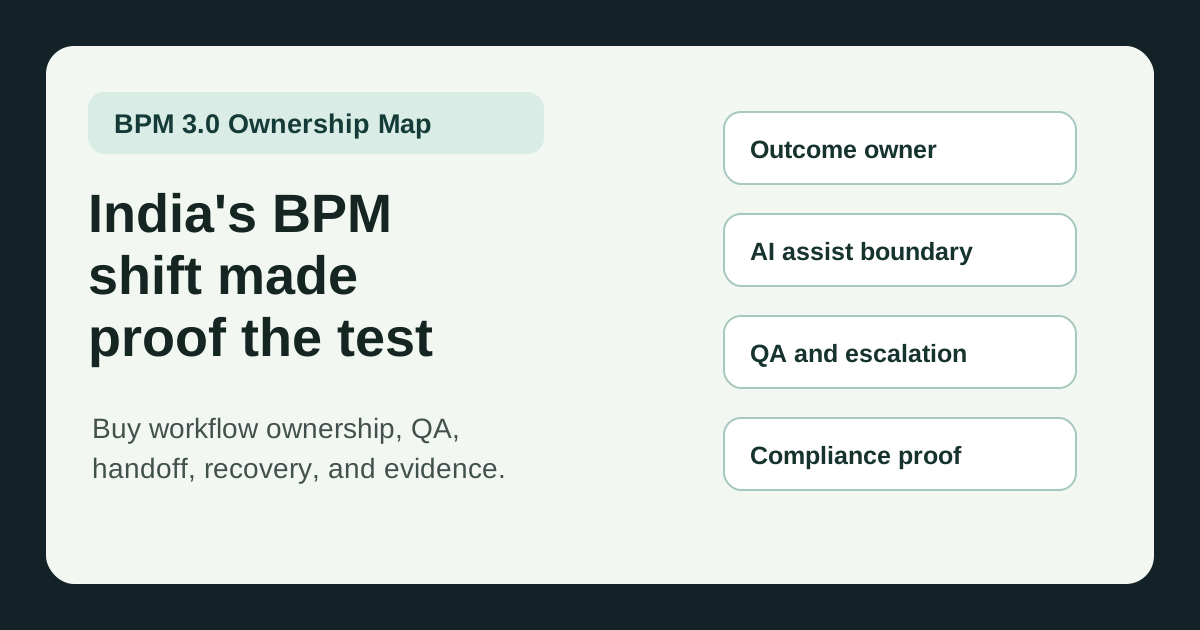
BPM 3.0 Outcome Ownership Map
Use this map before moving support, admin, or customer workflow work to an AI-assisted remote team.
| Ownership layer | Buyer question | Weak signal | Proof to require |
|---|---|---|---|
| Business outcome | What result is the partner accountable for? | The proposal sells hours, seats, or generic AI productivity. | Outcome metric, baseline, target, review cadence, and named owner. |
| Workflow scope | Which steps are fully owned, assisted, or excluded? | The partner says it can handle everything after access is granted. | Process map, task boundaries, blocked decisions, handoff triggers, and workflow owner. |
| AI assist | Where does AI draft, classify, summarize, or route work? | AI is described as a black-box productivity layer. | Tool list, prompt/control owner, source boundaries, review rules, and failure log. |
| Domain judgment | Who understands policy, customer context, and exceptions? | Agents follow scripts but cannot explain judgment calls. | Training samples, policy tests, exception examples, and supervisor QA. |
| Quality proof | How is performance reviewed after launch? | Quality is measured only by speed or containment. | QA rubric, sample tickets, reopened cases, callback misses, bad-record review, and customer repair notes. |
| Escalation and recovery | What happens when the workflow breaks? | Escalation is a vague promise to notify the client. | Warm handoff template, priority rules, callback owner, refund/repair limits, and after-hours path. |
| Compliance and data | How are records, access, and evidence protected? | The partner asks for broad access without a data map. | Role permissions, audit logs, retention rules, export controls, and incident owner. |
What buyers should do next
- Pick one support workflow where cost, speed, or missed follow-up is already painful.
- Define the outcome before buying headcount: response time, booking quality, CRM hygiene, callback completion, backlog reduction, or escalation prep.
- Separate work AI can assist from work a trained operator must own.
- Ask for QA samples, escalation evidence, training materials, exception handling, compliance controls, and recovery ownership.
- Use the support coverage calculator to size the human coverage that must remain behind AI-assisted workflows.
- Review the partner weekly on outcomes, not just hours or tickets touched.
The real takeaway
BPM 3.0 is not a slogan buyers should accept at face value. It is a higher standard.
If an outsourcing partner says it is moving from process execution to outcome ownership, the buyer should ask for proof: workflow scope, AI boundaries, domain judgment, QA evidence, escalation paths, and recovery ownership. The partners that can show those layers are the ones worth testing.
Buyer FAQs
- What is BPM 3.0? - In the current Economic Times and Nasscom framing, BPM 3.0 describes India's business process management sector moving beyond low-cost transaction processing toward AI-enabled process transformation, domain expertise, agility, and ownership of business outcomes.
- Why does BPM 3.0 matter to support outsourcing buyers? - It changes the buying question. Instead of asking only whether a partner can staff a queue cheaply, buyers should ask whether the partner can own outcomes, manage AI-assisted workflows, preserve QA, escalate exceptions, and show operational proof.
- Should buyers choose an AI-first outsourcing provider? - Only if the provider can show where AI helps, where trained operators remain accountable, what evidence is reviewed, and how customer recovery works when automation fails or the workflow changes.
- What proof should be requested before signing? - Ask for workflow ownership, AI tool boundaries, QA samples, escalation rules, compliance controls, data-handling practices, training plans, outcome metrics, and a named recovery owner.
Sources
- Economic Times - Current Economic Times coverage of BPM 3.0, the shift from cost-saving outsourcing to process transformation, and the role of AI, agility, domain expertise, engineering skill, and brand credibility.
- Economic Times x Nasscom video summary - Companion Economic Times and Nasscom coverage framing India's BPM sector as moving from transaction processing to outcome ownership and AI-driven transformation.
- Zinnov - Zinnov's India AI Edge 2026 report on India's AI scale, enterprise adoption, funding momentum, and the gap between broad AI activity and scaled enterprise integration.
- NITI Aayog - India AI Economy roadmap discussing the exposure of tech services, BPM, and CX work to AI disruption and the need for coordinated skilling and talent strategy.