AI Is Turning India BPO Work Into Escalation Coverage
The Times of India reported on July 19, 2026 that AI-powered chatbots and voice assistants are now handling routine customer-care work across India's BPO industry, pushing human agents toward complex issues, judgment calls, privacy-sensitive conversations, and AI oversight. The buyer issue is not whether AI can answer simple questions. It is whether an outsourced or remote support team can prove what happens after automation fails, escalates, hallucinates, or hands the customer to a person.

Direct answer
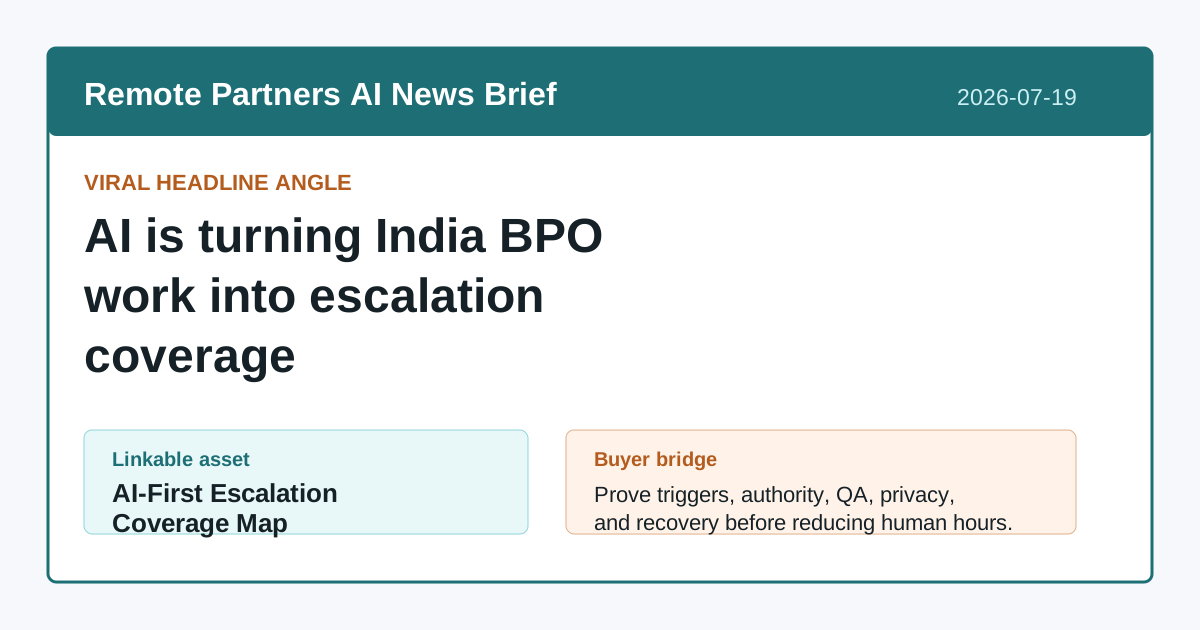
India’s BPO customer-care story is shifting from “agents answer every routine question” to “AI answers first, and humans own the difficult residue.” The Times of India reported on July 19, 2026 that AI chatbots and voice assistants are already handling common tasks such as routing, ticket creation, summaries, translation, and documentation, while human agents move toward complex issues that require judgment, empathy, privacy awareness, and recovery ownership.
For outsourcing buyers, that makes escalation coverage the proof test. If a vendor says AI will reduce volume, the buyer should ask exactly which work disappears, which human skills remain, when the AI must stop, and who owns the customer after a bad automated answer.
The lead image for this article is a synthetic representative editorial scene, not a photo of any named company or news event.
What happened
The Times of India framed the current customer-care shift around India’s BPO market. Routine requests increasingly start with chatbots or AI voice assistants, and humans are pulled into ambiguous, emotional, or sensitive conversations.
The article also described the agent-skill shift. AI can reset passwords, route tickets, summarize interactions, and handle structured requests. Human agents are increasingly expected to verify AI output, manage escalations, review automated responses, handle complaints, and make judgment calls when the system lacks context.
That lines up with broader contact-center analysis. TechTarget reported on July 15 that AI replacement will not be even across industries, with simple retail or food-service support more exposed than specialized work in sectors such as utilities, manufacturing, construction, banking, and insurance. Gartner has also said 85% of service and support leaders are expanding human-agent responsibilities as AI reduces contact volume and shifts work higher in value.
Why this is trending
This story lands because buyers are no longer debating whether AI will enter customer care. They are already living with AI-first support paths.
The hard part is the handoff. When AI gets the easy questions, the remaining human queue gets harder: angry customers, failed payments, sensitive financial matters, language gaps, exceptions, repeat contacts, and situations where a confident automated answer is wrong.
That changes the economics of outsourcing. A cheap routine-answering seat is not the same thing as an escalation-capable remote support team.
The Remote Partners AI take
AI-first support can be useful when it removes repetition and gives agents better context. It becomes fragile when leaders report only containment rate and cost savings.
The buyer-grade question is: what happens after the AI cannot solve it?
If the vendor cannot show escalation triggers, agent authority, QA, privacy controls, and recovery reporting, the buyer may be trading visible wait time for hidden customer loss.
AI-First Escalation Coverage Map
Use this map before approving AI-first customer care, BPO redesign, outsourced support changes, contractor-hour reductions, or new remote-agent staffing plans.
| Proof layer | Buyer question | Weak signal | Evidence to require |
|---|---|---|---|
| Routine work removed | Which exact tasks will AI handle before a human joins? | The vendor reports “AI deflection” without naming intents, queues, and exceptions. | Intent inventory, volume baseline, excluded cases, sample transcripts, and owner for each removed task. |
| Escalation triggers | When must the AI stop trying and bring in a person? | Handoff is available, but only after repeated customer frustration. | Confidence threshold, sentiment trigger, urgent-intent list, repeat-contact rule, and transfer test evidence. |
| Human authority | Can agents actually fix the issue after handoff? | Agents receive escalations but lack refund, reschedule, callback, or record-correction authority. | Permission map, supervisor route, callback SLA, exception playbook, and recovery examples. |
| Privacy and data | What customer data can the AI collect, summarize, store, or expose? | Privacy review focuses on the tool, not the support workflow. | Data-field inventory, retention setting, redaction rule, sensitive-topic trigger, and audit log sample. |
| AI-output QA | Who checks summaries, translations, classifications, and suggested answers? | QA samples only human work or only measures containment. | AI-output review sample, correction log, reopen analysis, hallucination tag, and weekly QA report. |
| Recovery reporting | Are savings reported beside manual repair work? | Leadership sees lower handle time but not reopens, complaints, callbacks, and lost customers. | Weekly report with automation volume, handoffs, reopens, complaints, callbacks, corrections, and final outcomes. |
What buyers should do next
- Pick the highest-volume workflow where AI is expected to answer before humans.
- List the routine tasks AI is allowed to handle and the cases it must never finish alone.
- Define escalation triggers for low confidence, customer frustration, sensitive data, language trouble, repeat contact, urgency, and failed answers.
- Confirm agents have authority to fix the customer’s problem, not only receive the transfer.
- Require weekly reporting that puts AI containment next to handoffs, reopens, complaints, callbacks, corrections, and customer recovery.
- Use the support coverage calculator before reducing hours or redesigning outsourced coverage.
- If you need humans around AI-first support, review AI back-office workflow support and include recovery reporting in the scope.
The real takeaway
AI is changing India’s BPO customer-care work, but it is not removing the need for accountable support. It is concentrating human labor around harder moments.
Do not buy AI-first support until the escalation coverage map is visible.
Buyer FAQs
- What changed in India's BPO customer-care market? - The Times of India reported that chatbots and AI voice assistants increasingly handle routine support tasks, while human agents are being pushed toward complex, sensitive, ambiguous, and emotionally charged customer issues.
- Why should outsourcing buyers care? - If AI removes routine volume, the remaining human work becomes higher risk. Buyers need proof that outsourced teams can handle escalations, privacy-sensitive cases, hallucinated answers, language gaps, and recovery work.
- Does AI-first support mean fewer remote agents? - Not automatically. Gartner says most service leaders are expanding or redesigning human-agent responsibilities. The buyer question is whether the retained team is trained and staffed for the work AI cannot finish.
- What proof should buyers ask for? - Ask for a routine-work inventory, escalation trigger list, human authority map, privacy controls, AI-output QA sample, recovery reporting, and examples of customers saved after automation failed.
Sources
- The Times of India - July 19, 2026 reporting on AI-first customer care, India's BPO transition, agent upskilling, privacy concerns, and the shift from routine work to complex escalations.
- TechTarget - July 15, 2026 analysis of uneven contact-center job replacement, Forrester's customer-service employment impact report, and the need for new support-team structures.
- Gartner - April 2026 Gartner press release saying 85% of service and support leaders are expanding human-agent responsibilities as AI reduces contact volume.