JPMorgan Says AI Cut Jobs 30% to 40% in Some Areas
JPMorgan CEO Jamie Dimon told analysts that AI has already reduced jobs by 30% or 40% in some discrete areas, while most affected employees were offered other jobs. The buyer issue is not whether large companies will keep automating. It is whether support leaders can prove redeployment, escalation ownership, exception handling, QA, and recovery reporting before AI savings become customer coverage risk.

Direct answer
JPMorgan’s latest AI comments turn AI staffing from a forecast into an operating proof test. On the company’s Q2 2026 earnings call, CEO Jamie Dimon said JPMorgan has about 1,000 AI use cases, roughly 50 important deployments, and some discrete areas where AI has already reduced jobs by 30% or 40%.
For support buyers, the issue is not the bank’s internal staffing plan. It is the pattern: large operators are starting to describe AI in terms of measurable work reduction. If a support vendor, BPO, helpdesk, or internal team uses similar claims, buyers need proof that customer recovery work has a named owner after the routine work is automated.
What happened
JPMorgan released Q2 2026 earnings and held its analyst call in July 2026. During the call, Dimon said the bank has around 1,000 AI use cases and about 50 that matter materially across front office, middle office, back office, trading, risk, legal, and research workflows.
The part that pushed the story beyond normal AI commentary was the staffing detail. Dimon said that in some discrete areas, AI had reduced jobs by 30% or 40%, and that most affected people had been offered jobs elsewhere.
Business Insider independently covered the remarks and framed them around both workforce impact and the real operating cost of AI token usage. JPMorgan’s earnings release provides the company-reported context for the quarterly call.
Why this is trending
This is not a vendor launch or an abstract AI productivity survey. It is a large enterprise telling investors that AI is already changing the amount of work needed in particular operating areas.
That matters because support organizations are being asked to approve AI agents, AI summaries, automated routing, offshore redesigns, and leaner staffing plans at the same time. The tempting shortcut is to measure only deflected tickets, handled chats, or reduced hours.
The buyer-grade test is wider. When AI reduces routine work, the company still needs visible human coverage for exceptions, angry customers, sensitive cases, bad summaries, failed automations, language gaps, callbacks, and manual repair.
The Remote Partners AI take
AI can remove repetition. It should not remove accountability.
The strongest support model does not frame automation as a pure headcount cut. It uses AI to move trained humans away from repeatable intake and into higher-value recovery work: escalations, quality review, exception queues, customer callbacks, knowledge-base cleanup, language review, and workflow repair.
That is the difference between an AI savings story and an AI coverage story. Buyers should ask for the second one.
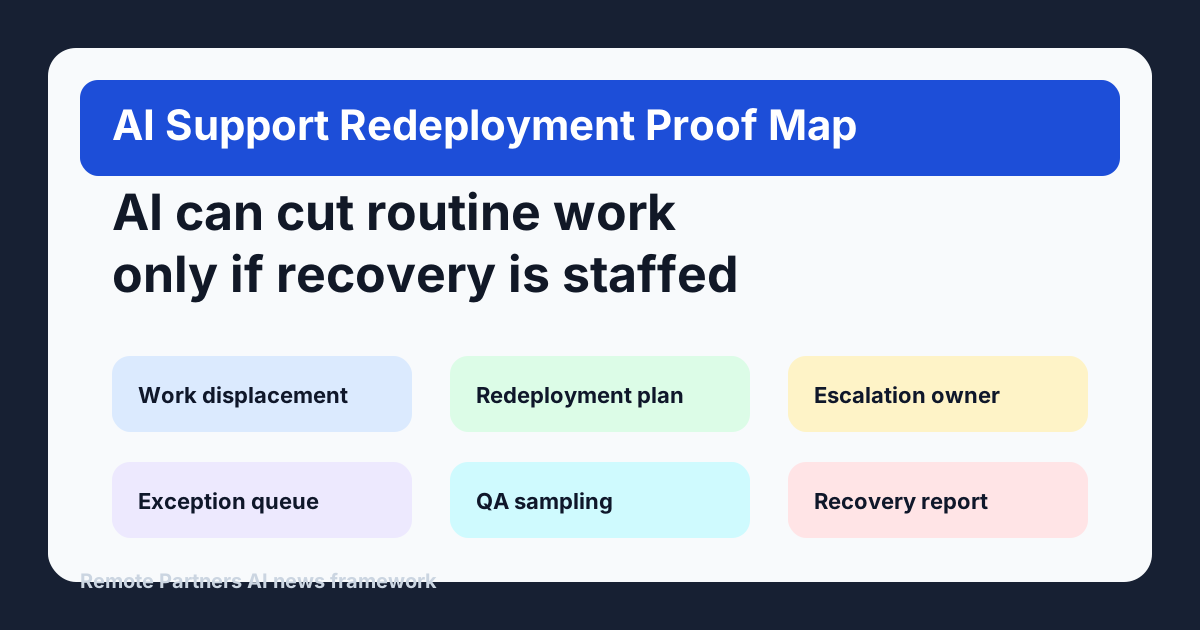
AI Support Redeployment Proof Map
Use this map before approving AI-driven support staffing changes, outsourced coverage redesigns, or vendor claims that automation will reduce support hours.
| Proof layer | Buyer question | Weak signal | Evidence to require |
|---|---|---|---|
| Work displacement | Which exact tasks, queues, intents, or ticket types are expected to need fewer human hours? | The vendor reports automation rate without naming the work removed. | Intent map, ticket sample, volume baseline, before-and-after staffing model, and excluded case types. |
| Redeployment plan | Where do affected agents, QA reviewers, specialists, or supervisors move after AI takes routine work? | Savings are booked as cuts while recovery work remains informal. | Redeployment list, new role ownership, training plan, QA coverage, and recovery queue staffing. |
| Escalation owner | Who owns the customer when the automated path fails or a caller asks for a person? | Escalation exists in the tool, but no team owns the outcome. | Named queue owner, transfer tests, callback SLA, context handoff, and failed-handoff review. |
| Exception queue | Which cases are never allowed to be closed by AI alone? | The exception list is implied by policy rather than encoded into workflow. | Sensitive-case tags, blocked intents, approval thresholds, supervisor route, and exception audit. |
| QA sampling | How are AI summaries, resolutions, translations, and classifications checked after launch? | QA only samples human-agent work or only measures containment. | AI-output sample, correction log, language review, reopen analysis, and weekly defect report. |
| Recovery reporting | Are savings reported beside customer recovery work and manual repairs? | Leadership sees reduced hours but not complaints, reopens, fixes, and callbacks. | Weekly report with AI volume, escalations, reopens, complaints, manual repairs, callbacks, and final outcomes. |
What buyers should do next
- Pick the support workflow where AI is expected to reduce the most human work.
- Write down the ticket types, call intents, summaries, classifications, and updates AI is expected to absorb.
- Identify the cases that still need human judgment, empathy, authority, language review, or compliance review.
- Name the team that owns failed AI sessions, bad summaries, urgent callbacks, reopens, and customer complaints.
- Require a weekly report that puts AI savings and human recovery work on the same page.
- Use the support coverage calculator before reducing hours or moving work to automation.
- If you need a managed human layer around AI workflows, review AI back-office workflow support and include recovery reporting in the scope.
The real takeaway
JPMorgan’s comments make the buyer question sharper. AI can reduce jobs in some discrete areas, but a support operation still needs named human coverage where customer harm, confusion, urgency, or failed automation appears.
Do not approve an AI staffing reduction until the redeployment and recovery map is visible.
Buyer FAQs
- What did JPMorgan say about AI and jobs? - On JPMorgan's Q2 2026 earnings call, CEO Jamie Dimon said AI had already reduced jobs by 30% or 40% in some discrete areas, while most affected employees were offered other jobs elsewhere in the company.
- Does this mean buyers should avoid AI support automation? - No. It means buyers should require redeployment and coverage proof. AI can reduce repeatable work, but support operations still need named humans for exceptions, escalations, complaints, language gaps, and recovery.
- Why does a bank earnings call matter to support outsourcing? - The call shows AI moving from abstract productivity promise into operating-model and workforce decisions at a large enterprise. Buyers using AI-assisted support or outsourced teams should test whether coverage remains measurable after automation changes the staffing mix.
- What proof should support buyers ask for? - Ask for the displaced-work map, redeployment plan, human escalation owner, exception queue rules, QA sampling evidence, callback recovery, and a weekly report that shows AI volume beside reopens, complaints, manual fixes, and customer outcomes.
Sources
- StockAnalysis - Q2 2026 earnings-call transcript in which JPMorgan CEO Jamie Dimon discussed roughly 1,000 AI use cases, around 50 important deployments, and job reductions of 30% or 40% in some discrete areas.
- Business Insider - Independent July 2026 coverage of Dimon's AI comments, including job reductions in some areas and the operating cost of AI token usage.
- JPMorgan Chase - Primary Q2 2026 earnings release used to verify the earnings context around the call.