Kaiser Nurses Say AI Surveillance Is Pressuring Patient Calls
CalMatters' Kaiser advice-line investigation is still moving through labor, healthcare, and builder communities after republication and Hacker News discussion. Seven current and former nurses told CalMatters that call-time pressure, productivity prediction, and past AI empathy scoring made patient calls feel more like metric work than clinical judgment. Kaiser disputed the average-handle-time claim and said its tools support quality with human oversight. The buyer issue is practical: remote support, healthcare triage, and AI QA teams need proof that speed metrics, coaching systems, and automation do not override judgment, escalation, compassion, or safety.

Direct Answer
The Kaiser story is a buyer warning about metric governance. CalMatters reported that seven current and former Kaiser advice-line nurses said call-time pressure, productivity prediction, and past AI empathy or tone scoring made them worry that patient care was being squeezed by efficiency goals. Kaiser disputed the average-handle-time claim and said the tools are meant to support quality with human oversight.
Remote support buyers should not treat this as only a healthcare labor dispute. Any outsourced support, AI QA, or remote call-center program can create the same failure mode if speed targets and automated coaching labels are stronger than judgment, escalation authority, and case-context review.
The lead image for this article is a synthetic representative editorial scene created for Remote Partners AI. It does not depict Kaiser, CalMatters, Local News Matters, Hacker News, or any named person.
What Happened
CalMatters reported in July 2026 that Kaiser Permanente advice-line nurses raised concerns about workplace surveillance and AI in call-center work. Seven current and former nurses told the publication that calls longer than 15 minutes could lead to criticism or performance review, and that call time was part of monthly performance scores.
The same report said Kaiser used software that predicts daily productivity risk and had used AI to rate empathy and tone of voice. CalMatters also reported that Kaiser nurses were entering contract talks with AI expected to be an issue, and that California lawmakers were considering workplace-AI bills.
Kaiser pushed back. The company told CalMatters it uses technology with patient safety in mind, does not use average handle time to assess agent performance, and has human review and oversight for contact-center tools.
The story kept circulating after regional republication, labor coverage, and Hacker News discussion. That momentum matters because the debate is not limited to one health system. It is a broader buyer question: when support work is measured by software, who can prove that the measurement does not distort the work?
Why It Is Trending
The story hits a live concern for buyers of AI support tools and remote teams. Over the last two years, support operations have added automated QA, productivity scoring, sentiment analysis, coaching bots, and workflow analytics. Those tools can be useful, but only if they are governed by the case context.
Advice-line nursing makes the risk easy to see. A call that looks inefficient in a dashboard may be the correct call if the patient is in crisis, confused, newly diagnosed, or waiting for a safe handoff. The same logic applies to customer support, insurance, finance, travel, ecommerce, and SaaS escalations.
The trending question is not whether teams should measure work. They should. The question is whether the buyer can tell the difference between a slow case, a blocked workflow, a necessary long conversation, and an actual coaching problem.
The Remote Partners AI Take
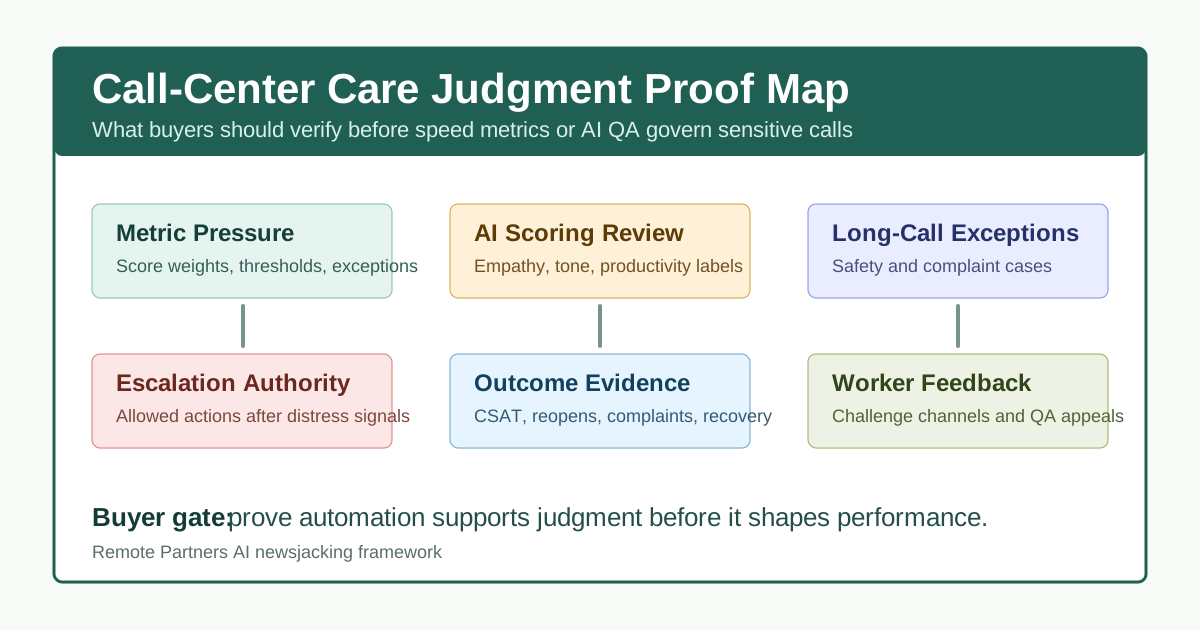
Remote support buyers should require a Call-Center Care Judgment Proof Map before approving aggressive productivity analytics or AI QA. The map should show where metrics help and where they must yield to human judgment.
| Proof layer | Buyer question | Evidence to request |
|---|---|---|
| Metric pressure | Which metrics can affect coaching, staffing, incentives, or performance review? | Scorecard fields, weighting, threshold rules, exception rules, and manager-review notes. |
| Long-call exception | Which call types are allowed to exceed target time without penalty? | Mental-health, safety, retention, billing, complaint, complex-care, and vulnerable-customer exception codes. |
| AI scoring review | How are empathy, tone, sentiment, productivity, or quality labels reviewed by humans? | Calibration samples, false-positive notes, reviewer override logs, and model-change history. |
| Escalation authority | What can the agent do after recognizing risk or distress? | Supervisor handoff rules, callback workflow, refund or exception thresholds, and emergency escalation paths. |
| Outcome evidence | Does leadership see the result beyond handle time? | CSAT, reopen rate, complaint rate, escalation success, retention, safety incident review, and recovery notes. |
| Worker feedback | Can frontline staff challenge a metric or report a harmful workflow? | Dispute process, worker feedback channel, QA appeal history, and action taken after complaints. |
Buyer Bridge
If you are buying remote support coverage, do not ask only for average handle time, QA scores, and automation coverage. Ask for the cases where the agent was right to be slower.
The diligence packet should include a small sample of sensitive or high-emotion interactions. For each one, the provider should show the metric score, the AI or QA label, the human review note, the allowed escalation path, and the outcome.
That proof is more useful than a general claim about compassion, compliance, or AI oversight. It shows whether the operating system supports human judgment when the dashboard creates pressure in the other direction.
Next Steps
- Pull the last 30 days of long calls, high-emotion tickets, complaints, repeat contacts, and supervisor escalations.
- Label which cases were slow because of complexity, risk, policy friction, customer vulnerability, or agent behavior.
- Compare the AI or QA score with a human reviewer note for each case.
- Identify cases where speed targets would have punished the correct support behavior.
- Add long-call exception codes and require manager review before performance action.
- Add reporting that separates productivity coaching from blocked workflow, escalation, and care-judgment cases.
- Use Remote Partners AI’s support coverage calculator and AI back-office workflow support when you need measurable support coverage without hiding the judgment layer.
Buyer FAQs
- What did Kaiser nurses tell CalMatters? - Seven current and former Kaiser advice-line nurses told CalMatters that call-time pressure, productivity software, and AI empathy or tone scoring made them worry that patient care was being subordinated to speed and efficiency.
- How did Kaiser respond? - Kaiser said its technology is used with patient safety in mind, disputed using average handle time to assess agent performance, and said any contact-center tools have human review and oversight.
- What should support buyers audit first? - Start with cases where calls or chats exceeded normal duration because the customer or patient needed more help, then compare the metric treatment, supervisor review, escalation path, and outcome.
Sources
- CalMatters - Primary July 2026 investigation quoting seven current and former Kaiser advice-line nurses, Kaiser responses, CNA bargaining context, and California workplace-AI policy context.
- Local News Matters - Regional republication of the CalMatters investigation that kept the story circulating after the original publication.
- Hacker News - Public developer and operator discussion showing continued momentum around the metrics, surveillance, and AI-management implications.
- World Socialist Web Site - July 21, 2026 labor-focused coverage summarizing the CalMatters investigation and framing the call-center AI dispute as a worker-surveillance issue.