Klarna's AI Support Rehire Story Is Really a Gig-Work Warning
The headline is not that people beat AI. It is that AI can split customer service into chatbot work, fragmented human gigs, and unclear accountability.

Direct answer
Klarna’s AI customer service story is trending again because the reversal is not a clean “AI failed, humans won” narrative. The Guardian reported that after Klarna replaced hundreds of customer service roles with AI, the company later recruited human customer service agents again, but in a more on-demand, gig-style setup.
For support buyers, the lesson is straightforward: AI can reduce repetitive work, but it can also make customer service more fragmented if stable trained operators are replaced by a mix of bots, temporary workers, and unclear escalation owners.
What happened
The Guardian connected Klarna’s customer service AI reversal to a broader labor trend. In 2024, Klarna promoted an AI assistant that could handle work equivalent to hundreds of support representatives. A year later, after customer service quality concerns, the company began bringing human agents back into the workflow.
The important detail is the structure. The Guardian reported that Klarna’s CEO described the model as an “Uber type of set-up” for customer service, where AI continues to handle basic requests and humans jump in for more advanced work.
Human Rights Watch separately warned that AI already shapes gig work through algorithmic assignment, pay, evaluation, and control. Customer Experience Dive also reported this month that an agentless contact-center future is not imminent because humans remain necessary for complex and sensitive service work.
Why this is trending
The story is trending because it challenges the simple AI replacement story. A buyer may hear that AI removes the need for a support team. The harder reality is that AI can leave behind smaller, more complicated human work: complaints, refunds, exceptions, escalations, unclear policy calls, and emotionally loaded conversations.
Those are not random tasks. They are the tasks where brand trust is won or lost.
If those moments are handled by a rotating gig pool with thin training, no account history, limited platform access, and weak QA, the company may reduce labor cost while increasing customer risk.
The Remote Partners AI take
The wrong move is to treat gig-style support as the default human layer behind AI.
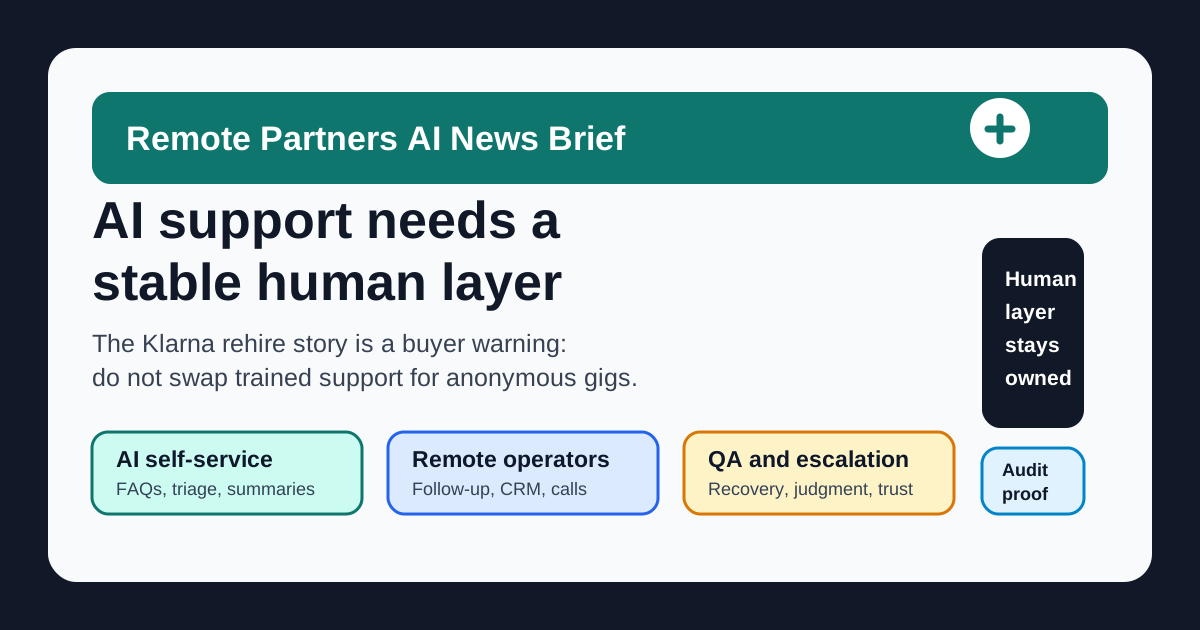
The better move is to design a stable support operating model. AI can draft, summarize, route, and retrieve knowledge. Trained remote operators should own customer tone, follow-through, data cleanup, exception handling, and escalation packets. Supervisors should own QA and recovery when the first answer was wrong.
The buyer goal is not simply fewer support hours. It is fewer unresolved issues.
Support Labor Continuity Map
Use this map before replacing a staffed support model with AI plus on-demand labor.
| Support lane | AI can assist with | Human continuity risk | Buyer proof to request |
|---|---|---|---|
| Basic self-service | Order status, FAQs, appointment reminders, policy lookup, triage | Customers may get stuck when the request is unusual or emotional | Containment rate, escalation rules, failed-chat samples, and fallback path |
| AI-assisted replies | Draft responses, summarize cases, classify intent, suggest next steps | Temporary agents may approve weak drafts without account context | QA rubric, approval rules, transcript review, and correction workflow |
| Trained remote operators | Handle repeat customer workflows, CRM updates, callbacks, inboxes, and dispatch notes | Replacing stable operators with anonymous labor weakens process memory | Named team structure, training path, backup coverage, and platform access boundaries |
| Escalation and recovery | Flag angry customers, repeat contacts, unresolved issues, and high-risk accounts | Gig-style agents may not know when to stop and escalate | Escalation owner, warm handoff notes, service recovery script, and response SLA |
| QA and coaching | Detect repeat errors, missed fields, bad tone, and reopened tickets | No one improves the system if every shift is a different worker | Weekly QA report, rework metrics, coaching log, and knowledge-base update owner |
| Sensitive workflows | Redact data, identify regulated topics, and surface policy references | Fragmented labor can expose data or make unauthorized commitments | Permission map, approval rules, audit logs, and human-only decision list |
What buyers should do next
Start by asking what kind of human layer sits behind the AI.
- List the customer issues that should never be left to a gig worker or bot alone.
- Require named owners for training, QA, escalation, and customer recovery.
- Ask whether support workers are stable team members, supervised contractors, or a rotating on-demand pool.
- Define which CRM, inbox, order, billing, and helpdesk actions AI may only draft, not complete.
- Measure reopens, corrections, missed follow-up, transfer quality, and customer complaints after AI-assisted workflows launch.
- Keep trained remote support coverage for judgment-heavy and relationship-heavy work.
If you are planning a blended support model, use the support coverage calculator to size the human layer that should remain behind AI.
The real takeaway
Klarna’s story is not just about AI replacing support jobs and then bringing people back. It is about the shape of the work that remains.
Buyers should avoid any model where AI handles the easy work and anonymous gig labor inherits the hard work. The durable model is AI-assisted support with trained human accountability, visible QA, and clear recovery paths when customers need more than a scripted answer.
Buyer FAQs
- What changed in the Klarna AI support story? - The Guardian reported that after replacing customer service roles with AI, Klarna later recruited human customer service agents again, but under a more on-demand gig-style model rather than a simple return to stable full-time support.
- Why does this matter to support outsourcing buyers? - It shows that AI replacement can create a third model: not fully automated support, and not stable human coverage, but fragmented labor that may weaken accountability, continuity, training, and escalation ownership.
- Is AI bad for customer support? - No. AI can help with summaries, routing, drafts, and repetitive questions. The buyer risk is using AI as permission to remove stable human owners from sensitive, complex, or relationship-heavy support work.
- What should buyers ask before using on-demand support labor? - Ask who owns training, QA, escalation, knowledge updates, customer tone, shift continuity, data access, and rework when a gig-style agent or AI workflow fails.
Sources
- The Guardian - Independent reporting on Klarna's customer service AI reversal and the shift toward gig-style service work.
- Human Rights Watch - Primary labor-rights context on algorithmic management and platform-work protections.
- Customer Experience Dive - Independent CX reporting that an agentless contact-center future is not imminent and human support remains needed for complex work.