Level AI Says Empathy Is Now a Measurable Support Metric
CX Dive's July 21, 2026 coverage of Level AI's Conversation Lab analysis turned agent empathy into a measurable operations issue. Level AI says it analyzed 35.1 million conversations across 85 companies and found explicit emotional validation correlated with higher inferred CSAT, with only about 18% of conversations showing that behavior. The buyer issue is not whether scripts should sound warmer. It is whether remote support teams can prove which cases need empathy coaching, which workflows still need human judgment, and how CSAT, escalation, reopens, QA, and recovery evidence move when empathy is coached intentionally.

Direct Answer
Level AI’s latest Conversation Lab analysis, covered by CX Dive on July 21, 2026, says explicit emotional validation correlated with higher inferred CSAT across a 35.1 million conversation dataset. The same coverage says only about 18% of conversations included that validation, making empathy a measurable support operations gap rather than a soft coaching preference.
For buyers, the practical takeaway is simple: do not buy remote support, AI QA, or escalation coverage on “friendly agents” claims. Ask whether the provider can show where empathy is detected, when it changes a case outcome, what authority the agent has after validating the emotion, and how that proof appears in reporting.
The lead image for this article is a synthetic representative editorial scene created for Remote Partners AI. It does not depict Level AI, CX Dive, or any named company.
What Happened
CX Dive reported that Level AI analyzed 35.1 million customer service conversations and found that agents who explicitly validated customer emotions had higher inferred CSAT. The article cited an inferred CSAT score of 3.94 when validation appeared, compared with 3.52 when it did not.
Level AI’s primary Conversation Lab post says the analysis covered 85 companies. Its headline finding is not that every case needs the same tone. It is that emotional validation can be measured at conversation scale and connected to customer satisfaction signals.
The prevalence number is the operating issue. CX Dive reported that only about 18% of conversations included explicit emotional validation. If that holds inside a buyer’s own support operation, the gap is not hidden in training decks. It is present in daily calls, chats, QA samples, and supervisor queues.
The reported impact also varied by sector. CX Dive said tech and SaaS saw a 14.8% lift associated with validation, financial services and insurance saw 14.3%, and healthcare and wellness saw 1.8%. That variation matters because a buyer should test empathy as a workflow behavior, not assume a universal script will produce a universal result.
Why It Is Trending
The story is catching attention because contact centers have spent years instrumenting speed, deflection, containment, handle time, and QA checklists. Empathy often stayed in a coaching lane because it was hard to measure consistently.
AI QA changed that buyer conversation. If a vendor or service partner can analyze large volumes of conversations, the buyer can ask harder questions: which customers sounded distressed, which agents acknowledged the issue, which cases still failed, and which workflows gave the agent no useful recovery option.
That last point is the risk. Measuring empathy without measuring authority can create polite dead ends. A customer may feel heard for a minute, but still leave angry if the agent has no refund path, no escalation path, no account context, or no permission to solve the problem.
The Remote Partners AI Take
Remote support buyers should treat empathy as an evidence loop: detection, coaching, action, and outcome. The goal is not to make every agent sound the same. The goal is to know when the customer needed acknowledgment, whether the agent responded appropriately, and whether the workflow let the agent fix the underlying problem.
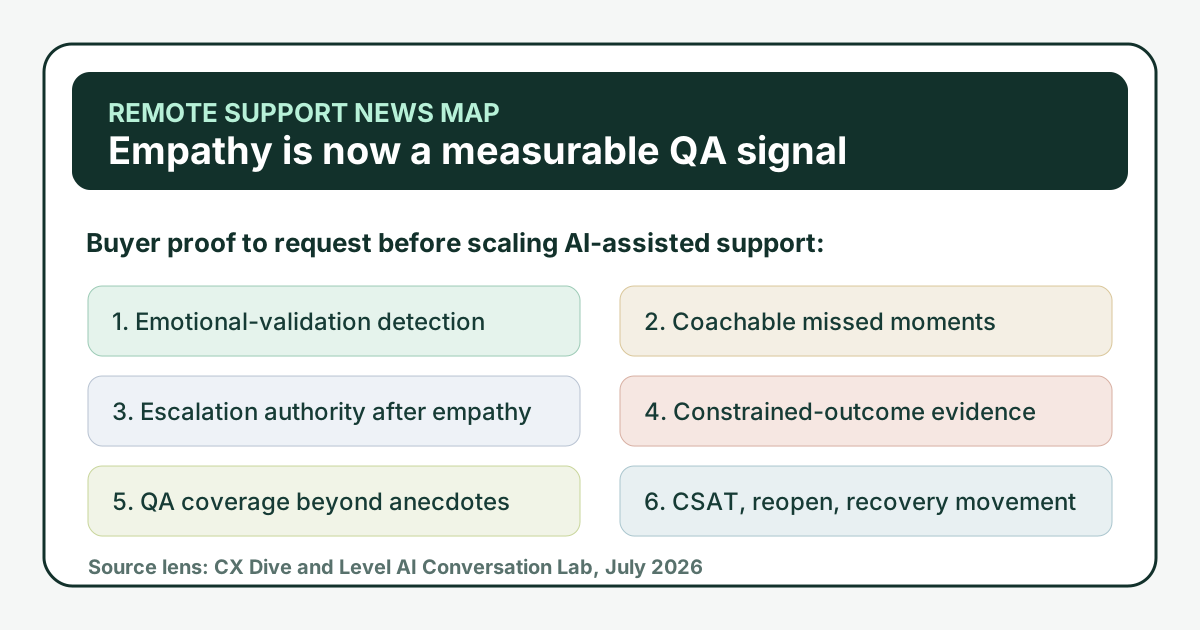
Use the map below when evaluating a remote support partner, outsourced CX team, or AI-assisted support workflow.
| Proof layer | Buyer question | Evidence to request |
|---|---|---|
| Emotional-validation detection | Can the team find moments where a customer expressed frustration, fear, confusion, or disappointment? | QA tags, model labels, sampled transcripts, and false-positive review notes. |
| Coachable moments | Can supervisors separate missed empathy from cases where empathy happened but the workflow still failed? | Coaching queue, manager notes, examples before and after coaching, and agent-specific trends. |
| Escalation authority | After validation, can the agent actually change the case path? | Refund thresholds, supervisor handoff rules, account-change permissions, and exception logs. |
| Constrained outcomes | Can reporting show cases where empathy did not overcome a policy or product limit? | Closed-lost reason codes, complaint tags, policy exceptions, and unresolved issue categories. |
| QA sampling | Is empathy evaluated across enough calls and chats to avoid cherry-picked examples? | Sampling rules, volume coverage, channel mix, and reviewer calibration records. |
| Recovery reporting | Does leadership see whether empathy coaching moves CSAT, reopens, refunds, and escalations? | Weekly trend report tying emotional validation to business outcomes. |
Buyer Bridge
If you are buying remote support coverage, Level AI’s finding should change the due diligence script. Ask the provider to show the last ten high-friction cases where a customer was upset, not the best ten quality examples.
Then ask four questions:
- Did the agent recognize the emotional state?
- Did the agent acknowledge the specific problem instead of using generic warmth?
- Did the workflow give the agent an action that could help?
- Did the customer outcome improve after that intervention?
Those answers are more useful than a general promise that agents are empathetic. They show whether empathy is operationalized.
Next Steps
- Pull your last 30 days of complaint, cancellation, refund, and repeat-contact cases.
- Score each case for explicit emotional validation and whether the language matched the actual customer concern.
- Split cases into “heard and helped,” “heard but blocked,” “not heard but resolved,” and “not heard and unresolved.”
- Compare CSAT, reopens, escalation rate, and refund exposure across those groups.
- Update coaching to focus on specific validation plus the next allowed action.
- Add a weekly management view that separates empathy misses from workflow constraint misses.
- Use Remote Partners AI’s support coverage calculator and AI back-office workflow support when you need a measurable support coverage plan instead of a soft-service promise.
Buyer FAQs
- What did Level AI report about empathy and CSAT? - Level AI said explicit emotional validation was associated with higher inferred CSAT in its 35.1 million conversation analysis, while only about 18% of conversations showed that behavior.
- Should buyers treat empathy scripts as enough? - No. Buyers should require proof that empathy guidance is linked to QA evidence, escalation authority, recovery workflow, and outcome reporting.
- What should remote support leaders audit first? - Start with a sample of recent escalations and complaints, then compare emotional-validation moments, supervisor handoffs, reopens, refunds, and CSAT recovery.
Sources
- CX Dive - July 21, 2026 coverage of Level AI's 35.1 million conversation analysis, inferred CSAT lift, industry variation, and low prevalence of explicit emotional validation.
- Level AI - Primary Conversation Lab report saying the analysis covered 35.1 million conversations across 85 companies and examined explicit emotional validation.