Meta Muse Growth: Build the Agent Adoption Support Capacity Map
September 25 TechCrunch reporting that Meta's Muse reached millions of estimated downloads within weeks, followed by a post-Connect usage lift and plans for more connectors and computer use, turns consumer-agent growth into an operations question: can support capacity, knowledge, permissions, escalation and recovery expand before a fast-growing agent becomes another customer channel?

Direct Answer
Meta Muse’s reported growth is a support-capacity story, not only an app-store story. TechCrunch cited several market-intelligence estimates that put downloads in the millions within weeks of launch, while Sensor Tower reported a 27% increase in daily active users after Meta Connect. The estimates vary, so they should not be treated as audited Meta figures. The operational signal is still useful: when a consumer agent gains reach and more connectors, businesses need an Agent Adoption Support Capacity Map covering demand forecasts, knowledge readiness, connector boundaries, staffing thresholds, escalation ownership and recovery proof.
Remote Partners AI is the marketing partner of Azpired. Azpired confirms, contracts and delivers selected services. This article is a planning framework based on public reporting; it does not claim Meta, Muse or Azpired client results, app analytics, staffing outcomes or guaranteed performance.
What Happened
TechCrunch reported September 25 that Sensor Tower estimated Muse had passed 3.4 million downloads after its September 8 launch. Other analytics firms cited by TechCrunch produced materially different estimates: Apptopia put the total at 4.3 million, while Appfigures estimated roughly 2.3 million. That spread matters. The figures support a direction of travel, not a single verified user count.
The same report said Sensor Tower observed a 27% increase in daily active users on the Wednesday after Meta Connect. It also described heavy cross-promotion across Meta properties, while noting that Sensor Tower attributed only a small share of launch-period ad impressions to paid promotion outside Meta’s own distribution.
TechCrunch’s Connect coverage adds the product-expansion signal: Meta announced plans for computer use on Mac, a dedicated email address, more partners and connectors, and smart-glasses integration. Axios had already framed Muse as an early test of whether distribution and connected personal context can make an agent useful at mass-market scale, while warning that usefulness increases the amount of personal data and trust involved.
Why It Is Trending
The important change is not that another assistant reached an app-store ranking. It is that an agent with access to browsers, accounts, email, purchases and eventually calls can create work for businesses outside its own interface. A customer may ask the agent to compare, cancel, book, dispute, return or follow up. The receiving company still needs staff, policies, knowledge and recovery paths when the request is ambiguous or fails.
Growth also compresses the planning window. Support teams that could handle agent-originated contacts as rare exceptions may face repeated patterns quickly, especially when a platform adds connectors or promotes the agent across a large installed base.
The Remote Partners AI Take
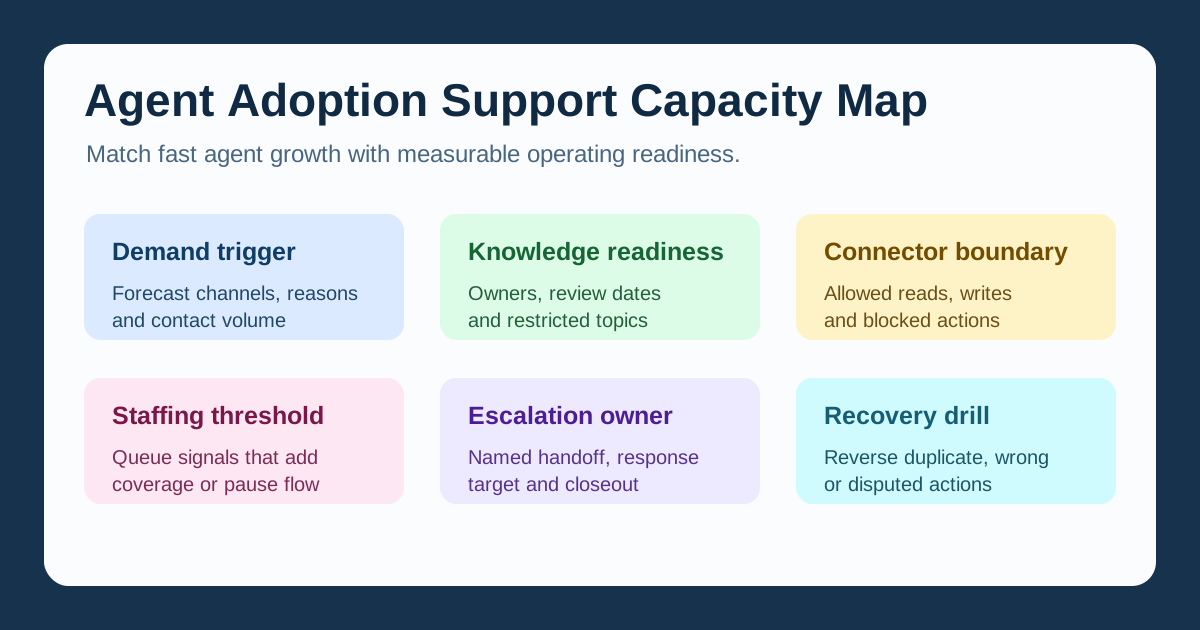
Use the Muse growth story as a capacity-planning prompt: “If consumer agents become a meaningful source of customer contact, what must be ready before volume arrives?”
| Capacity layer | Buyer question | Proof to request |
|---|---|---|
| Demand trigger | Which agent-driven calls, chats, emails, transactions and exceptions could reach us? | Channel forecast, contact reasons and volume assumptions |
| Knowledge readiness | Can approved policies, prices, availability and escalation rules be answered consistently? | Knowledge owner, review date, restricted topics and update SLA |
| Connector boundary | What may an external agent or connected tool read, submit, reserve, cancel or change? | Permission matrix, authentication rule and blocked-action list |
| Staffing threshold | When does rising volume require more coverage, specialist queues or extended hours? | Queue threshold, staffing trigger and overflow owner |
| Escalation ownership | Who takes over disputed, sensitive, high-value or failed agent requests? | Named owner, handoff context, response target and closure evidence |
| Recovery drill | How are duplicate actions, wrong requests and connector failures corrected? | Test transcript, rollback steps, customer notice and defect log |
Worked Example
Suppose a consumer agent starts contacting a service business to compare availability, request quotes, book appointments and cancel existing reservations. A weak plan treats each contact as an ordinary request. A stronger plan shows:
- Which requests can be completed without an account relationship.
- Which details require verified customer authority.
- Which actions need a person before anything is booked, cancelled or refunded.
- Which queue receives agent-originated exceptions and how context is transferred.
- Which demand threshold adds coverage or pauses an automated path.
- How duplicate bookings, wrong cancellations and disputed instructions are reversed.
That plan does not depend on one download estimate being exact. It prepares the operation for the class of demand the growth signal represents.
Buyer Bridge
Agent adoption can move faster than support operating models. Buyers should ask providers to tie staffing, knowledge management and escalation to observable thresholds rather than broad promises about scalability.
Attach an Agent Adoption Support Capacity Map to the statement of work. It should distinguish forecast from measured demand, name the knowledge and connector owners, define staffing triggers, preserve human approval for consequential actions and retain recovery evidence for failed or disputed requests.
Next Steps
- Inventory the contact reasons a consumer agent could generate across phone, chat, email, forms and transaction systems.
- Mark which requests are public-information, verified-account, sensitive, financial or prohibited workflows.
- Give every connector and knowledge source an owner, permission boundary, update SLA and fallback path.
- Set queue, abandonment, escalation and defect thresholds that trigger additional coverage or a workflow pause.
- Run a recovery drill for duplicate bookings, wrong cancellations, missing context and disputed agent authority.
For sourcing or delivery questions, contact Remote Partners AI and Azpired through the email listed on this site.
Buyer FAQs
- Why does Meta Muse growth matter to support operations? - A fast-growing consumer agent can generate new questions, transactions, calls and exceptions for businesses it interacts with. Support teams need capacity and control plans before those contacts arrive at scale.
- Are the reported Muse download numbers official Meta figures? - No. TechCrunch cited estimates from Sensor Tower, Apptopia and Appfigures, and the firms reported different totals. Treat the figures as directional adoption evidence, not audited Meta user counts.
- Does Remote Partners AI directly deliver contracted services? - Remote Partners AI is the marketing partner of Azpired. Azpired confirms, contracts, and delivers the services a buyer selects.
Sources
- TechCrunch - September 25, 2026 independent coverage of third-party Muse download estimates, post-Connect daily-active-user growth, Meta's promotion and planned product expansion.
- TechCrunch - September 23, 2026 coverage of announced Muse additions including computer use on Mac, a dedicated email address, more connectors and smart-glasses plans.
- Axios - September 18, 2026 reporting on Muse's early app-store momentum, connected-account ambitions, phone-call testing and the trust required by an agent acting across a user's life.
- Meta - September 8, 2026 primary launch announcement describing Muse's task, browser, planning, shopping and user-control positioning.