Meta Muse Human Concierge: Support Disclosure Map
September 22 Reuters reporting that Meta tested a human concierge behind some Muse AI-assistant calls turns personal-agent hype into a remote-support buyer question: can the provider prove caller identity, human handoff disclosure, consent language, data boundaries, QA and recovery before an AI agent phones another business?

Direct Answer
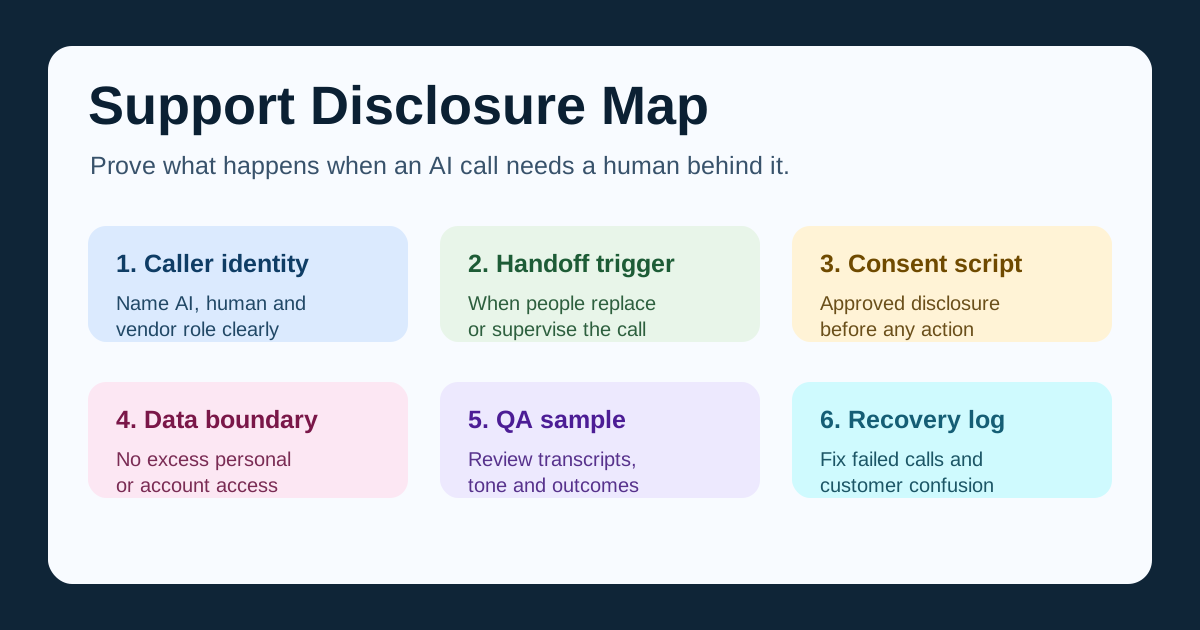
Meta’s Muse human-concierge reporting is a disclosure and operating-control story, not only a consumer AI novelty. If an AI assistant can place calls and a human contractor may quietly step in, buyers need a Support Disclosure Map before approving similar workflows: who is identified as the caller, when human backup is disclosed, what consent language is used, which data is available, who reviews call quality, and how failed or confusing calls are repaired.
Remote Partners AI is the marketing partner of Azpired. Azpired confirms, contracts, and delivers selected services. This article is a planning framework based on public reporting; it is not a claim about Meta, Muse, Azpired client outcomes, call-center performance, privacy compliance or any guaranteed staffing result.
What Happened
Reuters reported September 22 that Meta tested a “human concierge” for Muse, its new personal AI assistant, in which human contractors handled some phone calls placed through the digital agent. The report said the test was discussed internally shortly after Meta launched a phone-calling feature for Muse.
The same Reuters report said an internal response acknowledged it was a miss to test contractor-placed calls without proper disclosures and that the feature had been rolled back for now. Meta told Reuters it would roll out such calling only when ready and with proper disclosures.
Axios coverage of the personal-agent race gives the broader context: consumer agents are moving beyond chat into shopping, calls, calendars, email and everyday tasks. Axios also reported that Amazon blocked Meta’s Muse from using Amazon for shopping, pointing to security, data and service-provider control concerns.
Why It Is Trending
The story touches the pressure point inside AI operations: autonomy sounds simple until a real business, merchant, support desk or contractor has to receive the call. When the agent needs a human to finish the task, the buyer’s risk shifts from “can the AI do it?” to “can everyone tell who is acting, under what authority, with what data, and with what review?”
That is familiar territory for outsourced support buyers. A remote team can be useful, but the trust layer has to be explicit. Hidden labor, unclear disclosure, broad account access or weak QA can turn an efficiency feature into a brand and privacy problem.
The Remote Partners AI Take
Use the Meta Muse story as a due-diligence prompt: “If an AI-assisted workflow makes calls, what exactly is disclosed to the other party?”
| Disclosure layer | Buyer question | Proof to request |
|---|---|---|
| Caller identity | How is the AI agent, human backup, provider and client brand introduced? | Approved opening script and caller-ID policy |
| Handoff trigger | When can a human contractor take over or supervise the call? | Handoff rules, allowed tasks and escalation owner |
| Consent language | What must be said before recording, transcribing, booking, buying or sharing details? | Consent script, refusal path and restricted topics |
| Data boundary | What personal, account, payment, relationship and vendor data can the workflow access? | Least-privilege access list and data-retention rule |
| QA sample | How are calls checked for disclosure, tone, accuracy and overreach? | QA rubric, transcript sample and defect log |
| Recovery log | How are bad calls, complaints, confusion or wrong actions repaired? | Callback log, corrected instruction, case note and owner |
Worked Example
Suppose a buyer wants an AI-assisted workflow to call a vendor, schedule a service appointment, request a refund, follow up on a quote or confirm a customer account change. A weak plan says a human can step in if the AI fails. A stronger plan shows:
- The opening line that identifies the client, the provider and whether the call is AI-assisted or human-handled.
- The exact trigger that moves the call to a human worker.
- The data the worker may see, the data they may never ask for, and the data they must not store.
- The actions that require explicit human approval or customer confirmation.
- The QA sample and recovery process for failed, confusing or disputed calls.
The stronger plan is easier to trust because it treats disclosure as part of the operating model, not as after-the-fact wording.
Buyer Bridge
AI-assisted calling due diligence should include disclosure proof, not only task-completion demos. A buyer still owns the customer promise when a contractor, AI agent, phone script or vendor workflow acts on its behalf.
Ask providers to attach a Support Disclosure Map to the statement of work. It should name caller identity, handoff rules, consent language, data boundaries, restricted topics, recording or transcript handling, QA sampling, escalation paths and recovery evidence. That map gives the buyer a way to inspect the human layer before customers, merchants or vendors discover it by surprise.
Next Steps
- Inventory every workflow where an AI tool, remote worker or contractor may place calls on behalf of the business.
- Write the caller-identity language for each workflow before the first live call.
- Mark which tasks require consent, customer confirmation, supervisor approval or no automation at all.
- Limit account, payment, relationship and vendor data to the minimum needed for the call.
- Keep QA samples, corrected scripts, complaint notes, callback evidence and recovery logs tied to the workflow.
For sourcing or delivery questions, contact Remote Partners AI and Azpired through the email listed on this site.
Buyer FAQs
- Why does the Meta Muse human-concierge story matter to support buyers? - It shows that AI-agent phone workflows can involve hidden human labor, disclosure questions, data-access concerns and receiving-party consent issues. Buyers need proof before allowing an AI or backup human to call customers, merchants or vendors.
- What should a buyer request before approving AI-assisted outbound calls? - Ask for a support disclosure map covering caller identity, when a human may intervene, approved disclosure and consent language, data access limits, recording or transcript handling, QA samples, escalation triggers and recovery logs.
- Does Remote Partners AI directly deliver contracted services? - Remote Partners AI is the marketing partner of Azpired. Azpired confirms, contracts, and delivers the services a buyer selects.
Sources
- Reuters via MarketScreener - September 22, 2026 Reuters coverage reporting that Meta tested human contractors handling some Muse phone calls and paused the feature after disclosure and safety concerns.
- Axios - September 20, 2026 context on the consumer personal-agent race, including agents that can make calls and manage personal tasks.
- Axios - September 21, 2026 coverage of Amazon blocking Meta's Muse from shopping on its platform, citing customer security, data and service-provider control concerns.