Microsoft's AI Layoff Round Put Support Workforce Plans on Notice
The jobs headline is Microsoft-specific. The buyer lesson is broader: AI savings plans need coverage proof for handoffs, customer continuity, knowledge retention, and recovery work before support headcount changes.

Direct answer
Microsoft’s reported July layoff round is trending because it combines two pressure points buyers already feel: thousands of job cuts and rising AI spending.
For support leaders, the buyer lesson is not to copy Microsoft’s structure. It is to avoid treating AI as a staffing plan before the operating model is proven. If AI changes who answers customers, updates records, follows up, or owns exceptions, the business needs continuity proof before reducing coverage.
What happened
Business Insider reported that Microsoft was planning job cuts affecting thousands of employees, with expected impact across sales, consulting, Xbox, and other parts of the company.
GeekWire also reported on the planned cuts and tied the timing to Microsoft’s fiscal-year close. The publication said the layoffs followed earlier 2026 reductions and a voluntary retirement program for eligible employees.
MarketWatch and the New York Post covered the same report through the investor lens: Microsoft is still spending heavily on AI infrastructure while Wall Street is watching whether those investments translate into operating leverage.
The consumer headline is about Microsoft. The operating lesson travels because many companies are trying to make the same argument internally: AI should reduce labor cost, speed up service, or reshape teams.
Why this is trending
The story is high-momentum because it combines layoffs, AI capital spending, investor expectations, and a household technology company.
It also lands during a moment when support leaders are being asked to explain where AI can replace work, where it can assist people, and where human coverage cannot be removed without hurting customers.
For buyers, the risk is not only morale or public reaction. The risk is a broken coverage model: fewer people, more automation, but no named owner for exceptions, callbacks, QA, CRM updates, queue cleanup, or customer recovery.
The Remote Partners AI take
AI can absolutely reduce repetitive support work. It can summarize tickets, draft replies, classify intent, route messages, suggest next steps, and make smaller teams more productive.
But support operations are not only a pile of repeatable tasks. They are a continuity system. Customers need someone to own the issue when context is messy, the account history matters, the customer is frustrated, the bot loops, or the policy requires judgment.
The question before any workforce redesign is simple: what customer work remains human-owned after automation changes the queue?
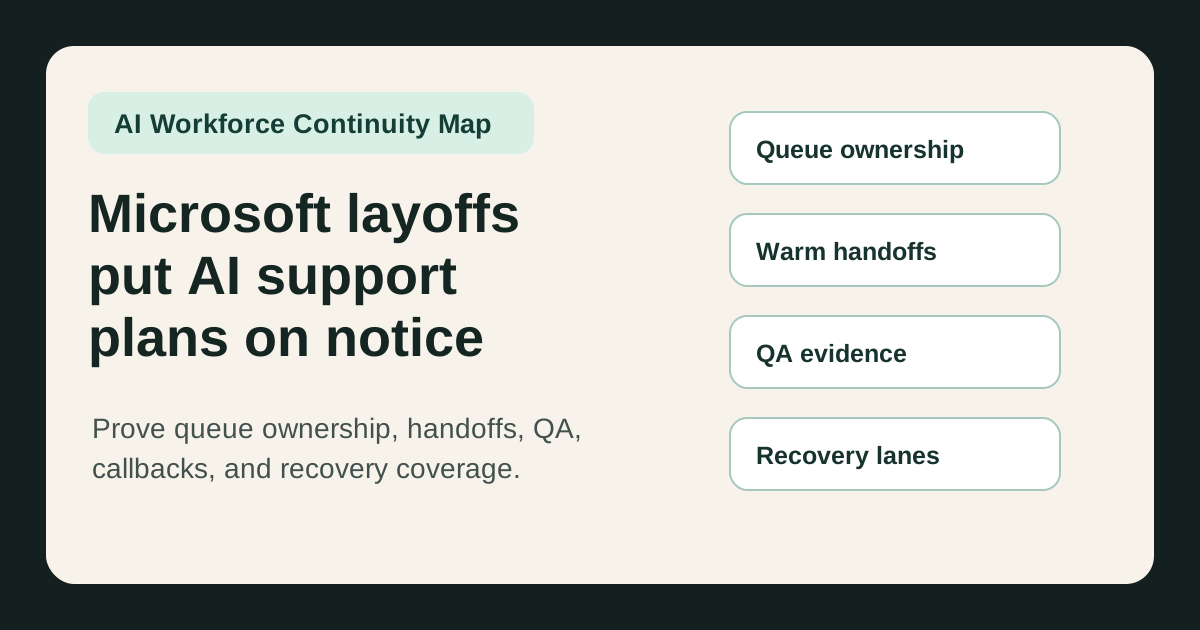
AI Workforce Continuity Map
Use this map before reducing support coverage, outsourcing a queue, or assigning AI to work that used to be held by a team.
| Continuity layer | What AI can improve | Where coverage breaks | Human proof required |
|---|---|---|---|
| Queue triage | Classify intent, summarize context, route by priority, flag sentiment | Tickets route incorrectly or sit between teams | Named queue owner, exception rules, and daily aging review |
| Customer handoff | Prepare summaries, draft replies, collect account details | Customers repeat themselves or lose the thread | Warm handoff notes, contact history, and accountable case owner |
| Knowledge retention | Surface policy answers, suggest scripts, identify common issues | Departing staff take undocumented process knowledge with them | Updated playbooks, QA review, and process owner sign-off |
| Follow-up work | Create tasks, schedule callbacks, update CRM fields, remind agents | Automation creates work but nobody closes the loop | Callback queue, task SLA, completion audit, and supervisor review |
| Escalation coverage | Detect repeat contact, high-risk language, urgent cases, billing issues | High-stakes cases stay trapped in self-service | Escalation triggers, trained operators, and decision authority |
| Recovery and QA | Cluster failures, review transcripts, detect reopen patterns | AI mistakes repeat because nobody repairs the process | Failed-case review, coaching loop, and customer repair workflow |
What buyers should do next
- Build a queue-by-queue map of work that AI can assist, work that AI can own, and work that still needs trained people.
- Keep human ownership for billing exceptions, customer complaints, callbacks, high-risk accounts, and failed automation.
- Turn every staffing-change proposal into a coverage proof packet: hours, languages, queues, escalation triggers, QA owner, and recovery owner.
- Measure reopen rates, repeat contacts, abandoned queues, refund events, negative reviews, and customer effort after AI changes.
- Use remote support teams for documented continuity lanes instead of treating them as generic overflow.
- Use the support coverage calculator to size the human coverage that should remain behind automation.
The real takeaway
The Microsoft story makes the workforce version of AI adoption visible. AI can change support economics, but only when the coverage model is redesigned with proof.
Before cutting seats or promising savings, buyers should make sure customers still have a path to a trained person, a named owner, and a recovery process when automation is not enough.
Buyer FAQs
- What is the Microsoft layoff story? - Business Insider reported that Microsoft planned thousands of job cuts across areas including sales, consulting, and Xbox while continuing heavy AI investment. GeekWire and other outlets independently covered the expected cuts.
- Why does this matter to support buyers? - Large-company AI restructuring gives smaller buyers a warning: headcount savings are only real if customer handoffs, queue coverage, knowledge retention, QA, and recovery work are still owned.
- Should support teams cut staff as soon as AI tools improve? - No. Staff changes should follow proof that the AI layer can handle routine work and that trained people still cover exceptions, emotional customers, account-specific issues, callbacks, and failed automation.
- Where can remote operators help? - Remote operators can hold documented continuity lanes: overflow, after-hours coverage, follow-up tasks, failed AI handoffs, queue cleanup, CRM updates, QA sampling, and customer recovery.
Sources
- Business Insider - Independent reporting that Microsoft planned thousands of job cuts across sales, consulting, Xbox, and other areas while ramping AI spending.
- GeekWire - Independent Seattle technology coverage confirming the planned Microsoft job cuts and placing them near Microsoft's fiscal-year close.
- MarketWatch - Market coverage connecting the layoff report to investor scrutiny over Microsoft's AI capital spending.
- New York Post - Business coverage summarizing the expected cuts, prior 2026 layoff rounds, and investor concern about AI spending.