Mechanical Turk Closure Puts Human Review Continuity on the Clock
Amazon's September 30 closure ends a long-running route to distributed human work. Buyers must now separate unfinished tasks, worker settlement, historical records and replacement human-review capacity.

Direct Answer
Amazon’s Mechanical Turk closure date was September 30, 2026. Operations buyers with a dependency on that workforce now need a Human Review Continuity Map: which work remains unresolved, who decides pending submissions, how worker settlement is checked, which records must be preserved, and how replacement reviewers will be qualified. The current event is the arrival of the published closure date, not a newly announced shutdown or proof that AI replaced the workers.
Remote Partners AI is a marketing partner of Azpired. Azpired confirms, contracts and delivers selected services. This is an illustrative planning framework, not a claim of an Amazon relationship, completed migration, client result or guaranteed replacement capacity. The lead image is a synthetic representative workplace scene, not a photograph of Amazon or the closure.
What Happened
Amazon’s closure FAQ sets September 30 as the end of HIT submissions. It also gives a post-closure approval period through October 30, allows bonuses through that date, and keeps transaction history accessible until January 28, 2027. Completed and approved work follows the existing payment schedule. These are different operational deadlines; ending task intake does not finish settlement or record preservation.
The FAQ also says the Mechanical Turk Worker type is no longer available for new SageMaker Ground Truth labeling jobs or Amazon Augmented AI human-review workflows. This concerns that workforce option, not a blanket closure of every related AWS service.
Independent reporting by TechRadar covered the shutdown in August. The University of Maine separately told affected researchers to change platforms and modify their IRB applications before collecting data through a replacement. Its notice shows that continuity can involve institutional approvals as well as a new supplier account.
Why This Matters Now
The scheduled closure has arrived. A team that treated human review as a background API can discover that queue completion, finance, records and quality ownership sit with different people. A new marketplace account alone does not reproduce the old instructions, reviewer access or acceptance criteria.
The broader buyer lesson is a platform dependency. Human review may sit behind an AI workflow, a labeling pipeline, a research study or a content queue. When the access route ends, the need for accountable review remains. Buyers should check the workflow rather than assume that automation absorbs the missing work.
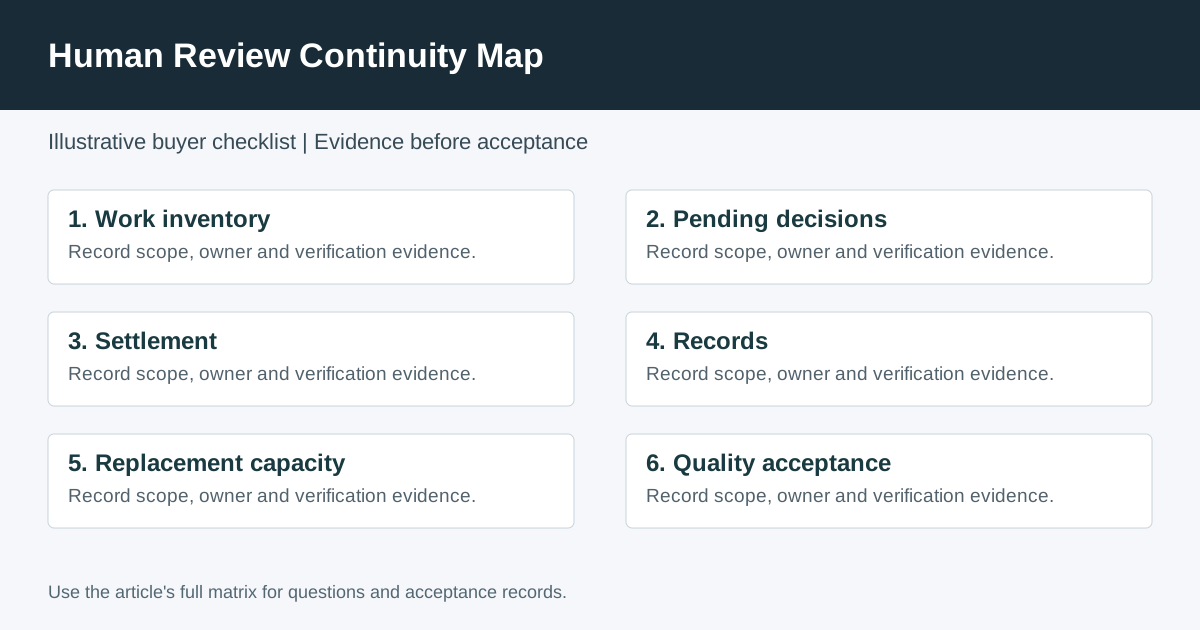
Human Review Continuity Map
| Layer | Buyer question | Acceptance evidence |
|---|---|---|
| Work inventory | Which queues and integrations depended on MTurk? | Queue list, open items, API owner and stopped-submission confirmation |
| Pending decisions | Who reviews outstanding submitted work? | Assignment status, review owner and decision log |
| Settlement | Who checks payment, bonuses and refunds? | Reconciliation record and unresolved-payment owner |
| Records | What must be exported before access expires? | Authorized archive, retention rule and retrieval test |
| Replacement capacity | Who can review the same task under approved conditions? | Scope, access controls, staffing commitment and escalation contact |
| Quality acceptance | How will the replacement be judged? | Sample rubric, disagreement review, acceptance threshold and signoff |
This map is an original planning asset. Its acceptance rows are proposed buyer controls, not requirements stated by Amazon or a promise of any supplier’s capabilities.
Worked Example
Consider an illustrative team using distributed reviewers to label support conversations for quality analysis. Before switching providers, it lists the unresolved labeling batches, separates submitted work from unsubmitted tasks, and names a finance owner for settlement. It exports only authorized records under its retention policy.
The replacement reviewers then receive a limited test set with approved data access and the same written rubric. A supervisor reviews disagreements and decides whether the sample meets the team’s acceptance threshold. The new route expands only after task instructions, review capacity and exception handling are understood. No customer result is implied by this example.
Buyer Bridge
For remote operations, the practical question is who supplies and supervises the human work when a platform disappears. Keep the data owner, task owner and delivery owner visible. Ask a prospective provider to confirm scope and capacity in writing, demonstrate a review sample, and identify who resolves ambiguous cases.
A continuity decision should account for work already performed and people awaiting settlement. It should also preserve the evidence needed to understand old decisions after the platform’s history access ends. Treat replacement selection, record retention and financial reconciliation as separate deliverables with named owners.
Next Steps
- Identify MTurk-dependent task queues and human-review integrations.
- Assign pending submission decisions and settlement reconciliation to named owners.
- Preserve authorized records before the published history-access deadline.
- Confirm replacement reviewers’ task scope, confidentiality, capacity and escalation coverage.
- Run a bounded quality sample and record acceptance before expanding the new route.
Use the support coverage calculator to structure the staffing discussion. Contact the email listed on this site for sourcing questions; Azpired confirms any proposed delivery scope.
Sources
- Amazon Mechanical Turk closure FAQ
- TechRadar’s independent shutdown coverage
- University of Maine research compliance notice
Buyer FAQs
- Did Amazon say AI caused Mechanical Turk's closure? - Amazon's public closure notice cites an assessment. It does not establish that AI replacement caused the shutdown.
- Does the closure end every SageMaker human-review option? - The FAQ specifically removes the Mechanical Turk Worker type from new labeling jobs and human-review workflows. That is not a claim that every related AWS service or workforce option is closed.
- What role does Remote Partners AI have? - Remote Partners AI is a marketing partner of Azpired. Azpired confirms, contracts and delivers selected services; availability and scope must be confirmed with Azpired.
Sources
- Amazon Mechanical Turk closure FAQ - Primary closure timetable, pending work, worker settlement, records access and affected MTurk workforce option.
- TechRadar - Independent August 29 reporting on the permanent closure scheduled for September 30.
- University of Maine Office of Research Compliance - Institutional notice explaining that affected researchers need another platform and an IRB application modification.