OpenAI, Anthropic, Amazon, and Microsoft Just Backed a $500M AI Workforce Push
The news is not another AI demo. It is a labor-market signal: the largest AI firms are funding worker transition while buyers decide which support roles should change first.
Direct answer
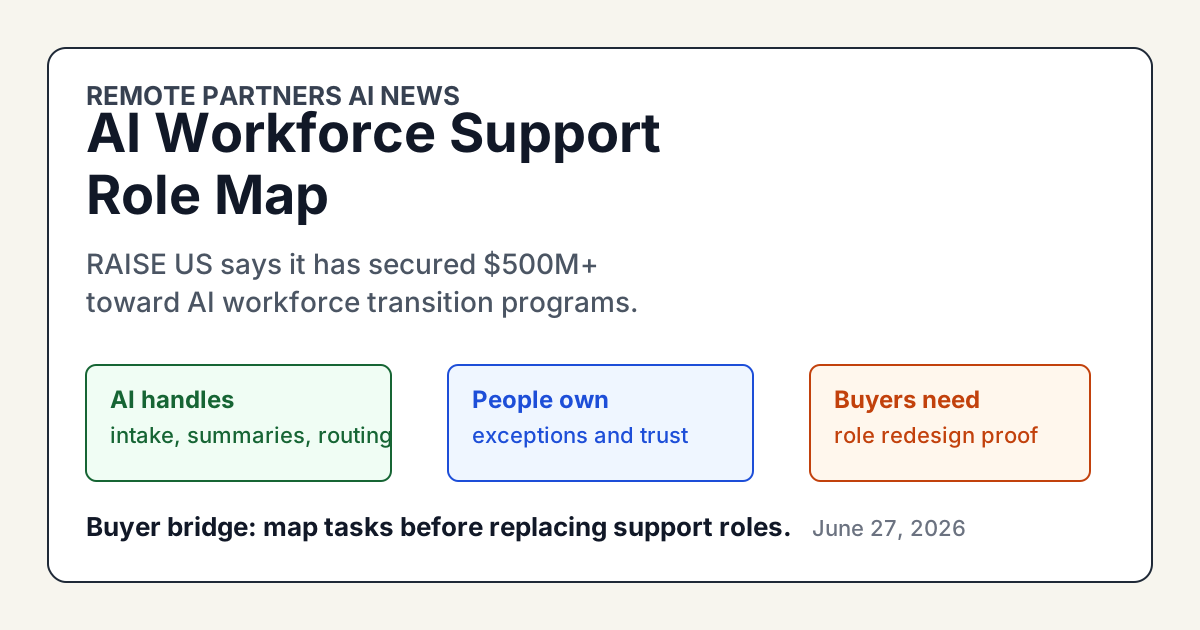
RAISE US launched on June 25, 2026 with more than $500 million secured toward a $1 billion national AI workforce initiative. Its anchor partners include Amazon, Anthropic, Microsoft, and the OpenAI Foundation, with initial state partnerships in Arkansas, Connecticut, Maryland, and Utah.
For customer operations buyers, the signal is clear: AI adoption is now a workforce transition issue. The practical response is not to replace support people blindly. It is to map which tasks AI can handle, which tasks trained remote specialists should own, and which customer moments still need accountable human judgment.
What happened
RAISE US announced that it will work with governors, employers, workers, workforce agencies, training providers, and technology companies to help Americans adapt as AI changes work.
The launch announcement says the organization has secured more than half of its $1 billion goal and names Amazon, Anthropic, Microsoft, the OpenAI Foundation, Bank of America, and other organizations among the launch supporters and anchor partners.
The first state partners named in the announcement are Arkansas, Connecticut, Maryland, and Utah. Maryland also issued its own release confirming the workforce partnership.
Why this is trending
The story is getting attention because it ties AI labor risk to concrete funding from the companies building the technology. Instead of saying AI will change jobs in the abstract, the initiative puts capital, state partnerships, training, and employer coordination behind the transition.
That matters for service teams because customer support is one of the first functions where AI directly changes job design. AI can classify requests, draft replies, summarize calls, route work, update CRM fields, coach agents, and handle routine questions. But customers still judge the business on exceptions, trust, follow-up, and accountability.
The Remote Partners AI take
The wrong question is: “How many support agents can AI replace?”
The better question is: “Which support tasks should move to AI, which tasks should move to trained remote operators, and which decisions still need a person who owns the outcome?”
Small businesses should treat AI workforce planning as a role-design exercise. A chatbot or voice agent can reduce repetitive handling, but only if CRM data is reliable, escalation paths are clear, and humans are trained for the higher-value work that remains.
AI Workforce Support Role Map
Use this map before changing staffing, outsourcing, or AI coverage.
| Customer operations lane | AI can usually help with | Human owner should keep | Retraining signal |
|---|---|---|---|
| First-contact intake | Capture intent, contact details, urgency, and transcript summary | Detect sensitive cases, angry customers, and incomplete context | Train agents to review AI summaries and correct routing fast |
| Routine status | Answer order, appointment, ticket, or delivery status from trusted systems | Handle stale data, missing records, exceptions, and promises outside policy | Train operators on CRM and scheduling data hygiene |
| CRM notes and follow-up | Draft notes, next steps, tags, and reminders | Approve account-sensitive updates and relationship context | Train staff on QA, account history, and follow-up discipline |
| Knowledge answers | Suggest documented policy, troubleshooting steps, and links | Own legal, pricing, medical, financial, or unusual policy judgments | Train people to maintain knowledge bases and flag gaps |
| Complaints and refunds | Summarize the issue and prepare options | Decide refunds, credits, cancellations, escalation, and retention actions | Train specialists on empathy, policy boundaries, and risk |
| QA and coaching | Find reopens, sentiment spikes, transfer failures, and repeated issues | Decide coaching, process changes, and customer recovery | Train supervisors to audit AI outcomes, not just handle volume |
What buyers should do next
Start with a task inventory, not a vendor demo.
- List the top support intents by volume and cost.
- Mark each intent as routine, judgment-heavy, sensitive, or revenue-sensitive.
- Identify which systems the answer depends on: CRM, orders, billing, calendars, ticket history, or knowledge base.
- Decide whether AI can complete the task, prepare the task, or only route it.
- Assign a human owner for complaints, refunds, complex troubleshooting, escalations, and high-value accounts.
- Track reopened cases, missed follow-up, transfer accuracy, customer effort, and revenue risk.
If you are planning coverage changes, use the support coverage calculator to estimate the human layer before moving routine work into automation.
The real takeaway
RAISE US is a workforce story, but it is also a buyer-readiness story.
AI will keep absorbing repetitive customer operations work. The companies that avoid service damage will be the ones that redesign roles before they automate: clean data, narrow AI task boundaries, trained remote specialists, human escalation, and QA that measures customer outcomes instead of only labor reduction.
Buyer FAQs
- What is RAISE US? - RAISE US is a national AI workforce initiative launched on June 25, 2026 to partner with states, employers, workers, training organizations, and technology companies on AI readiness, training, and worker transition.
- Which companies are backing the initiative? - The launch announcement names Amazon, Anthropic, Microsoft, and the OpenAI Foundation as anchor partners, with additional support from Bank of America and other organizations.
- Why does this matter to customer support buyers? - It shows that AI adoption is being treated as a workforce redesign issue, not only a software purchase. Support buyers need role maps, escalation ownership, and retraining paths before replacing routine tasks.
- What should small businesses do first? - Map customer support work by task, data dependency, risk, and human judgment requirement before adding AI agents or changing staffing.
Sources
- RAISE US launch announcement - Primary source for the June 25 launch, anchor partners, initial state partnerships, and more than $500 million secured toward a $1 billion workforce goal.
- Associated Press coverage - Independent coverage of the AI workforce initiative, state partnerships, and policy context.
- Axios workforce analysis - Independent analysis connecting the initiative to AI labor-market anxiety and large technology-company involvement.
- Maryland governor announcement - State-level confirmation that Maryland joined the launch cohort alongside other state partners.