Philippine BPO Group Pushes Back on US Plan to Bring Call Center Jobs Home
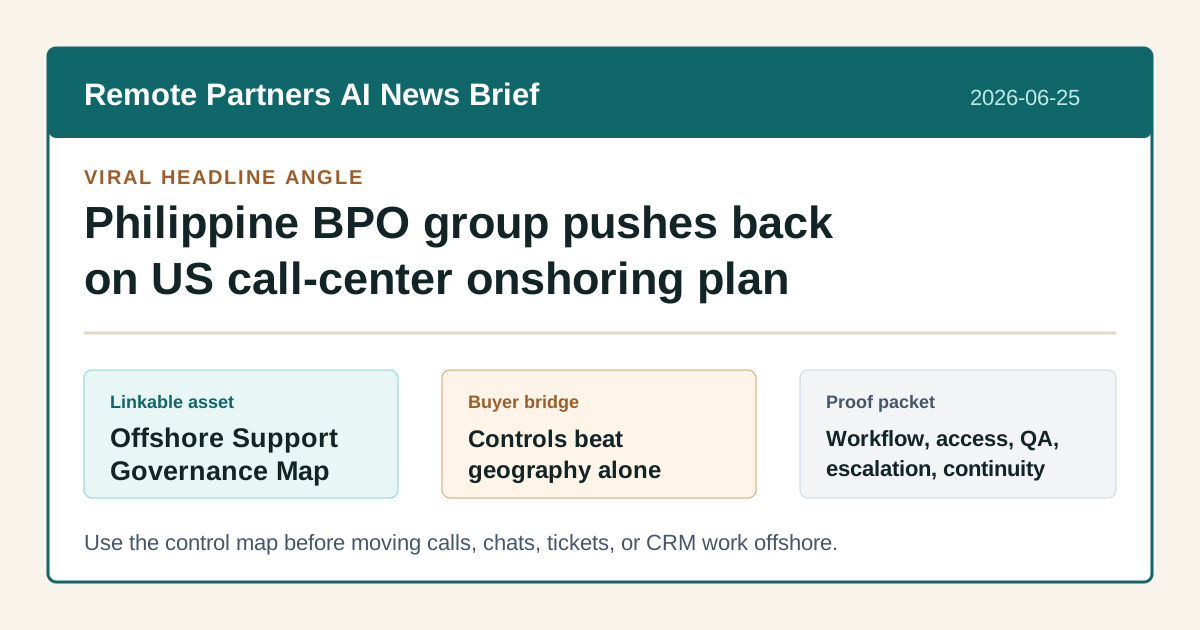
The viral headline is protectionist. The buyer lesson is operational: offshore support risk is governed by controls, QA, and accountability, not geography alone.

Direct answer
GMA News reported on June 23, 2026 that Philippine outsourcing groups pushed back on a US Federal Communications Commission proposal aimed at encouraging call-center onshoring and strengthening standards for foreign customer-service operations.
The buyer takeaway is not that every offshore support model is automatically safe or unsafe. It is that geography is a weak proxy for quality. Customer outcomes depend on governance: approved workflows, access controls, QA, supervision, cybersecurity, escalation rules, and the client-side owner who remains accountable.
What happened
The FCC published a proposed rule in the Federal Register on April 23, 2026. It says the Commission is exploring actions to improve customer service communications, better protect sensitive consumer information, limit use of foreign call centers, improve standards for remaining foreign call-center operations, and deter scam or unlawful calls made to the United States from abroad.
GMA News reported that three groups, the IT and Business Process Association of the Philippines, the American Chamber of Commerce of the Philippines, and the US-ASEAN Business Council, filed a position paper opposing the approach. The groups argued that geographic caps would create operational and economic consequences without clear consumer benefit.
Their core argument is useful for buyers: legitimate enterprise contact-center operations are usually governed by client workflows, monitoring, audit requirements, cybersecurity controls, escalation procedures, scripts, and contractual performance obligations.
Why this is trending
The story sits at the intersection of US consumer protection, offshore labor, AI automation, robocall policy, and the future of the Philippine BPO industry.
It is also easy to oversimplify. A headline about bringing call-center jobs home can turn into a location debate. Operators have a harder question: what proof shows that a support workflow is safe, accountable, and good for customers?
That question matters even more as companies mix offshore teams, AI assistants, voice translation, call summaries, fraud controls, CRM access, and after-hours coverage.
The Remote Partners AI take
Do not respond to this story by choosing a country first.
Choose the control model first.
Small businesses need support coverage that answers customers, protects data, escalates judgment calls, and leaves a clean audit trail. A local team can fail those tests. An offshore team can pass them. The difference is whether the workflow has real operating controls instead of a staffing promise.
If you are evaluating support outsourcing, ask for the proof packet before the headcount plan.
Offshore Support Governance Proof Map
Use this map before moving call answering, chat, dispatch, ticket triage, CRM updates, or follow-up work to an offshore team.
| Control area | What to verify | Failure signal | Buyer action |
|---|---|---|---|
| Workflow scope | Which intents the team may handle, prepare, or escalate | ”They can help with anything” | Approve a narrow first workflow before expanding coverage |
| Data access | Which systems, fields, recordings, and customer records the team can see | Broad admin access or shared logins | Use role-based access, MFA, and least-privilege permissions |
| Script and authority | What the team may say, promise, refund, change, or schedule | Agents improvise policy | Separate routine answers from judgment calls requiring approval |
| QA evidence | How calls, chats, tickets, and notes are reviewed | Only anecdotal quality checks | Require sampled transcripts, scorecards, dispositions, and corrections |
| Escalation rules | Which complaints, urgent cases, VIP accounts, and exceptions move to humans | No named owner for edge cases | Name the internal owner and time-to-escalate rule |
| Security controls | How suspicious callers, identity questions, and account access are handled | Support team verifies identity by habit, not policy | Document verification steps, fraud flags, and incident response |
| Continuity | How coverage survives outages, holidays, surges, and tool downtime | Coverage depends on one person or one channel | Define backup staffing, fallback tools, and client notification rules |
What buyers should do next
Start with one workflow that is already leaking value: missed calls, after-hours intake, appointment reminders, first-response chat, ticket triage, or CRM cleanup.
Then ask the provider to show:
- The exact task boundary.
- The systems and permissions required.
- The script, SOP, and escalation rule.
- The QA scorecard and review cadence.
- The incident and data-access process.
- The metrics that prove the customer experience improved.
Use the support coverage calculator to estimate how much human capacity the workflow needs before deciding whether AI, offshore support, or internal staff should own each layer.
The real takeaway
The FCC debate is politically loud because it is about jobs, fraud, data, service quality, and customer trust.
For buyers, the practical lesson is quieter: offshore support should never be bought as cheap labor alone. It should be bought as a governed operating system with proof.
When a provider can show workflow limits, access controls, QA evidence, escalation rules, and client accountability, geography becomes one factor in the decision instead of the whole decision.
Buyer FAQs
- What did Philippine BPO groups oppose? - GMA News reported that IBPAP, AmCham Philippines, and the US-ASEAN Business Council pushed back on FCC proposals that could encourage or require more customer-service work to move back to the United States.
- What is the FCC proposal about? - The FCC proposed rule explores ways to improve customer service and protect consumer information by limiting use of foreign call centers, improving standards for remaining foreign call-center operations, and deterring unlawful foreign-originated calls.
- Does geography alone determine support quality? - No. The operating controls matter more: training, approved scripts, data access, monitoring, QA, escalation, cybersecurity, and contract accountability.
- What should buyers check before outsourcing support? - Buyers should ask for proof of workflow ownership, access controls, QA sampling, escalation triggers, audit logs, incident response, and client-side authority for sensitive decisions.
Sources
- GMA News coverage - Independent Philippine coverage of the IBPAP, AmCham Philippines, and US-ASEAN Business Council position paper responding to the FCC proposal.
- Federal Register proposed rule - Primary regulatory source for the FCC proposal, comment dates, affected service providers, and foreign call-center policy questions.
- Philstar business column - Additional Philippine business context on AI, onshoring pressure, and the BPO industry's exposure.