PwC's India-US Joint Venture: Remote Support Delivery Proof Map
PwC's September 2026 US-India consulting joint venture is a buyer prompt: when delivery, engineering, AI and managed services are blended across borders, ask who owns the support work, data access and escalation proof.

Direct Answer
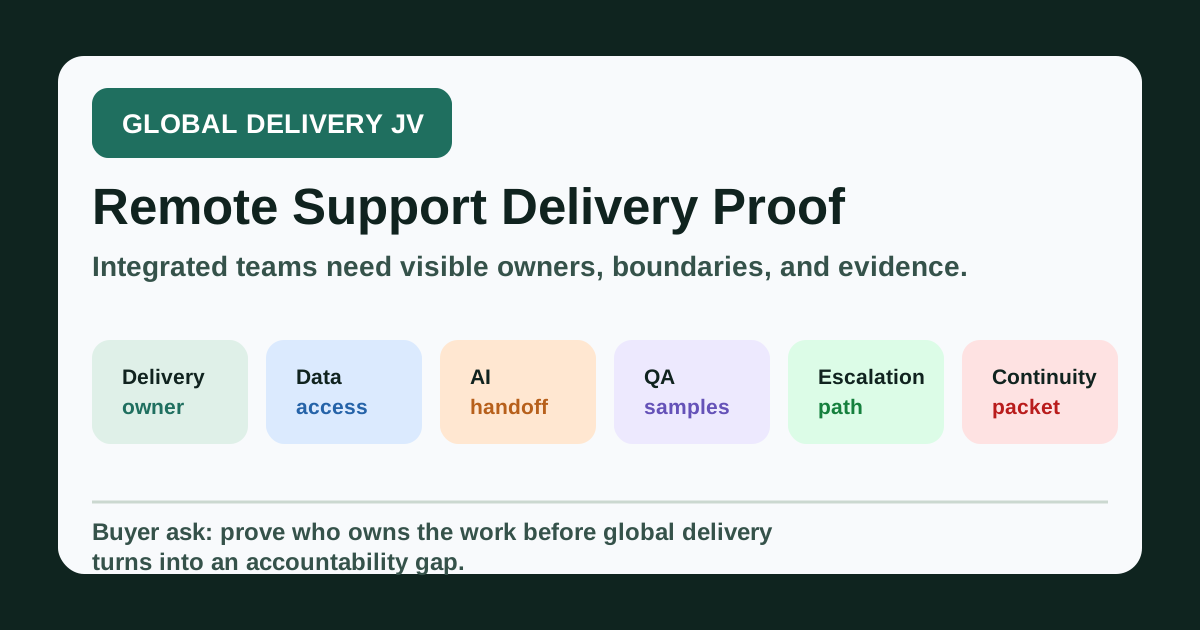
PwC’s September 2026 US-India joint venture is a reminder that remote and offshore delivery is no longer just a lower-cost staffing decision. Buyers should ask for a Remote Support Delivery Proof Map that shows who owns the work, which data each role can access, where AI is used, how QA is sampled, and how escalations are closed.
Remote Partners AI is the marketing partner of Azpired. Azpired confirms, contracts, and delivers selected services. This article is a planning framework based on public reporting; it is not a claim about PwC, Azpired client outcomes, or any guaranteed delivery result.
What Happened
PwC US and PwC India announced on September 13, 2026 that they are forming a joint venture combining PwC India’s Consulting business with PwC US Advisory’s India-based capabilities. PwC described the goal as a single integrated platform serving clients in India, the US and other markets.
The official announcement said the combined platform spans strategy, transformation, technology, engineering and AI, and brings managed services together at greater scale. PwC also said the transaction is expected to close in the first half of calendar 2027, subject to conditions and regulatory approvals.
Independent coverage framed the move as part of a larger shift in consulting delivery: India-based capability centers, offshore delivery teams, managed services and AI-enabled work are being pulled closer to client-facing operations.
Why It Is Trending
The story sits at the intersection of three buyer concerns: global delivery, AI-enabled work and accountability. Executives want speed and cost leverage, but customers still experience the support model as one promise. If data permissions, escalation ownership, QA and continuity are unclear, the savings can turn into rework.
For smaller support buyers, the lesson is practical. A remote team can be excellent, but only when the operating model is explicit enough to audit. “Where the work sits” matters less than whether the buyer can see who owns each outcome and what evidence proves it.
The Remote Partners AI Take
Use large-firm restructuring news as a vendor-screening moment. If major firms are blending advisory talent, delivery centers, AI and managed services, buyers should expect every support proposal to explain its delivery boundaries in plain language.
| Delivery layer | Buyer question | Proof to request |
|---|---|---|
| Capability owner | Who owns the queue, knowledge, QA and escalation path? | Named owner, backup owner, role matrix and handoff route |
| Data access | Which systems, fields and records can each role view or change? | Permission export, field restrictions, audit log and approval rule |
| AI handoff | Where does AI draft, summarize, classify, recommend or block work? | Workflow map, human-review triggers and rejected-output examples |
| Time-zone coverage | Which hours are staffed, monitored or escalated? | Coverage schedule, surge rule, after-hours owner and response target |
| QA sampling | How is remote work reviewed before errors compound? | Sample rate, scorecard, correction log and coaching owner |
| Continuity | What happens if the team, tool, vendor or country path is interrupted? | Backup team, documentation store, recovery test and exit packet |
Worked Example
Suppose a SaaS company wants an offshore support team to handle CRM updates, inbox triage and AI-drafted replies. A weak proposal lists agents, shifts and hourly rates. A stronger proposal shows:
- Which actions agents can complete without approval.
- Which CRM fields are read-only, editable or hidden.
- Which AI outputs require human review before sending.
- Which exceptions trigger a senior reviewer.
- Which evidence will be retained for disputes or audits.
The stronger version is easier to trust because the buyer can inspect the control surface before a customer-impacting mistake occurs.
Buyer Bridge
Ask providers to turn the delivery model into an artifact. The map does not need to be complicated, but it should name the team, task, data boundary, AI role, reviewer, escalation owner and evidence trail.
That proof helps buyers compare vendors on operating maturity instead of only on seat count or hourly price.
Next Steps
- Pick the five support workflows most likely to affect money, access, retention or trust.
- Ask each provider to map task owner, data permission, AI involvement and escalation owner for those workflows.
- Require sample evidence: QA notes, permission exports, exception logs, handoff notes and recovery examples.
- Keep the delivery proof map attached to the scope of work so changes in tooling, staffing or country mix trigger a review.
For sourcing or delivery questions, contact Remote Partners AI and Azpired through the email listed on this site.
Buyer FAQs
- Why does PwC's joint venture matter to remote support buyers? - It shows that global delivery is becoming more integrated with engineering, AI and managed services. Buyers should ask smaller providers the same practical questions: who owns the work, what data is accessed, how AI is supervised, and how escalation evidence is kept.
- What proof should a buyer request before approving a global support model? - Ask for a delivery proof map covering role ownership, country and time-zone coverage, data permissions, AI handoff rules, QA sampling, escalation owners, continuity plans and evidence retention.
- Does Remote Partners AI directly deliver the contracted services? - Remote Partners AI is the marketing partner of Azpired. Azpired confirms, contracts, and delivers the services a buyer selects.
Sources
- PwC - September 13, 2026 announcement of a joint venture uniting PwC India's Consulting business and PwC US Advisory's India-based capabilities.
- PR Newswire - Syndicated release describing the strategic combination, global delivery intent, managed services scale and expected first-half 2027 close.
- Financial Times - Independent September 2026 coverage framing the move as a shake-up of Indian operations as AI changes consulting delivery economics.
- Business Insider - Independent September 2026 reporting on PwC US's offshore delivery structure and Acceleration Centers in India.