Qantas' Project iQ Made AI Offshoring a Support Coverage Test
The news hook is fresh Australian reporting that Qantas is considering moving as many as 1,000 back-office roles offshore as part of Project iQ, its artificial-intelligence and technology overhaul. News.com.au reported the roles could include marketing, finance, and human resources work, with early talks involving Accenture and India. The Australian independently reported the Accenture/offshore talks and noted Qantas had not made a formal agreement. The buyer issue is not airline staffing politics; it is whether any AI-plus-offshore transition can prove customer coverage, data boundaries, knowledge ownership, handoff quality, and recovery evidence before work moves.

Direct Answer
Qantas’ Project iQ reporting is a buyer-risk story because it shows how quickly AI modernization and offshore delivery can become the same operating decision. News.com.au reported on August 4, 2026 that Qantas is considering moving up to 1,000 back-office roles offshore, including functions such as marketing, finance, and human resources, while The Australian independently reported early Accenture talks. Qantas had not announced a final decision.
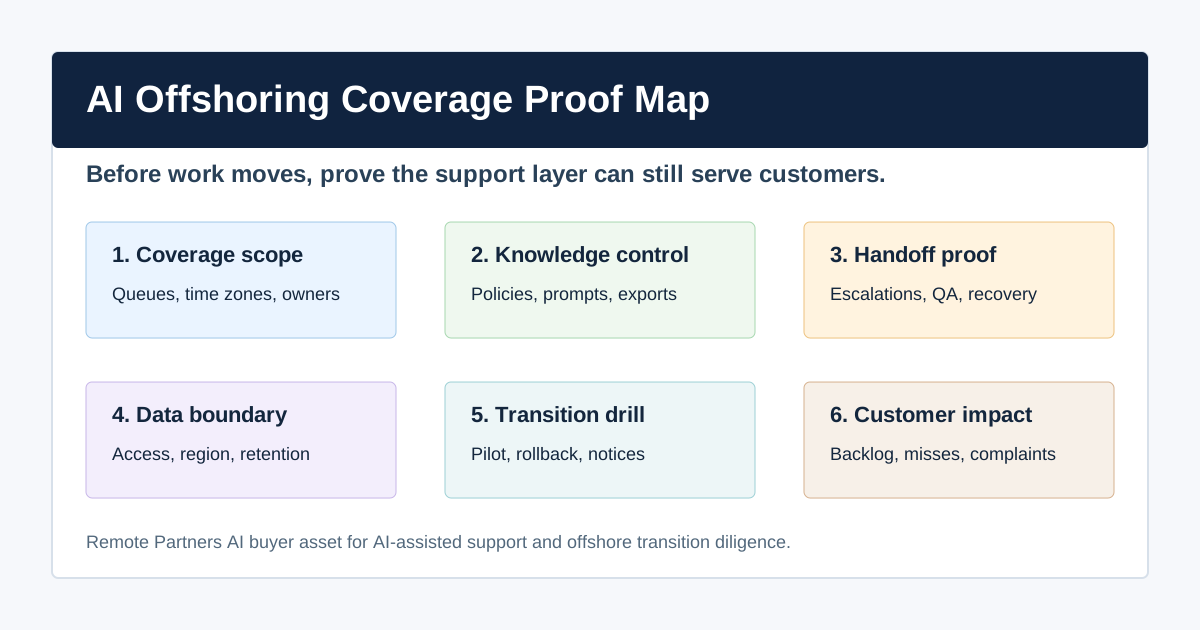
The buyer answer is an AI Offshoring Coverage Proof Map. Before approving any AI-plus-offshore transition, buyers should require evidence for queue coverage, knowledge ownership, handoffs, data boundaries, transition drills, and customer-impact recovery.
The lead image for this article is a synthetic representative editorial scene created for Remote Partners AI. It does not depict Qantas, Accenture, News.com.au, The Australian, any real employee, or any real customer incident.
What Happened
News.com.au reported that Qantas is weighing a major back-office shift as part of Project iQ, an artificial-intelligence and technology overhaul. The report said the work under consideration could involve up to 1,000 roles across corporate functions such as marketing, finance, and human resources, with India named in the offshore discussion.
The Australian separately reported that Qantas was in talks with Accenture about moving hundreds of back-office roles overseas. Both reports described the talks as early-stage rather than a completed outsourcing agreement.
That matters because AI transformation programs rarely change only software. They also change queue ownership, workflow routing, policy knowledge, access rights, escalation paths, and the amount of human recovery capacity available when customers, employees, or internal teams need help.
Why It Is Trending
The story has momentum because it combines three live themes: AI productivity pressure, offshore delivery, and sensitive back-office work. It is not a narrow software announcement. It is a labor, operations, vendor, and technology story at a large consumer-facing company.
It is also trending because buyers are being asked to trust AI programs before the operating evidence is visible. A company can say a modernization program will improve efficiency, but customers and internal users experience the result through response times, missed handoffs, record errors, exceptions, and escalation quality.
For remote support buyers, the practical question is whether the new model can prove coverage before the old model is removed.
The Remote Partners AI Take
Use an AI Offshoring Coverage Proof Map before approving customer-facing or back-office work that combines automation, offshore delivery, and vendor execution.
| Proof layer | Buyer question | Evidence to request |
|---|---|---|
| Coverage scope | Which queues, workflows, time zones, languages, and service levels will move or change? | Queue map, staffing matrix, service-level baseline, peak-volume plan, and named owner. |
| Knowledge control | Who owns policy, scripts, macros, prompts, and source-of-truth updates after the move? | Knowledge-base export, prompt library, update workflow, QA rubric, and approval log. |
| Human handoff | What happens when AI, offshore staff, or the vendor cannot resolve the issue? | Escalation paths, internal owner list, exception handling, after-hours rule, and sample tickets. |
| Data boundary | Which customer, employee, financial, or HR fields can the new workflow access? | Field-level access map, region rules, retention policy, audit log, and exception report. |
| Transition drill | Has the cutover been tested before customer or employee impact appears? | Pilot results, test cases, backlog simulation, rollback plan, and readiness signoff. |
| Customer impact | How will the buyer know if the move harms service quality? | Reopen rate, missed SLA report, complaint tags, repeated-contact analysis, and recovery queue. |
Buyer Bridge
Do not ask only whether an offshore team can do the work cheaper or whether AI can automate a task. Ask whether the combined operating model can prove that the customer will still get the right answer, in the right channel, with the right escalation path, after the work moves.
The first procurement question should be: “Show us the before-and-after coverage map.” The second should be: “Show us the recovery process if answer quality, backlog, access, or handoff breaks during cutover.”
Strong providers can show queue-level staffing, knowledge ownership, prompt and macro governance, QA samples, handoff rules, access boundaries, transition tests, rollback ownership, and customer-impact reporting. Weak providers will promise savings first and discover coverage gaps later.
Next Steps
- Inventory every workflow, record type, queue, macro, prompt, policy, escalation, and exception that the AI/offshore program will touch.
- Split the transition plan into AI-owned tasks, offshore-agent tasks, internal-owner tasks, and vendor-owned tasks.
- Run a transition drill using live-style tickets, policy exceptions, bad inputs, missing data, escalations, and backlog spikes.
- Require data-access proof for customer, employee, financial, and HR records before offshore staff or AI tools receive production access.
- Track repeated contacts, missed SLAs, reopen rate, complaint tags, answer defects, and rollback triggers during the first 30 days.
- Use Remote Partners AI’s AI back-office workflow support, support coverage calculator, and contact intake to pressure-test the human operating layer before migration.
Buyer FAQs
- What is the Qantas Project iQ news? - Australian outlets reported that Qantas is considering moving up to 1,000 back-office roles offshore as part of Project iQ, an AI and technology modernization effort. Reporting named early Accenture and India talks, while Qantas said no formal agreement or final decision had been made.
- Why does this matter to remote support buyers? - AI-assisted offshoring can change who owns queues, customer records, knowledge, escalation, quality review, and recovery work. Buyers need proof that service coverage will hold before work is moved.
- What proof should buyers ask for first? - Ask for an AI Offshoring Coverage Proof Map that shows coverage scope, knowledge ownership, human handoff rules, data boundaries, transition drills, customer-impact reporting, and rollback ownership.
Sources
- News.com.au - August 4, 2026 report that Qantas is considering moving up to 1,000 back-office jobs offshore under Project iQ, with early Accenture and India talks and no final decision.
- The Australian - Independent August 2026 business coverage of Qantas talks with Accenture about moving hundreds of back-office roles offshore.
- IndoNeo - Follow-up coverage connecting the Qantas offshoring report to Project iQ, India talks, and the planned Adelaide technology hub.