Revelio's Call-Center Shrinkage Made Transition Proof a Buyer Gate
Revelio Labs reported that global call-center headcount is 5.3% below its December 2023 peak after eight straight quarters of year-over-year decline. Remote support buyers should ask how vendors preserve coverage, retrain roles and escalate customers before automation reduces the first-rung workforce.

Direct Answer
Revelio Labs reported on October 6 that global call-center employment is now 5.3% below its December 2023 peak and has declined year over year for eight straight quarters. Its analysis says call-center workers are not moving into higher-paying white-collar roles at the rate a traditional career ladder would imply: only 10.8% of movers reached technical support, customer success or software and data work in the observed transition set.
The buyer lesson is not to assume a headline proves every vendor is cutting staff or that AI alone caused the decline. The lesson is that support buyers should ask for transition proof before automation, agentic tools or remote delivery changes touch customer queues.
The lead image is a synthetic representative editorial scene created for this article. It is not a photo of Revelio Labs, AI Lately, Digg, Azpired, Remote Partners AI or a real call-center transition review.
What Changed
Revelio Labs framed call-center work as a traditional first rung into white-collar employment. Its October analysis said that rung is weakening: global call-center employment is below its late-2023 peak, the decline has lasted eight year-over-year quarters, and many workers who leave call centers move sideways or out of white-collar work rather than into higher-paying technical roles.
Independent discussion then picked up the implication for AI and work. AI Lately treated the same Revelio data as a warning that support automation can remove a career bridge, while Digg surfaced the story into a wider AI-news feed. The trend is current enough for buyers to treat it as a procurement question, not an abstract labor-market debate.
Why Buyers Should Care
Remote support programs are rarely a single headcount decision. They combine queue coverage, training, QA, escalation, customer promises, CRM hygiene and manager oversight. If a vendor replaces or compresses front-line tasks without a transition plan, the buyer may see slower edge-case handling, thinner callback coverage, weaker complaint escalation or quality drift that does not appear in the demo.
Remote Partners AI is a marketing partner of Azpired. Azpired confirms, contracts and delivers selected services. This article is a buyer planning framework based on public reporting; it is not a claim about Azpired customer outcomes, labor-market certifications, government approval, guaranteed savings or guaranteed AI replacement.
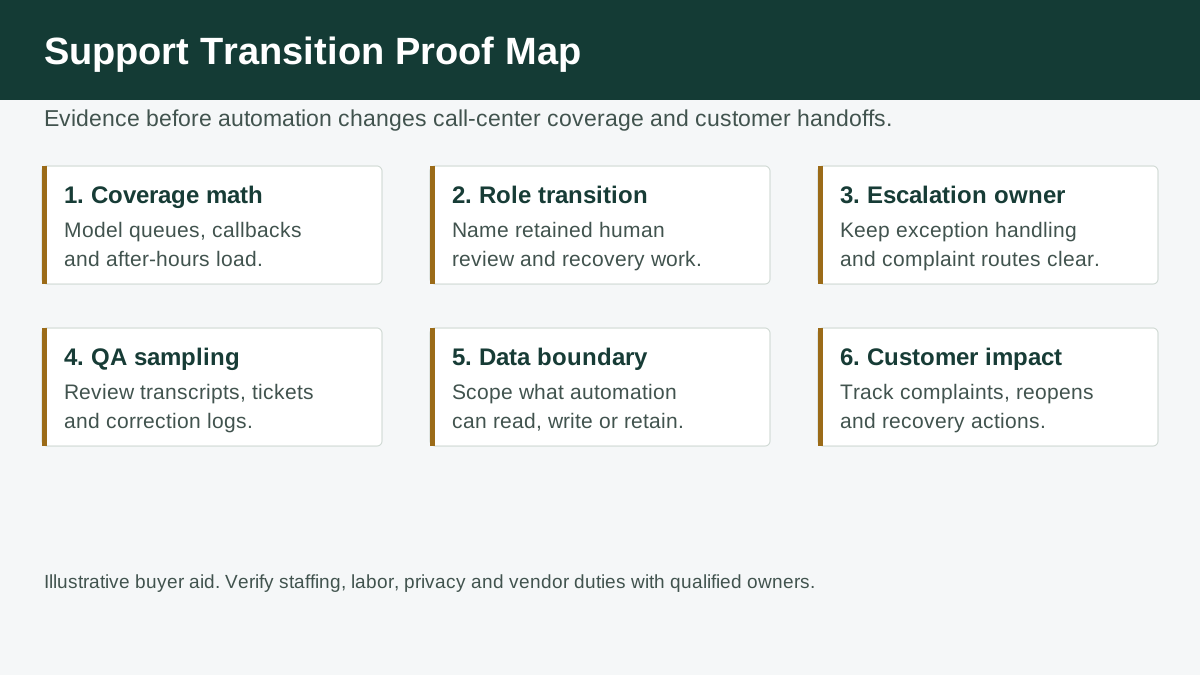
Support Transition Proof Map
| Proof layer | Buyer question | Evidence to request |
|---|---|---|
| Coverage math | Which queues, hours, languages and callback windows still need human coverage after automation? | Queue model, staffing roster, after-hours plan, overflow rule and abandoned-contact threshold |
| Role transition | Which tasks move to AI, which workers supervise, and which roles remain human-owned? | Task inventory, retained-role list, retraining plan and manager sign-off |
| Escalation ownership | Who handles complaints, sensitive cases, exceptions and unresolved customer intent? | Escalation tree, response-time target, accountable owner and fallback route |
| QA sampling | How does the buyer know quality did not drift after tasks were automated or compressed? | Sample plan, QA rubric, score trend, transcript review and correction log |
| Data boundary | Which customer records, call notes and workflow tools can automation read or update? | Access scope, retention rule, audit log and approval boundary |
| Customer impact | What evidence shows customers are not absorbing hidden transition costs? | Complaint trend, reopened-ticket rate, callback delay, CSAT notes and recovery actions |
This is a buyer planning aid. It does not determine labor law, vendor liability, worker-transition duties or the proper staffing model for any individual provider.
Illustrative Operations Example
Suppose a buyer moves tier-one email triage and call summaries into AI-assisted workflows. The vendor still needs people who can review ambiguous cases, coach the model workflow, answer callbacks, handle complaints, update the CRM and close quality findings. The buyer should ask which of those roles exist, how they are staffed, and what evidence shows customer handling improved or at least held steady.
The same question applies to remote teams that do not advertise AI. A vendor can shrink work by scripts, templates, stricter routing or fewer escalation paths. The buyer still needs proof of coverage and recovery.
Buyer Bridge
Ask for the transition map before the price sheet becomes the decision. A useful vendor answer names the queues affected, the human roles retained, the escalation owner, the QA sample, the data boundary and the customer-impact metric. If the answer is only “AI makes support more efficient,” the buyer still has work to do.
Use the support coverage calculator to model queue coverage, then confirm actual service scope, escalation contacts and support transition details by email with the provider.
Next Steps
- List every customer queue where automation, templates, AI agents or reduced staffing could change coverage.
- Ask vendors which roles remain human-owned after automation and who handles edge cases.
- Request QA samples, escalation logs and staffing assumptions for the first month after transition.
- Compare callback delay, reopened-ticket rate, complaint trend and CSAT notes before and after the change.
- Keep the transition evidence with the contract or scope record so future changes do not depend on memory.
Buyer FAQs
- Does this prove AI is the only reason call-center employment is shrinking? - No. Revelio Labs said AI's role is hard to wave off, but the public data does not isolate one cause. Buyers should use the trend as a trigger to ask for coverage, training and escalation evidence.
- Is Remote Partners AI claiming it can replace any call-center team with AI? - No. Remote Partners AI is a marketing partner of Azpired. Azpired confirms, contracts and delivers selected services after scope is discussed by email.
- Should buyers avoid vendors that use automation? - No. The safer question is whether automation is paired with role ownership, QA sampling, fallback capacity, escalation routes and customer-impact reporting.
- What should buyers request first? - Ask for a written transition map showing which queues are automated, which human roles remain, who handles edge cases and how service quality is measured after change.
Sources
- Revelio Labs - October 6 primary analysis reporting that global call-center headcount is 5.3% below its December 2023 peak after eight straight quarters of year-over-year decline.
- AI Lately - October 10 independent discussion connecting the Revelio data to the disappearing call-center career rung.
- Digg - October social-discovery coverage showing the Revelio analysis spreading through the AI and work conversation.