State Farm's AI Makeover Made Agent Coverage the Customer Test
State Farm's AI modernization drew fresh customer and agent pushback after WSJ reported more than 1,000 reader responses. The buyer issue is broader than insurance: any AI-assisted support rollout needs proof that human agents still own inaccurate summaries, sensitive cases, customer frustration, system outages, escalation authority, and recovery work.

Direct answer
The State Farm story is a warning about agent coverage proof. AI can help summarize customer households, speed up agent work, and reduce system switching, but the rollout becomes a customer-risk problem if summaries are wrong, agents cannot override them, customers cannot reach a person, or outages and old data problems are hidden behind a new AI interface.
Support buyers should not ask only whether AI will make agents faster. They should ask what happens when the AI summary is wrong, which human can fix it, how sensitive cases are routed, and what evidence proves customers were recovered.
What happened
WSJ reported that more than 1,000 readers responded to its coverage of State Farm’s AI modernization, with many customers and agents expressing skepticism about more automation in insurance service.
The coverage described concerns around inaccurate household summaries, frustration with existing digital service, system outages, workload pressure, and whether AI tools would make agents more effective or simply push more work onto fewer people.
PYMNTS summarized the backlash as State Farm customers and agents giving low marks to the insurer’s AI overhaul. The same coverage noted that many people accept AI as inevitable, but few were excited about more automation replacing the personal service they expect from an insurance agent.
State Farm’s own newsroom frames the strategy as Next Gen Good Neighbor. The company says Household Story gives agents AI-powered customer intelligence, and that future operations support should help agents get information without moving across multiple systems.
Why this is trending
The story lands because it is not a lab demo. It is a large consumer brand trying to change front-line service at scale while customers and agents judge whether the technology helps them or adds another layer of friction.
Insurance also raises the stakes. Customers call after accidents, losses, billing surprises, policy confusion, and family emergencies. If the AI summary is wrong or the human agent lacks authority, the experience can feel worse than a slower old workflow.
That pattern applies to healthcare, home services, financial services, field service, ecommerce, and B2B support. AI can assist the agent, but customers still judge the business by whether a trained human can understand, decide, and recover the case.
The Remote Partners AI take
The weak version of AI support is a dashboard that promises agent productivity while leaving the human team to clean up bad context, bad data, and angry customers without authority.
The stronger version is a coverage model. AI can summarize, search, draft, classify, and recommend. Remote support agents can review queues, fix CRM records, complete callbacks, prepare escalation notes, and audit failed AI sessions. But the workflow only works if the business names the human owner for every sensitive customer moment.
The buyer question is not whether AI belongs in customer support. It is whether the AI rollout preserves accountable agent coverage.
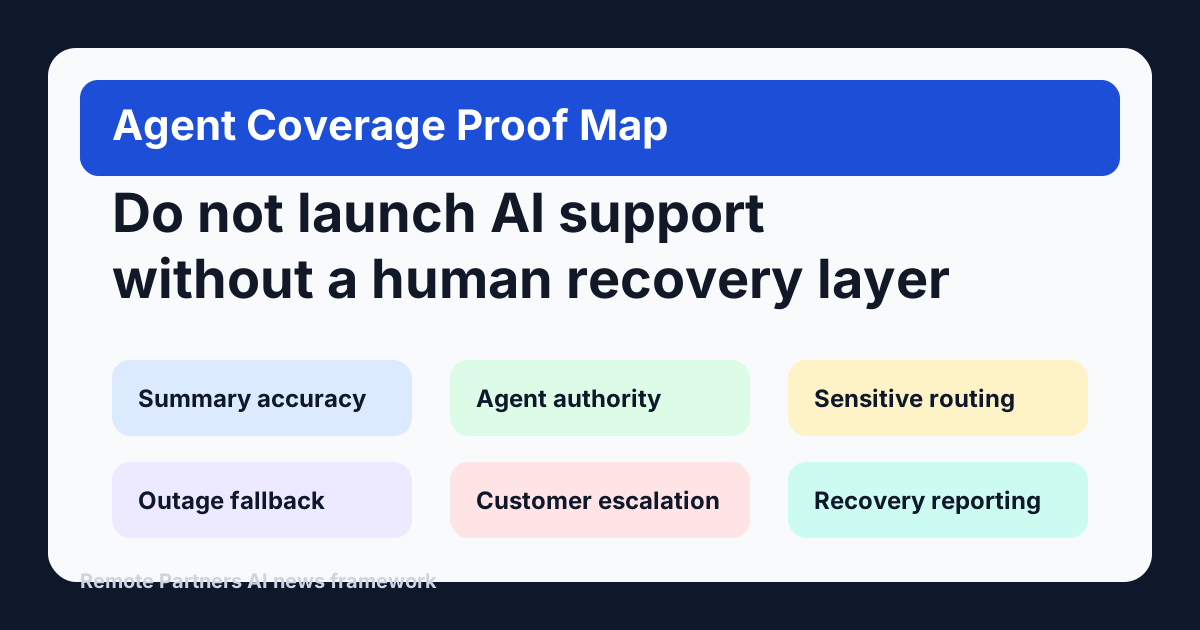
Agent Coverage Proof Map
Use this map before rolling AI summaries, agent assist, or customer-facing automation into a support workflow.
| Coverage layer | Buyer question | Weak signal | Evidence to require |
|---|---|---|---|
| Summary accuracy | Can agents prove the AI summary matches the customer record? | Agents see confident summaries with wrong dates, stale context, or missing issues. | QA samples, source fields, correction log, summary confidence rule, and owner for disputed summaries. |
| Agent authority | Can the human fix the problem after AI finds it? | Agents can explain the answer but cannot correct records, approve refunds, route urgent cases, or change outcomes. | Authority matrix, approval thresholds, escalation owner, repair workflow, and callback rule. |
| Sensitive-case routing | Which cases require a trained person before automation continues? | Claims, billing, health, identity, complaints, cancellations, and vulnerable customers are treated like routine inquiries. | Sensitive-case tags, blocked AI actions, human review triggers, QA rubric, and supervisor signoff. |
| System reliability | What happens when old systems, new AI, or customer portals fail? | The AI interface is promoted while outages, missing data, or legacy system friction remain unresolved. | Outage playbook, manual fallback, queue reroute, customer notice, and post-incident recovery report. |
| Customer escalation | Can customers reach a person without repeating the whole story? | Escalation exists in policy but not in the live flow, or the agent receives no useful context. | Live transfer test, callback completion, context handoff, wait-time report, and failed-handoff review. |
| Recovery reporting | Is success measured beyond automation usage? | Leaders report AI adoption while ignoring complaints, reopens, bad summaries, and extra agent work. | Weekly report with AI-handled volume, reopens, complaints, manual corrections, missed callbacks, and recovery notes. |
What buyers should do next
- Pick one AI-assisted support workflow and list the customer situations where a wrong summary would create risk.
- Review live examples with agents: correct summaries, wrong summaries, missing context, sensitive cases, and cases where the agent lacked authority.
- Create a human-owner table for corrections, escalations, callbacks, complaints, urgent requests, and regulated workflows.
- Add a failed-AI queue that captures bad summaries, trapped customers, data mismatches, and manual repair work.
- Report adoption and recovery together, not separately.
- Use the support coverage calculator before reducing agent coverage.
- If you need a managed human layer, review AI back-office workflow support and make summary correction and callback recovery part of the scope.
The real takeaway
AI support can make agents faster, but only if the human layer remains accountable.
The State Farm backlash shows what buyers should test before launch: when the AI gets the customer wrong, who catches it, who fixes it, and how does the business prove the customer did not fall through the workflow?
Buyer FAQs
- What is the State Farm AI makeover story? - WSJ reported fresh reader, customer, and agent reactions to State Farm's AI modernization effort. The concerns included trust in automation, inaccurate customer summaries, old system pain, workload fears, and the future role of human agents.
- Does the story prove AI should not be used in support? - No. State Farm says its strategy is human plus digital, and AI can help agents find information faster. The operating lesson is that AI must be paired with visible human coverage, data-quality checks, escalation paths, and recovery evidence.
- Why does this matter beyond insurance? - Any business adding AI to support can face the same pattern: customers want speed, but they do not want inaccurate summaries, trapped workflows, missing context, or an agent who cannot fix the problem.
- What should buyers require before rolling out AI support? - Ask for summary accuracy tests, agent override authority, sensitive-case routing, outage playbooks, customer escalation rules, data-quality owners, and weekly recovery metrics.
Sources
- The Wall Street Journal - July 2026 reader-response coverage of State Farm's AI makeover, customer and agent concerns, reported household-summary inaccuracies, and the insurer's human-plus-digital positioning.
- PYMNTS - Independent July 8, 2026 coverage summarizing WSJ's customer and agent reaction story and State Farm's broader AI customer-experience overhaul.
- State Farm newsroom - State Farm's primary May 2026 explanation of its Next Gen Good Neighbor initiative, Household Story AI-powered customer intelligence, operations support plans, and AI customer-service tools.
- State Farm OpenAI collaboration - Primary State Farm announcement describing its OpenAI collaboration, large policy/account base, and commitment to preserve personal human touch.