Uber's AI Support Push: Response Coverage Proof Map
Fresh reporting on Uber's internal AI tools, support-response automation and California layoffs turns AI-assisted customer service into a buyer question: can the support model prove answer ownership, review rules, remote coverage and recovery before automation changes the workflow?

Direct Answer
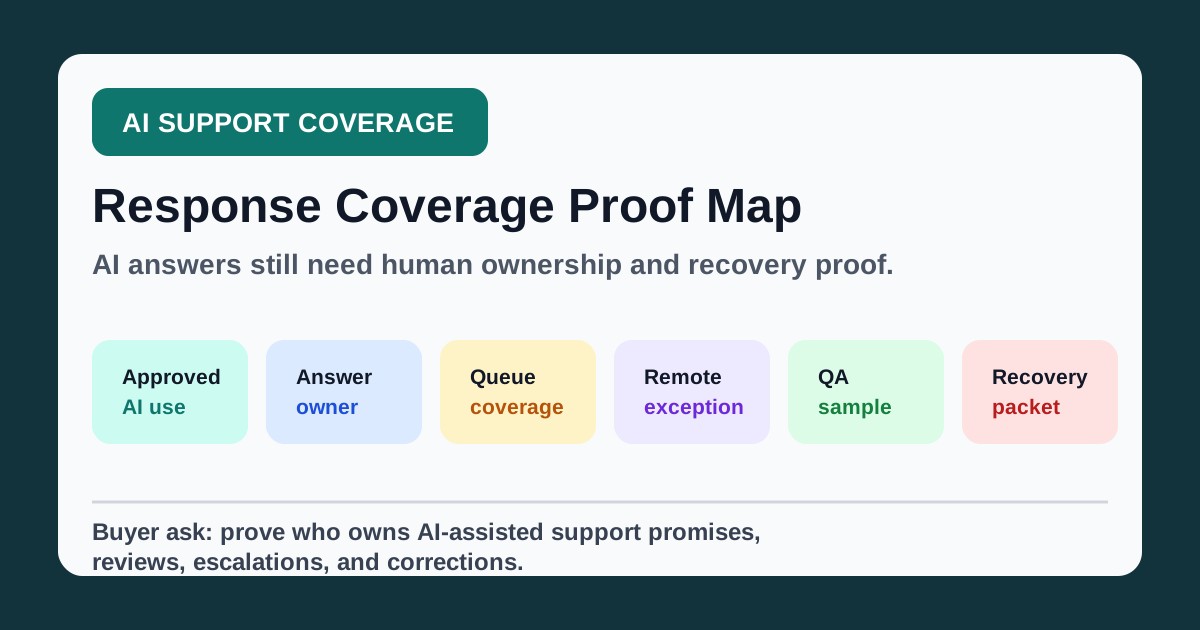
Uber’s September 2026 AI and layoff reporting is a support-response governance warning, not proof that AI automatically replaces service teams. When internal copilots write or suggest support responses while the company also restructures teams and tightens remote-work exceptions, buyers should ask for a Response Coverage Proof Map that shows who owns AI-assisted answers, which queues require human review, how remote coverage is approved, and what recovery evidence proves customers are protected.
Remote Partners AI is the marketing partner of Azpired. Azpired confirms, contracts, and delivers selected services. This article is a planning framework based on public reporting; it is not a claim about Uber, Azpired client outcomes, AI replacement, employee performance, or any guaranteed staffing result.
What Happened
Business Insider reported September 18 that former Uber employees questioned how heavily the company is leaning on AI tools after layoffs. The report said former staff described internal AI use cases including a tool that writes customer-support chat responses and tools that answer employee questions in Slack.
The same Business Insider report said Uber CEO Dara Khosrowshahi disputed the idea that AI was directly replacing laid-off workers. It reported that he framed the layoffs as a management restructuring designed to reduce bureaucracy, consolidate offices and improve team effectiveness.
San Francisco Chronicle reporting the same day said Uber disclosed 390 layoffs in California WARN notices, including 253 roles in San Francisco and 137 in Sunnyvale, within a broader global reduction of about 3,300 jobs. The Chronicle also reported that Uber tightened return-to-office rules and limited fully remote-work exceptions.
Axios reported in August that Uber’s weekly AI agent requests had increased 9.4 times since February while total AI costs stabilized after an earlier budget spike. That context matters because AI assistance is not limited to customer-facing chat. It can affect internal support, escalation, incident response and the information agents use to answer customers.
Why It Is Trending
The story combines several high-momentum issues at once: AI productivity claims, layoffs, return-to-office tension, internal copilots, support automation and management-layer reductions. That combination is exactly where support buyers can get confused.
The buyer risk is not whether one company says AI caused or did not cause a layoff. The practical risk is that AI-assisted answers, staffing changes and remote-work exceptions can change customer support faster than the coverage evidence catches up.
The Remote Partners AI Take
Use the Uber story as a due-diligence prompt: “If AI now helps write or route support answers, what proof shows that humans still own the customer promise?”
| Coverage layer | Buyer question | Proof to request |
|---|---|---|
| Approved AI use | Which support, knowledge, Slack, incident and workflow tasks may use AI? | Approved-use register, restricted topics and tool owner |
| Answer owner | Who is accountable when AI suggests a customer-facing response? | Human owner, reviewer rule and escalation trigger |
| Queue coverage | Which customer queues, regions, hours and languages change when automation expands? | Queue owner matrix, staffing model and overflow plan |
| Remote exception | Which roles can remain remote and how does that affect peak coverage? | Exception criteria, backup owner and handoff procedure |
| QA sample | How are AI-assisted answers sampled for accuracy, tone and forbidden claims? | QA sample, defect categories and correction log |
| Recovery packet | How will the team prove bad answers were found and repaired? | Changed-answer log, customer callbacks, reopened tickets and lessons learned |
Worked Example
Suppose a service team lets an AI tool draft responses for delivery refunds, billing questions and account-access issues. A weak plan says agents will review output before sending. A stronger plan shows:
- Which topics AI may draft and which topics are blocked.
- Which human role approves refund, account, privacy and complaint language.
- Which queues have coverage if remote-work exceptions shrink or peak demand rises.
- Which QA sample checks AI-assisted answers against policy and customer outcomes.
- Which recovery packet proves corrections, callbacks and reopened tickets were handled.
The second plan is easier to trust because it treats AI support as an auditable workflow, not a productivity slogan.
Buyer Bridge
AI-assisted support due diligence should include answer ownership and coverage proof, not only tool demos. A buyer still owns the customer promise when automation, office policy, management structure or staffing mix changes.
Ask providers to attach a response coverage proof map to the statement of work. It should name approved AI uses, human reviewers, queue owners, remote-coverage assumptions, escalation triggers, QA samples, forbidden claims and recovery evidence. That map makes the support model easier to inspect before customers discover the weak point.
Next Steps
- Inventory every place AI can draft, summarize, route or answer support work: chat, email, phone notes, knowledge base, Slack, incident channels and CRM tasks.
- Separate low-risk internal summaries from customer-facing answers, refunds, account access, complaints and legal or compliance topics.
- Name the human owner, reviewer rule and escalation trigger for each AI-assisted queue.
- Stress-test coverage against office-policy changes, remote exceptions, holidays, outages and peak contact windows.
- Keep QA samples, changed-answer logs, customer callbacks and reopened-ticket evidence tied to the automation change.
For sourcing or delivery questions, contact Remote Partners AI and Azpired through the email listed on this site.
Buyer FAQs
- Why does Uber's AI support reporting matter to support buyers? - It shows that AI tools can enter support-response, knowledge and internal-help workflows while staffing, management layers and remote-work rules also change. Buyers should verify who owns AI-assisted answers, which queues have human review, and how recovery evidence is kept.
- What proof should a buyer request before approving AI-assisted support? - Ask for a response coverage proof map covering approved AI use, answer owner, forbidden claims, human review, queue coverage, remote exception handling, QA samples, escalation paths and recovery evidence.
- Does Remote Partners AI directly deliver the contracted services? - Remote Partners AI is the marketing partner of Azpired. Azpired confirms, contracts, and delivers the services a buyer selects.
Sources
- Business Insider - September 18, 2026 reporting from former Uber staff saying the company leaned on internal AI tools for work including support-chat responses and employee Slack question answering, while Uber's CEO tied layoffs to management restructuring rather than AI replacement.
- San Francisco Chronicle - September 18, 2026 reporting on Uber's California WARN notices, including San Francisco and Sunnyvale layoffs, broader global reductions and the company's tightened remote-work exception policy.
- Axios - August 27, 2026 coverage of Uber's internal AI usage growth, including a reported 9.4x increase in weekly AI agent requests since February while AI costs stabilized.