UK Right-to-Work Expansion Made Contractor Proof a Staffing Gate
The October 1 right-to-work implementation cycle expanded the buyer conversation beyond payroll employees. Remote staffing buyers should know which contractor, agency, subcontractor and platform-worker checks their suppliers actually perform and retain.

Direct Answer
The UK government’s June written statement said October 2026 measures would extend illegal-working controls beyond ordinary employment into contracted workers, subcontractors, agency arrangements and gig-economy work. GOV.UK also published updated research on illegal-working perspectives on October 1, while public guidance continues to emphasize fair, documented checking practice.
For remote staffing buyers, the lesson is not to infer legal coverage from a job title or supplier invoice. The useful question is evidence-based: which worker arrangements are in scope, who performs the check, what proof is retained, and what happens when a contractor, agency worker or substitute changes.
The lead image is a synthetic representative editorial scene created for this article. It is not a photo of the UK government, NHS Employers, Azpired, Remote Partners AI or a real right-to-work file.
What Changed
The written statement framed the October 2026 measures as an extension of the right-to-work enforcement model into more flexible labor arrangements. That matters because modern support and operations programs often mix employees, remote contractors, agencies, subcontractors and platform-style pools.
The draft code of practice is also a reminder that checking discipline is not only about collecting a document. Buyers need to understand the route used, the timing of the check, the worker category, the anti-discrimination guardrails and whether a follow-up or expiry process exists.
Why Buyers Should Care
Remote staffing programs can look clean in a proposal while hiding several worker paths underneath. A buyer may speak to one account manager, sign one scope and receive one monthly invoice, but the work can involve agency staff, subcontracted delivery, substitute workers, temporary cover or offshore coordination.
Remote Partners AI is a marketing partner of Azpired. Azpired confirms, contracts and delivers selected services. This article is a buyer planning framework based on public reporting and government material; it is not a claim about Azpired customer outcomes, legal status, immigration advice, government approval, certification or guaranteed compliance.
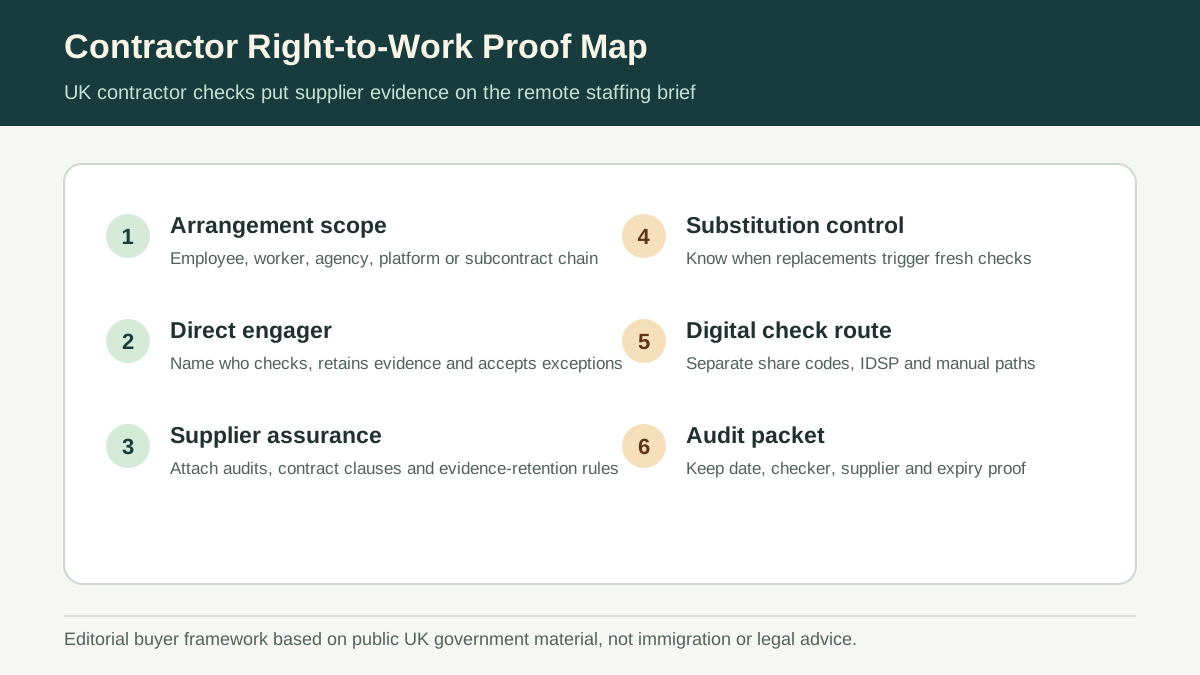
Contractor Right-to-Work Proof Map
| Proof layer | Buyer question | Evidence to request |
|---|---|---|
| Arrangement scope | Which employees, workers, agency staff, subcontractors, platform workers and substitutes can touch the work? | Worker-category map, role list, supplier chain and excluded arrangement notes |
| Direct engager | Who is responsible for performing the check for each worker path? | Named checker, checking route, accountable manager and exception owner |
| Supplier assurance | How does the buyer know the supplier and its subcontractors follow the required process? | Contract clause, audit right, evidence sample, escalation contact and review cadence |
| Substitution control | What happens when a substitute worker, temporary cover or replacement contractor starts work? | Change trigger, pre-start check rule, supplier notice and updated access record |
| Digital check route | Which share-code, IDSP, manual or follow-up route applies to each worker group? | Check type, date, evidence location, expiry date and non-discrimination review |
| Audit packet | Can the buyer reconstruct the check without exposing unnecessary personal data? | Date, worker category, checker, supplier, proof type, retention rule and redacted audit sample |
This is a buyer planning aid. It does not determine employment status, immigration liability, supplier obligations or the correct legal route for any individual worker.
Illustrative Operations Example
Suppose a buyer sources remote customer-support overflow through a supplier that uses a mix of directly managed staff, agency workers and occasional subcontracted language coverage. A generic “all staff are compliant” line is not enough for governance. The buyer needs a worker-path map, a named checker, a supplier assurance clause, a substitution trigger and an audit packet that can be reviewed without over-collecting personal data.
The same logic applies when no worker is physically present in the buyer’s office. Remote work can still involve access to customer systems, records, scripts and workflows. The buyer should know who is allowed into that environment and how the supplier proves eligibility before access is granted.
Buyer Bridge
Ask for the proof map before the staffing plan becomes production capacity. A useful vendor answer names the worker categories, the checking owner, the supplier-chain controls, the substitution rule, the digital or manual check route and the audit evidence retained.
Use the support coverage calculator to model staffing coverage, then confirm actual service scope, delivery entity, compliance responsibilities and contact path by email with the provider.
Next Steps
- Inventory every worker path used in the remote staffing scope, including substitutes and subcontracted cover.
- Ask suppliers who performs right-to-work checks, which checking routes are used and where evidence is retained.
- Add a change trigger for new contractors, substitutions, agency changes, subcontractor changes and location changes.
- Keep a redacted audit-packet sample with the service scope instead of relying on verbal supplier assurance.
- Route immigration, employment-status and data-retention interpretation to qualified legal counsel before treating the map as compliance advice.
Buyer FAQs
- Does this article provide UK immigration or employment-law advice? - No. It is a buyer evidence framework based on public sources. Employers, suppliers and staffing buyers should route legal interpretation to qualified counsel.
- Does the change mean every contractor arrangement is checked in the same way? - No. Worker status, engagement route, agency role, substitution rights, geography and contractual control can differ. Buyers should ask suppliers to map the actual arrangement.
- Is Remote Partners AI claiming government approval or right-to-work certification? - No. Remote Partners AI is a marketing partner of Azpired. Azpired confirms, contracts and delivers selected services after scope is discussed by email.
- What should a buyer ask first? - Ask who performs the check, which worker arrangements are in scope, how supplier assurance is retained and what happens when a contractor or substitute changes.
Sources
- UK Parliament written statement - June 30 ministerial statement saying measures coming into force in October 2026 extend illegal-working controls to contracted workers, subcontractors, agency arrangements and gig-economy work.
- GOV.UK draft code of practice - Draft code covering fair right-to-work checking practice, digital checks, share-code checks and avoiding discriminatory treatment.
- GOV.UK worker and employer perspectives - October 1 research publication on worker and employer perspectives of illegal working and right-to-work compliance.
- NHS Employers - October 5 guidance noting extension-scheme handling and evidential steps for affected right-to-work situations.