WIRED's Chatbot Hell Story Turns AI Support Into an Escalation Test
WIRED's July 2026 account of a missing $2,000 e-bike, chatbot-blocked support paths, and months of unresolved handoffs turned a consumer complaint into a broader AI support warning. AnswerConnect's May 2026 OnePoll research found 85% of surveyed consumers prefer a real person over AI in customer service, while SurveyMonkey's 2026 CX research found 89% believe companies should always offer a human option. The buyer issue is not whether AI can answer simple questions. It is whether a support operation can prove who owns exceptions, cross-vendor handoffs, human access, reimbursement authority, and recovery reporting when automation becomes the wall.

Direct answer
WIRED’s chatbot-hell story is a warning about support accountability, not just bad chatbot UX.
The article follows a missing e-bike order that moved across shipping, retail, banking, credit-card, and local police support paths. The recurring failure was that automated support often delayed or blocked access to someone who could own the exception. AnswerConnect’s May 2026 OnePoll research and SurveyMonkey’s 2026 CX research add the buyer context: consumers still want human access, especially when money, trust, accuracy, or problem resolution is at stake.
For outsourcing buyers, the proof test is direct: when AI cannot solve the problem, who can?
The lead image for this article is a synthetic representative editorial scene, not a photo of any named company or news event.
What happened
WIRED published a July 2026 first-person account of a missing e-bike order worth about $2,000. The package was marked delivered and signed for, but the buyer did not receive it. The recovery effort moved through multiple support channels: the shipper, retailer, bank, credit-card company, and police.
The operational pattern is the important part. Automated systems and chatbot-governed support paths repeatedly slowed the route to a human, forced restarts, or narrowed the available action. Even when a human appeared, the handoff chain did not produce a full recovery.
The story connected that experience to a broader support concern sometimes called sludge: friction that makes resolution exhausting enough for customers to abandon the effort.
AnswerConnect’s May 2026 research, conducted with OnePoll, says 85% of surveyed adults across the US, UK, and Canada prefer speaking to a real person over AI in customer service, and 59% find AI agents frustrating when calling support. SurveyMonkey’s 2026 customer-service research separately found 89% believe companies should always offer an option to speak with a human.
Why this is trending
AI support backlash spreads because nearly everyone understands the feeling of being trapped in a support loop.
What makes the WIRED story useful is that it is not about a simple FAQ failure. It is about an expensive exception with multiple parties, missing ownership, and no clean recovery path. Those are exactly the cases AI-first support teams often route badly if the operating model is built around containment alone.
The story also lands at the same time companies are promoting AI support efficiency, agentic workflows, and headcount reductions. Buyers are asking whether the savings are real if unresolved exceptions become chargebacks, complaints, churn, public criticism, or hours of manual recovery later.
The Remote Partners AI take
Remote support buyers should not judge AI support by containment screenshots.
The better proof is an escalation operating model: a human escape hatch that actually works, named owners for exceptions, cross-vendor handoff rules, authority to fix the issue, evidence logs, and recovery reporting that shows what happened after automation failed.
If those controls are missing, AI can turn a normal support problem into a customer-trust problem.
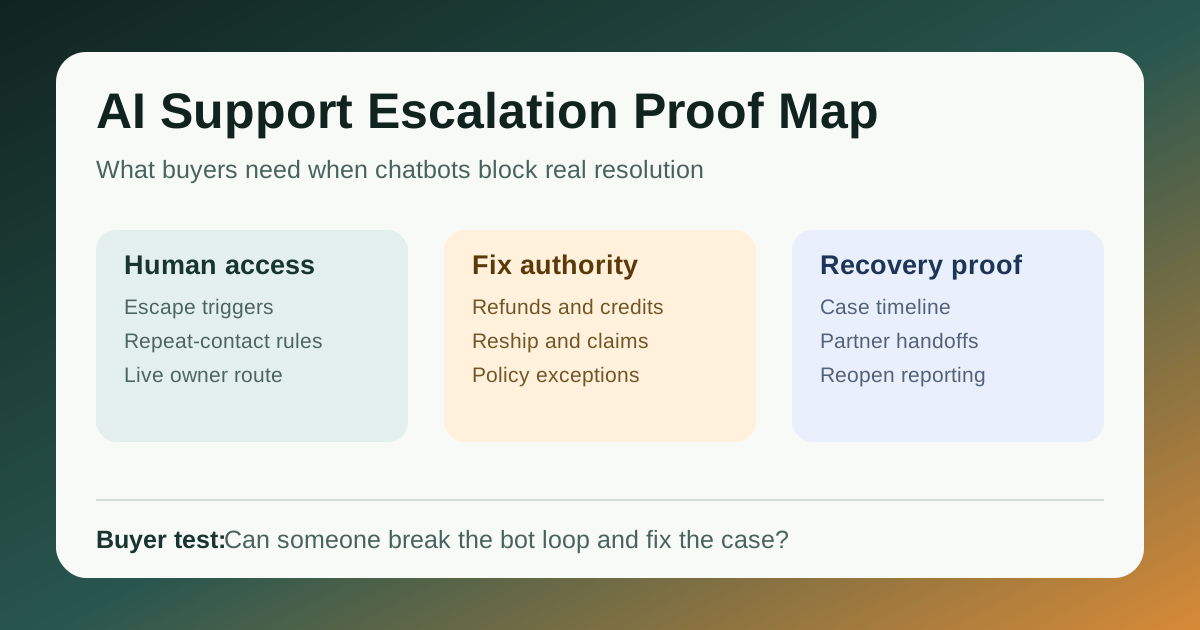
AI Support Escalation Proof Map
Use this map before approving AI chatbots, AI voice agents, outsourced support reductions, after-hours automation, offshore support redesign, or customer-service vendor handoffs.
| Proof layer | Buyer question | Weak signal | Evidence to require |
|---|---|---|---|
| AI-owned intents | Which questions can the bot finish alone, and which cases must never be trapped in automation? | The vendor says the bot can handle support without listing excluded cases. | Intent inventory, excluded case list, sample transcripts, and named owner for each AI-owned workflow. |
| Human escape hatch | Can customers reach a person when the case is expensive, emotional, repeated, or off-script? | The bot accepts requests for a human but loops customers through more prompts. | Escape phrases, repeat-contact triggers, value thresholds, sentiment triggers, and test transcripts showing transfer works. |
| Exception owner | Who owns lost shipments, billing disputes, urgent callbacks, refunds, damaged goods, and cross-vendor problems? | Agents can apologize but cannot decide who fixes the exception. | Escalation roster, authority matrix, queue coverage, supervisor route, and closure examples. |
| Cross-vendor handoff | What happens when the problem sits between a shipper, retailer, bank, platform, or local authority? | Each party tells the customer to contact someone else. | Handoff playbook, required evidence packet, partner contact path, customer update cadence, and ownership deadline. |
| Authority to fix | Can the support team refund, reship, credit, reschedule, file a claim, or override policy when evidence supports it? | Humans answer the transfer but have no practical power. | Permission map, exception policy, supervisor approval rules, compensation examples, and audit trail. |
| Evidence trail | Can the team preserve what the bot saw, what the customer said, and why the case moved? | Customers repeat the story at every handoff and prior bot context disappears. | Transcript export, ticket notes, attachment rules, bot-summary QA, and case timeline. |
| Recovery reporting | Are unresolved bot loops visible to leaders? | Dashboards report deflection while hiding reopened cases, complaints, and unresolved value. | Weekly report with containment, human transfers, reopens, lost revenue, refunds, complaints, saved customers, and automation defects. |
What buyers should do next
- Pick one high-value support workflow where AI is expected to reduce human contact.
- Write down which cases AI can finish and which cases require an immediate human route.
- Test the human escape hatch with repeat-contact, refund, lost-item, angry-customer, and cross-vendor scenarios.
- Confirm the support team has authority to fix the issue after escalation.
- Require an evidence packet for partner handoffs, including transcripts, timestamps, attachments, and owner notes.
- Add bot-loop defects to weekly reporting beside containment, reopens, complaints, compensation, and saved customers.
- Use the support coverage calculator before reducing human coverage, and review AI back-office workflow support if the escalation lane needs trained remote operators.
The real takeaway
AI can answer easy support questions. It cannot replace accountability for the cases that are expensive, confusing, emotional, or stuck between companies.
Before buying an AI-first support promise, ask for the escalation proof map.
Buyer FAQs
- What is the AI support escalation problem? - It is the gap between a chatbot answering routine questions and a support operation proving that a human can take over complex, expensive, emotional, or cross-vendor problems without making the customer restart the process.
- Why does the WIRED story matter to outsourcing buyers? - The story shows a real resolution problem crossing a carrier, retailer, bank, card company, and police department. Outsourced and remote support buyers need evidence that AI does not trap those cases in scripts or unowned handoffs.
- Does this mean AI support should be avoided? - No. AI can still handle simple work. The risk is deploying it without visible escalation rules, owner authority, exception handling, and reporting that shows whether humans fixed the cases automation could not finish.
- What should buyers ask for? - Ask for a human-access route, exception inventory, cross-vendor handoff playbook, authority map, evidence trail, customer recovery report, and sample cases where an AI support loop was successfully broken.
Sources
- WIRED - July 2026 first-person reporting on a missing e-bike, repeated AI chatbot support loops, failed cross-company escalation, and the broader customer-service sludge concern.
- AnswerConnect - May 2026 OnePoll research covering 6,000 adults in the US, UK, and Canada; the report says 85% prefer a real person over AI in customer service and 59% find AI agents frustrating.
- SurveyMonkey - February 2026 consumer research on humans versus AI in customer service, including human preference, human option, accuracy, and money-saving perceptions.