Training contract
Solution
Voice Agent Implementation Partner
Build, integrate, monitor, and staff an AI voice agent without making your internal team own every production detail.
Solution answer
A voice-agent implementation partner turns an AI phone-agent idea into a managed production workflow: platform selection, call-flow design, integration coding, QA, monitoring, escalation rules, and Cebu-based human handoff support when automation should stop.
When To Use This
A good fit when the issue is repeatable but still needs judgment and control.
Use this when you already like a platform or need one selected, but you need a partner to code integrations, set routing rules, monitor quality, and staff handoffs.
Common signals
Client control
What stays under your approval?
What improves
What should improve?
A production voice-agent workflow that can answer, route, write to systems, escalate, and improve without becoming another unsupported software experiment.
Partner operating model
The useful partner is the layer between voice-agent software and real operations.
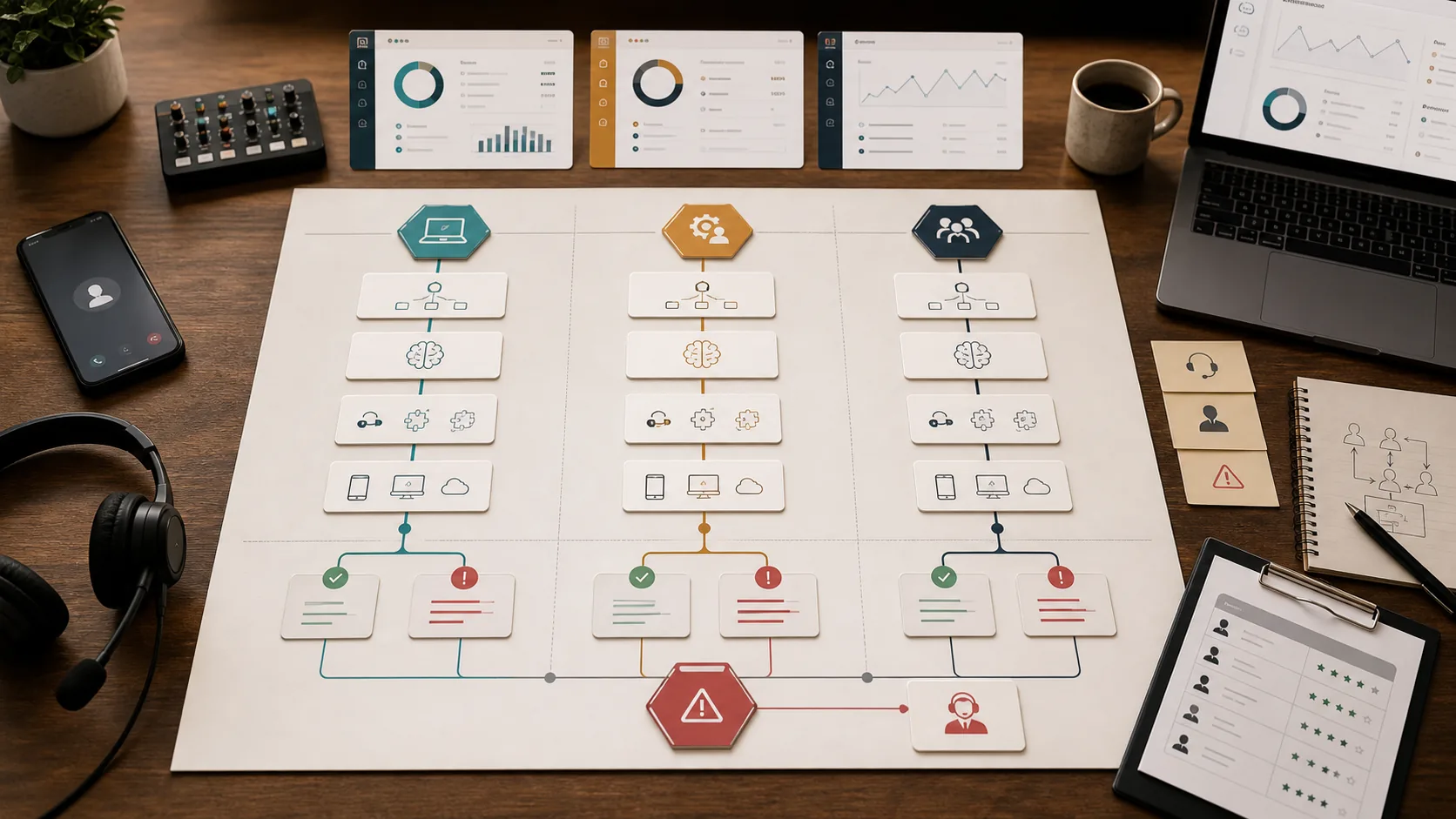
The buyer is not only buying a voice. They are buying a path from phone automation to integrated work: who configures the platform, who codes the tool actions, who handles failed calls, who staffs handoffs, and who decides when the agent gets more authority.
Voice platform
Runtime, speech, telephony, and core agent tools
The selected platform supplies the voice runtime, model orchestration, call handling, and available tool interface.
Implementation partner
Call-flow design, integration coding, and launch QA
Remote Partners AI turns the platform into a controlled workflow with approved prompts, APIs, routing rules, transfer packets, and review gates.
Cebu handoff
Live transfer, callback, exception queue, and support coverage
Trained support handles the moments automation should not finish alone: urgency, uncertainty, failed tools, frustrated callers, and follow-up.
Client control
Authority, permissions, compliance, scripts, and expansion approval
The client keeps final say over data access, customer promises, pricing, refunds, safety, legal, payment, and sensitive account decisions.
Decision evidence
When a partner model beats software-only, agency-only, or BPO-only options.
Use this comparison before choosing an implementation service: see who owns the hard parts and where Remote Partners AI is responsible.
Model
Best for
Common gap
Remote Partners AI role
Voice-agent software only
Simple call paths where the vendor's native setup is enough.
Your team still owns prompts, tool access, transfers, QA, and failed-call review.
Usually not needed unless integrations or staffed fallback become important.
Custom build agency
Deep custom product work, proprietary routing, or long-term platform ownership.
The build can ship without a practical staffing and operations layer.
Can provide implementation, QA, and human handoff around the built workflow.
Managed implementation partner
Businesses that want production phone automation without owning every technical and human detail.
Scope must be clear so automation, Cebu support, and client owners do not overlap.
Design, connect, monitor, QA, and staff the first repeatable voice workflow.
BPO or answering service only
Human coverage without voice automation or custom AI workflow needs.
Good for answering phones, but usually not enough for API-connected voice-agent automation.
Add AI implementation when the business wants automation plus human fallback.
First workflow
The first launch should make one call path boringly reliable.
A partner earns trust by reducing unknowns. Start with the call path that is valuable, repeatable, and reviewable before expanding to more numbers, queues, integrations, or caller intents.
Name the first call path
Pick one workflow such as missed-call recovery, appointment booking, after-hours triage, lead intake, or L1 support.
Document system authority
List what the agent can read, what it can write, which actions need approval, and which actions are blocked.
Design the handoff packet
Define what Cebu support, QA reviewers, and client owners receive when a call transfers, fails, or needs callback.
Set the first review gate
Review transcripts, tool failures, caller complaints, routing accuracy, cost, and handoff notes before expansion.
Operating checkpoints
How to know this support workflow is ready to hand off.
The strongest launch is narrow enough to train, visible enough to review, and useful enough to relieve the team before more channels or tasks are added.
Start with one queue
Start here when you already like a platform or need one selected, but you need a partner to code integrations, set routing rules, monitor quality, and staff handoffs. The first scope should name the channel, owner, tool access, expected response, and review cadence.
Make control visible
Client control stays explicit: final platform, number routing, and data-access decisions, approved scripts, promises, escalation rules, and compliance boundaries. Anything outside the approved scope routes back before a customer promise is made.
Review before expanding
QA should compare real notes, callbacks, and escalations against the training contract before adding more volume, more tools, or longer coverage hours.
Services that help
Services that can support this solution
Start with the operating problem first. The right service mix comes after the training, tools, approval, and quality-review rules are clear.
Voice Agent Implementation
Complete AI Voice Agent Implementation and Human Handoff
Complete AI Voice Agent Implementation gives buyers a managed path from vendor selection to working phone automation: call-flow design, LiveKit or vendor setup, Deepgram-style speech-provider planning, integration coding, CRM or calendar connections, prompt and tool setup, QA, monitoring, human-in-the-middle review, and Cebu-based handoff support for the calls that should not stay fully automated.
AI Voice Support
AI Voice Support Outsourcing for Call Answering and Dispatch
Adds trained phone coverage when the solution depends on answered calls, intake discipline, callback ownership, or urgent handoffs.
QA and Escalation
Human-in-the-Loop QA and Escalation Support
Adds the control layer: QA criteria, escalation timing, approval rules, correction loops, and AI use that managers can inspect.
Back-Office Workflow Support
AI Back-Office Workflow Support and Admin Outsourcing
Adds admin support when the solution depends on cleaner notes, scheduled follow-up, CRM hygiene, or records that stay reviewable.
FAQ
Voice-agent partner questions buyers should settle before launch.
What does a voice-agent implementation partner do that software vendors may not?
A partner owns the practical work around the platform: call-flow design, integration coding, routing, human handoff rules, QA, monitoring, and launch support.
Why include Cebu support in a voice-agent implementation?
Cebu support gives the workflow a human fallback for live transfers, callbacks, unclear requests, urgent issues, failed tool calls, and quality review instead of forcing every caller through automation.
Can Remote Partners AI support an existing voice-agent platform?
Yes, if the platform, phone path, data access, integration requirements, and permissions are workable. The first step is mapping what the platform handles, what must be coded, and what should hand off to people.
What should stay under client control?
Credentials, permissions, approved language, compliance boundaries, pricing, refunds, payment-sensitive issues, safety, legal concerns, VIP accounts, and expansion approval should stay under client control.
Next step
Turn this problem into a support operating plan.
Share the calls, tools, notes, and follow-up work that keep breaking. We can help define what gets trained, what stays under approval, and where Cebu-based support should start.