Remote Partners AI

Voice-agent implementation guide

AI voice agent build vs buy vs managed service.

The decision is not software versus people. The real decision is ownership: who designs the call flow, connects the systems, watches the failures, and handles the calls that automation should not complete alone.

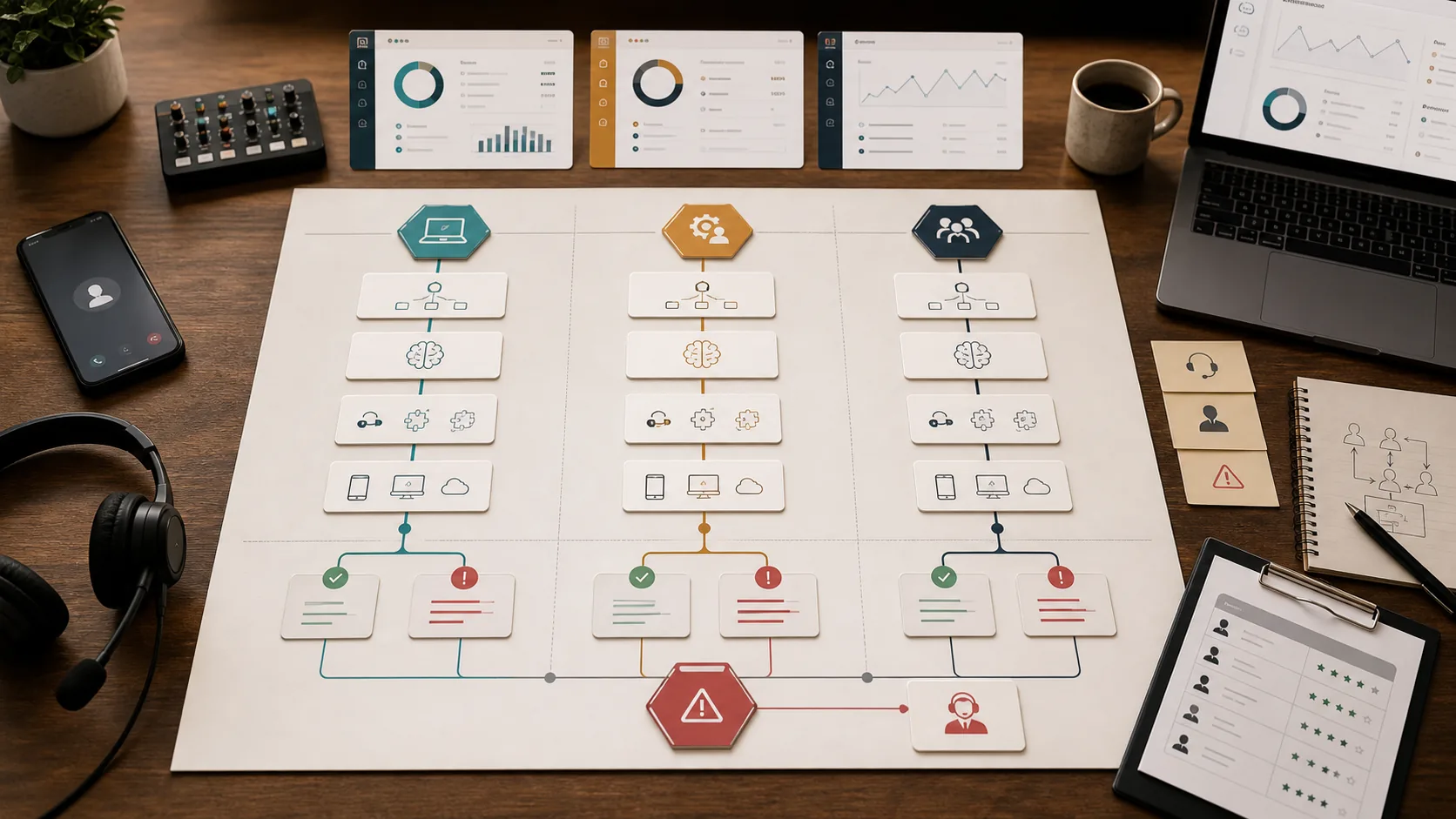
Voice-agent build, buy, and managed-service decision map with integration, QA, and handoff checkpoints.

Direct answer

Choose based on operational ownership, not the voice demo.

Voice-agent software can make a convincing call demo quickly. Production success depends on less glamorous work: phone routing, tool permissions, API writes, transfer packets, QA review, callback staffing, monitoring, and a clear owner for failed calls. If your team cannot own those pieces, the better lane is implementation partner or managed service.

Decision table

What each lane really makes you own.

AI voice-agent implementation model comparison
Lane Who owns the hard parts Choose when Watch-out
Software only Your team configures prompts, tools, routing, QA, reporting, and exceptions. The workflow is simple, the vendor integration is already enough, and someone internal can monitor calls. The demo launches, but nobody owns failed transfers, bad summaries, tool timeouts, or staffing gaps.
Custom build Your engineering team owns telephony, orchestration, integrations, monitoring, and release process. You need deep product control, strict routing, custom APIs, or a reusable platform capability. Engineering becomes the support desk for every prompt, carrier, calendar, CRM, and caller-experience issue.
Implementation partner A partner designs the call flow, connects systems, sets escalation rules, and helps launch the workflow. You like the platform direction but need help turning it into a production workflow. If the partner leaves no operating playbook, the business can be stuck with software it cannot safely improve.
Managed voice-agent service The partner helps build, monitor, QA, and staff human handoffs, callbacks, and exceptions. The business needs automation plus people for urgent, uncertain, or high-value calls. Scope must be written clearly so automation, Cebu support, and internal owners each know their boundaries.

Production gaps

Where voice-agent projects break after the sales demo.

Most failed launches are not caused by a bad voice. They fail because the business did not decide who owns the call path, the tool path, the human fallback path, and the review path.

Phone routing, transfer, recording, business-hour logic, and number ownership are not mapped before launch

CRM, calendar, help desk, dispatch, or custom API writes are only demoed against a clean test case

The voice agent has no staffed fallback when confidence is low, the caller is upset, or a tool call fails

QA is limited to call transcripts, with no scorecard for summaries, transfer packets, latency, or promises made

Nobody reviews failed calls daily during the first week, so small launch problems become customer-facing patterns

Managed launch checklist

How Remote Partners AI would make the first release manageable.

Step 1

Pick the first phone workflow

Choose one call path, such as missed-call recovery, appointment booking, tier-one triage, or after-hours intake.

Step 2

Map tools and permissions

Document the CRM, calendar, help desk, dispatch board, webhook, or custom API actions the agent may use.

Step 3

Write escalation rules

Define when the agent must transfer, create a callback, route to Cebu support, or return to the client team.

Step 4

Launch with monitoring

Review transcripts, transfer packets, failed tool calls, summary quality, caller complaints, and cost before expanding.

Use software only when

The workflow is narrow and someone internal can operate it.

  • The first workflow is low-risk and already fits the vendor's native integrations.
  • Your team can review transcripts, tool failures, transfers, and caller complaints.
  • You do not need custom API coding or staffed human fallback at launch.
  • A rollback path to normal phone handling is easy.

Use managed implementation when

The phone agent must connect to real operations.

  • Calls need CRM, calendar, help desk, dispatch, or custom API work.
  • Human handoff, callback support, or Cebu staffing is part of the offer.
  • QA, monitoring, and failed-call review need an owner after launch.
  • The internal team wants outcomes, not another tool to maintain.

FAQ

Common build, buy, and managed-service questions.

What is the safest way to start with an AI voice agent?

Start with one repeatable phone workflow, approved escalation rules, visible QA, and a human fallback path. Do not launch every number or queue at once.

When does a business need a managed voice-agent service?

A managed service is useful when the business needs AI phone automation but does not want internal staff to own every integration, monitoring, callback, transfer, and exception path.

Can Remote Partners AI help with coding integrations?

Yes. Remote Partners AI can help scope and code approved integrations for CRM, calendar, help desk, dispatch, webhook, API, reporting, and human handoff workflows.

Next step

Turn the phone-agent idea into an implementation plan.

Share the calls, tools, handoff points, and staffing gaps that matter. Remote Partners AI can help decide what should be automated, what should be integrated, and what should route to Cebu-based support or your internal team.